

Fast transfer seeks an early opportunity before the motor bus has moved too far from the alternate source. In-phase transfer seeks a later alignment as the relative angle evolves. Neither method can be judged by its name or by the angle observed when a close command leaves the relay. [1]
The breaker closes after a delay. The study must assess the bus and source at that later instant, with credible timing uncertainty and measurement validity.
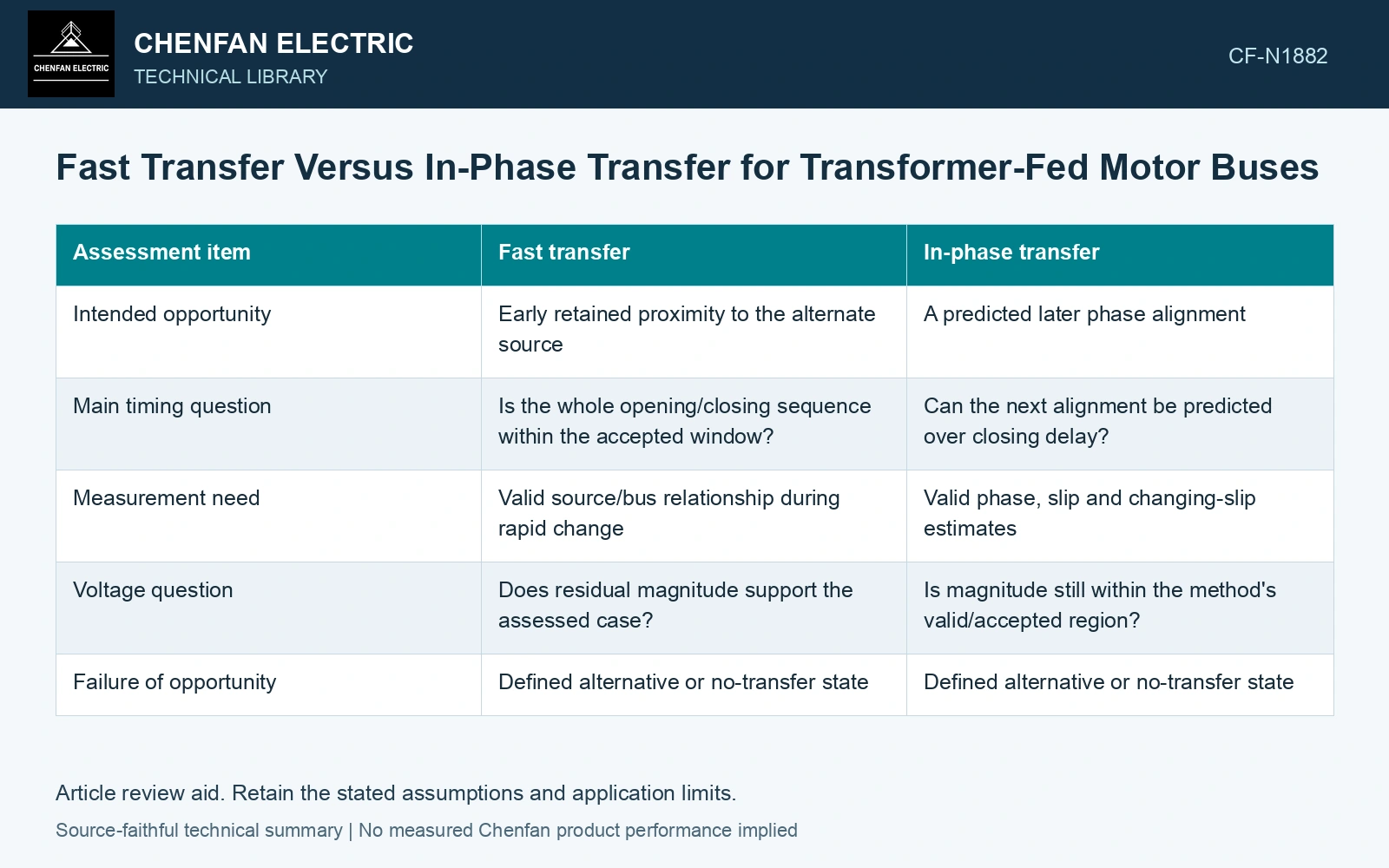
Compare the opportunity each method uses
| Assessment item | Fast transfer | In-phase transfer |
|---|---|---|
| Intended opportunity | Early retained proximity to the alternate source | A predicted later phase alignment |
| Main timing question | Is the whole opening/closing sequence within the accepted window? | Can the next alignment be predicted over closing delay? |
| Measurement need | Valid source/bus relationship during rapid change | Valid phase, slip and changing-slip estimates |
| Voltage question | Does residual magnitude support the assessed case? | Is magnitude still within the method’s valid/accepted region? |
| Failure of opportunity | Defined alternative or no-transfer state | Defined alternative or no-transfer state |
The table organizes a study. It supplies no angle, time or voltage setting. Those limits belong to the actual motors, breakers, network and accepted operating objective.
Account for the disturbance before opening
An upstream fault can change motor flux, torque and phase before the source breaker opens. The early transfer case should begin from that disturbed state, not from an undisturbed motor at rated speed. A short interruption alone does not prove that bus and alternate source remain suitably aligned.
The SEL implementation paper demonstrates supervised transfer and discusses blocking an early attempt when measured conditions are unsuitable. Its refinery-specific results are not a universal fast-transfer window.
Predict the physical closure
For in-phase transfer, the control needs a closing-delay model and the relative-angle trajectory. Changing slip can make constant-frequency extrapolation inaccurate. The actual closing-time range also turns a predicted point into a range of possible arrival angles.
Evaluate the candidate closure using a dynamic motor and mechanical model appropriate to the risk. The paper expressly warns that simplified torque formulas can be inadequate. A small voltage-angle difference is relevant evidence, but it is not a complete shaft-stress calculation.
Carry the observed closing-delay spread and timing-measurement uncertainty into both method comparisons. Treat them as distinct inputs and retain justified correlations when forming the arrival interval. [2]
Compare opportunities at physical closure
Assume a fast-transfer command at 40 ms with 60 ms closing delay, and an in-phase command at 240 ms with the same delay. Evaluate the respective 100 ms and 300 ms machine states. A favorable angle at either command is insufficient if its arrival state falls outside the validated case. These times are illustrative.
References
- P. Muralimanohar, D. Haas, J. R. McClanahan, R. T. Jagaduri and S. Singletary, Implementation of a Microprocessor-Based Motor Bus Transfer Scheme, IEEE PCIC, 2016, DOI: 10.1109/PCICON.2016.7589248.
- B. N. Taylor and C. E. Kuyatt, NIST Technical Note 1297, Guidelines for Evaluating and Expressing the Uncertainty of NIST Measurement Results, 1994, sections 5 and 6.