

Dust, metallic particles, salt deposits and condensation can create a path across an NGR’s insulating gap. The consequence depends on its endpoints. A bridge between adjacent element sections differs from a bridge to the grounded frame or across a sensing component. [1]
Map the path before interpreting the alarm or resistance reading. Cleaning an assembly without preserving the location can remove the evidence needed to explain why the grounding behavior changed. The assessment is performed on isolated equipment under the approved maintenance method.
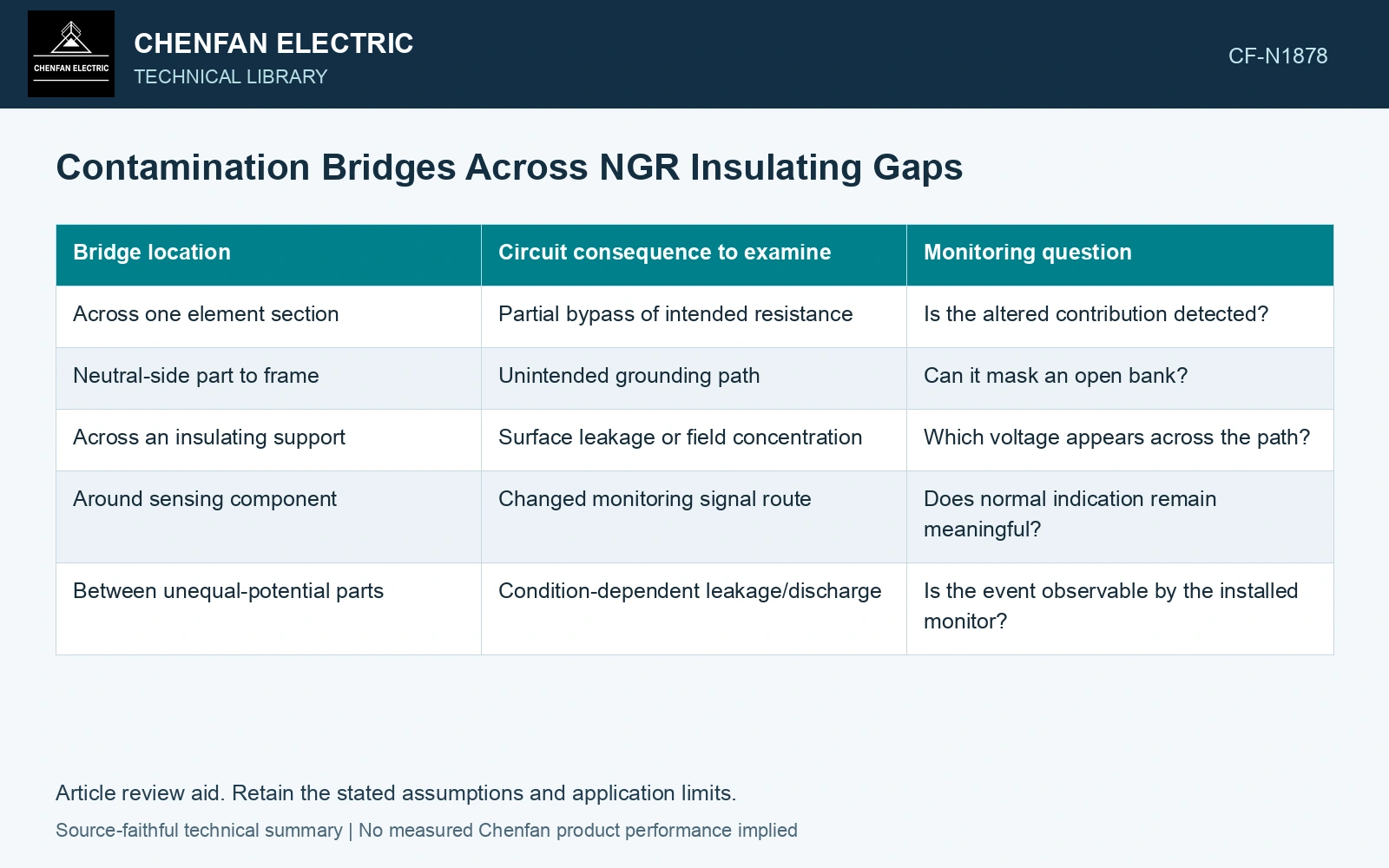
Classify the endpoints
| Bridge location | Circuit consequence to examine | Monitoring question |
|---|---|---|
| Across one element section | Partial bypass of intended resistance | Is the altered contribution detected? |
| Neutral-side part to frame | Unintended grounding path | Can it mask an open bank? |
| Across an insulating support | Surface leakage or field concentration | Which voltage appears across the path? |
| Around sensing component | Changed monitoring signal route | Does normal indication remain meaningful? |
| Between unequal-potential parts | Condition-dependent leakage/discharge | Is the event observable by the installed monitor? |
Record material, wetness, location and accessible extent. A dry deposit and the same deposit under condensation may have very different behavior. A photograph can identify a plausible bridge, but cannot quantify its service current.
Use the simple circuit only to frame the concern
If a linear resistance Rp lies directly in parallel with an intended section Rs, their equivalent is Req = RsRp/(Rs + Rp), in ohms. This shows why an unintended path can lower the measured resistance. It assumes stable, linear resistances and the stated endpoints.
Contaminated surfaces may be nonlinear, intermittent or voltage dependent. A low-voltage resistance measurement can therefore fail to represent the path under fault stress. The investigation needs a qualified method appropriate to the material and electrical boundary.
Look beyond the total ohmic value
A bridge to ground can change where current flows even if the total measured value remains superficially plausible. A monitor may observe the bypass rather than the intended resistor continuity. Compare the monitoring circuit with the contamination map before accepting a normal status.
Match wet-contamination material evidence to the actual support and field boundary. IEC 60587 uses accelerated liquid-contaminant inclined-plane tracking/erosion tests; its public scope explicitly distinguishes those conditions from the complete service environment. [2]
Calculate the bypassed section
Assume a 200 Ω section is bridged by a stable 1,000 Ω contamination path. Their parallel value is 166.7 Ω, 16.7% below the intended section resistance. That low-voltage model demonstrates a possible bypass; evaluate wet, nonlinear service behavior separately before attributing an alarm to the element.
References
- IEEE, IEEE C57.32-2015, IEEE Standard for Requirements, Terminology, and Test Procedures for Neutral Grounding Devices (historical edition).
- IEC, IEC 60587:2022, Electrical insulating materials used under severe ambient conditions — Test methods for evaluating resistance to tracking and erosion.