

An NGR survives a fault, the protection clears it, and another fault occurs before the assembly has cooled. The second event is a new electrical event with an old thermal starting condition. Treating both as cold-start duties can understate the peak temperature. [1]
The assessment needs a sequence: fault power, clearing time, cooling interval and the next fault. Keep enough detail to identify which part of the assembly reaches its limit. Elements, supports and neighboring components do not necessarily heat and cool at the same rate.
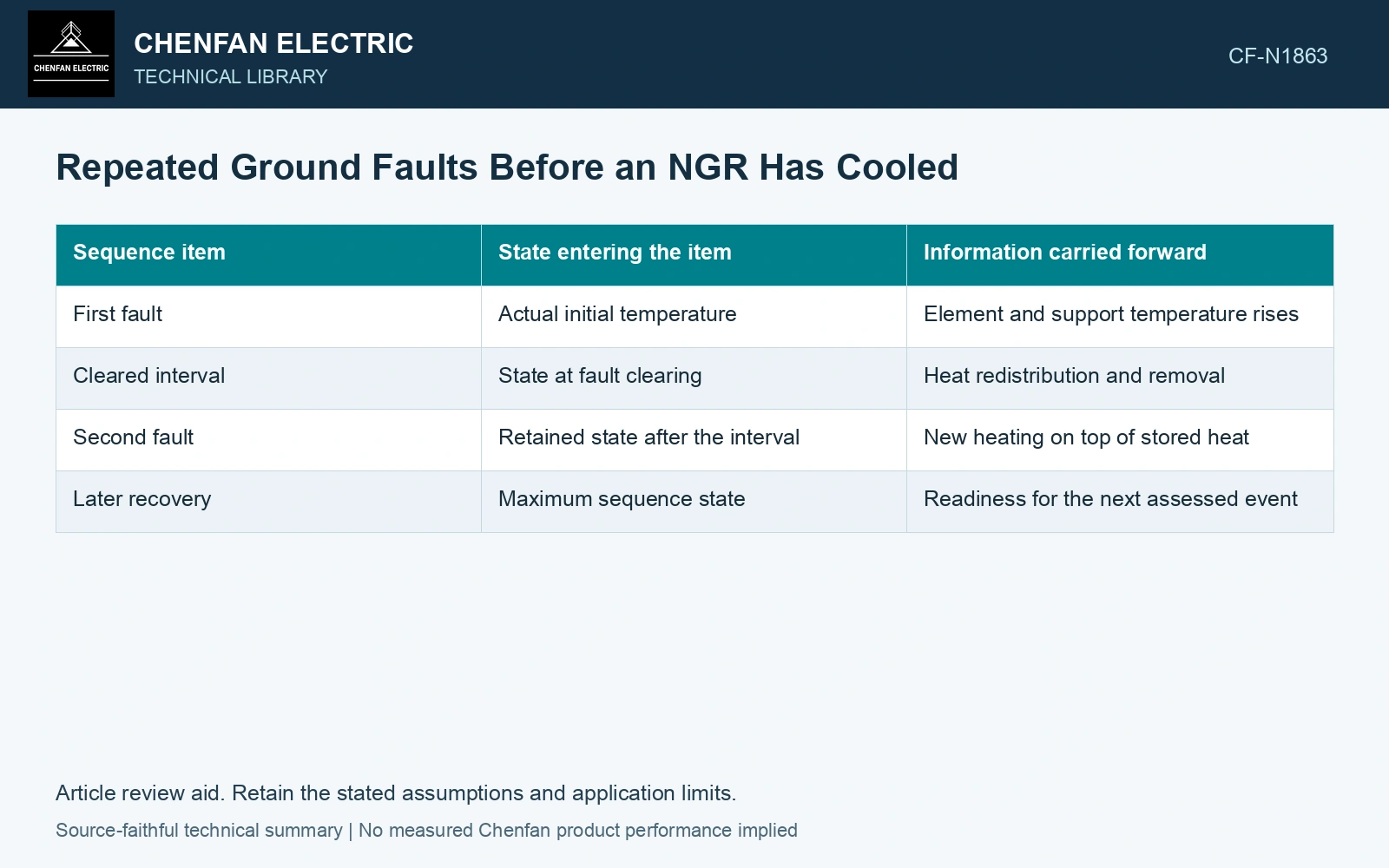
Carry states across event boundaries
| Sequence item | State entering the item | Information carried forward |
|---|---|---|
| First fault | Actual initial temperature | Element and support temperature rises |
| Cleared interval | State at fault clearing | Heat redistribution and removal |
| Second fault | Retained state after the interval | New heating on top of stored heat |
| Later recovery | Maximum sequence state | Readiness for the next assessed event |
A data logger’s return to no-fault indication is an electrical status. It does not establish thermal recovery. If temperature is inferred rather than directly measured, preserve the model and its uncertainty with that inference.
Understand a simple cooling illustration
For a one-node, linear cooling model with no further heat input, excess temperature x decays as xnext = xend exp(−Δt/τ). x is temperature rise in kelvins, Δt is the cooling interval in seconds and τ is a thermal time constant in seconds. The ambient is assumed unchanged.
At an interval equal to τ, a substantial fraction of the previous rise remains. This is a mathematical illustration, not an assigned NGR cooldown time. Actual cooling may involve several time constants, temperature-dependent transfer and heat moving from elements into supports after clearing.
Watch for delayed support heating
The component with the largest instantaneous electrical loss may cool quickly while an insulating support continues warming from stored heat nearby. A model tracking only average element temperature can miss that delayed state. Map conductive contacts, radiation exposure and restricted airflow around the support.
If repeat qualification is claimed, ask which component temperatures and event sequence were covered. A repeated test performed after full recovery does not establish a shorter interval. A continuous-duty result may help, but it still needs to represent the current, enclosure and local component conditions being assessed.
Carry the stored thermal state through the cooling interval and into the next power input. A heat balance needs the heat-removal boundary and thermal storage, rather than an alarm reset being treated as temperature recovery. [2]
Carry retained heat into the next fault
Assumptions: a one-node cooling time constant is 600 s, post-fault rise is 200 K, and the next sufficiently short pulse adds 80 K with cooling during it neglected. After 300 s, retained rise is 200 exp(−300/600) = 121.3 K, so the next peak is 201.3 K. Against an assumed allowable rise of 180 K, that sequence fails by 21.3 K. Retained rise must fall to at most 100 K before the same pulse; solving 200 exp(−t/600) ≤ 100 gives t ≥ 415.9 s. Use this model-derived interval only with its actual component thermal evidence, including delayed support heating and uncertainty.
References
- IEEE, IEEE C57.32-2015, IEEE Standard for Requirements, Terminology, and Test Procedures for Neutral Grounding Devices (historical edition).
- U.S. Department of Energy, DOE-HDBK-1012/2-92, Thermodynamics, Heat Transfer, and Fluid Flow, Volume 2, 1992.