

A daily feeder peak is a repeating thermal event. The cable enters it with heat retained from earlier loading and exits it into a cooling period that may be too short to restore the previous state. A cyclic rating must represent that sequence. [1]
A calculation starting at ground ambient can look favorable for the first evening and become unsuitable after several similar days. The assessment should find the sustainable repeating temperature pattern, not merely survive one isolated peak.
Preserve the cycle, including its quiet hours
Record current, ambient and relevant route conditions across the entire cycle. Convert loading into the applicable loss terms rather than averaging current first. Because conductor loss is related to current squared, the losses associated with an average current generally differ from average losses.
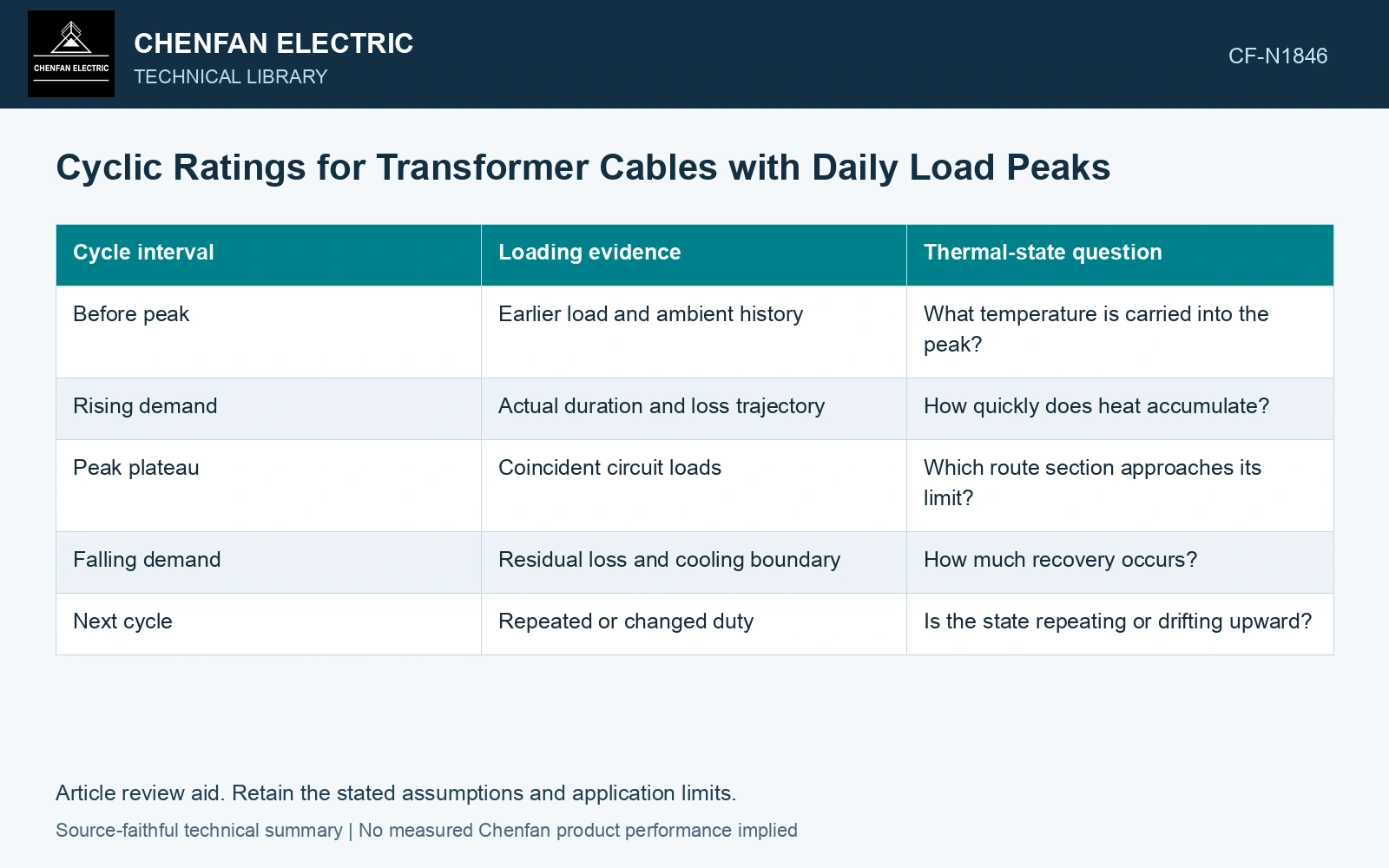
| Cycle interval | Loading evidence | Thermal-state question |
|---|---|---|
| Before peak | Earlier load and ambient history | What temperature is carried into the peak? |
| Rising demand | Actual duration and loss trajectory | How quickly does heat accumulate? |
| Peak plateau | Coincident circuit loads | Which route section approaches its limit? |
| Falling demand | Residual loss and cooling boundary | How much recovery occurs? |
| Next cycle | Repeated or changed duty | Is the state repeating or drifting upward? |
Use a simple model to expose the memory
For an illustrative one-node thermal model, let x be temperature rise in kelvins, P loss in watts, R thermal resistance in kelvins per watt and τ the thermal time constant in seconds. With constant P during interval Δt, xnext = PR + (xstart − PR) exp(−Δt/τ).
The expression shows why the starting state and interval length matter. It assumes linear, constant properties and one thermal node. A buried cable has multiple heat-storage regions and distributed paths; the expression is a reasoning aid, not a complete cable-rating calculation.
Solve until the daily boundary agrees
In a verified cyclic model, repeat the loading pattern until the temperature at the start and end of a cycle reaches the required consistent state. Review the highest conductor temperature within the cycle, not just the daily endpoint. Different route sections can have different thermal responses and limiting times.
The exponential step response follows the linear stored-heat balance. Close the thermal state across successive peak and recovery intervals before comparing conductor temperature with the accepted gate. [2]
Close a recurring thermal cycle
Assumptions: a 66 kV cable is screened by a linear conductor node with 4 h time constant, steady rises 80 K during a 4 h daily peak and 20 K during the following 20 h, ambient 25 °C and conductor gate 80 °C. Let a = e⁻¹ and b = e⁻⁵. The periodic start rise is [20(1 − b) + 80b(1 − a)]/(1 − ab) = 20.26 K; the peak-end rise is 80 + (20.26 − 80)a = 58.02 K, giving 83.02 °C. Starting the first peak at ambient would instead predict 75.57 °C and falsely pass. Reject the repeating 4 h duty under this model, then reduce the peak or improve the thermal path and resolve the new complete cycle. Use a qualified multi-region model for the operating rating. [1][2]
References
- IEC, IEC 60853-2:1989, Calculation of the cyclic and emergency current rating of cables — Part 2: Cyclic rating of cables greater than 18/30 (36) kV and emergency ratings for cables of all voltages.
- U.S. Department of Energy, DOE-HDBK-1012/2-92, Thermodynamics, Heat Transfer, and Fluid Flow, Volume 2, 1992.