

A sensitive helium detector can respond to tracer left by an earlier test or present around its inlet. A small reading is not automatically a tank leak, while subtracting a drifting background can also conceal a real one. Preserve the signal history and the test boundary. [1]
Read the trace in four parts
Background: record the stable or changing baseline before the defined tank test.
Reference response: verify the instrument through the approved calibration/check arrangement.
Test response: associate each reading with location, time and the applied tracer boundary.
Recovery: record return toward baseline and any carry-over before another location or tank is tested.
NASA’s tracer-gas guidance couples measured background with setup calibration and calls for further quantitative investigation of suspect probe indications. [1] For the tank, the approved procedure defines pressure, tracer application, detector operation and recovery checks.
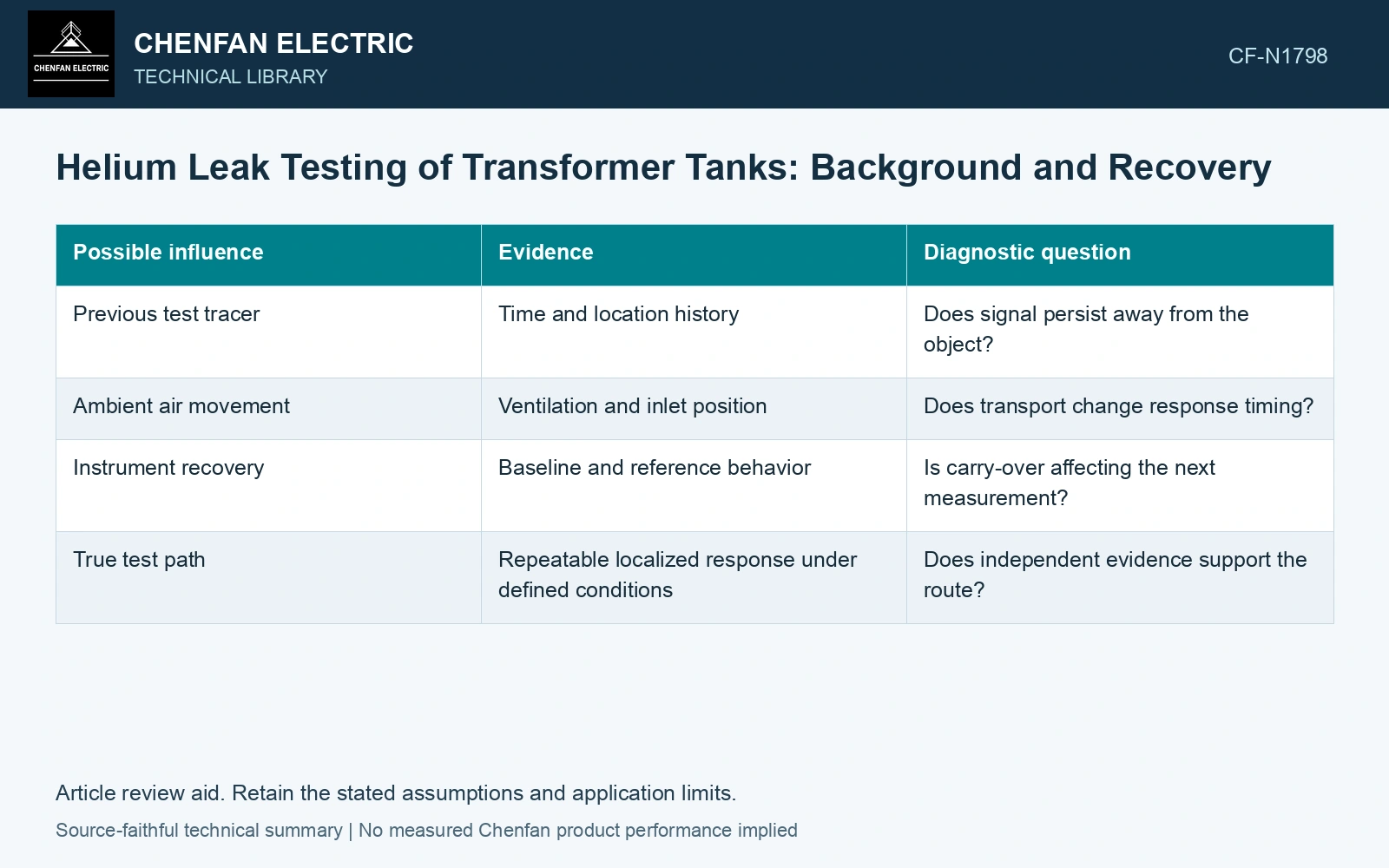
Track the source of background
| Possible influence | Evidence | Diagnostic question |
|---|---|---|
| Previous test tracer | Time and location history | Does signal persist away from the object? |
| Ambient air movement | Ventilation and inlet position | Does transport change response timing? |
| Instrument recovery | Baseline and reference behavior | Is carry-over affecting the next measurement? |
| True test path | Repeatable localized response under defined conditions | Does independent evidence support the route? |
Combine standard uncertainties with covariance where effects are correlated; repeatability alone does not include all systematic contributions. [2]
Bound a background-corrected leak indication
Assumptions at 20 °C under the same approved test configuration: test and representative background readings are 8×10⁻⁸ and 3×10⁻⁸ Pa·m³/s, with independent standard uncertainties 1×10⁻⁸ and 2×10⁻⁸ Pa·m³/s. Corrected indication is 5×10⁻⁸ Pa·m³/s and uc = 2.236×10⁻⁸ Pa·m³/s. With assumed coverage factor 2, its interval is 0.528–9.472×10⁻⁸ Pa·m³/s. An assumed tank criterion requires the upper decision value to be at most 8×10⁻⁸ Pa·m³/s; the present result cannot demonstrate compliance, despite its lower nominal value. Hold release and resolve background stability/recovery and the localized path before retesting. This interval by itself does not prove an excessive tank leak. [2]
References
- NASA, NASA-STD-7012A, Leak Test Requirements, 2023, sections 4.2 and 5.11.
- B. N. Taylor and C. E. Kuyatt, NIST Technical Note 1297, Guidelines for Evaluating and Expressing the Uncertainty of NIST Measurement Results, 1994, sections 5 and 6.