

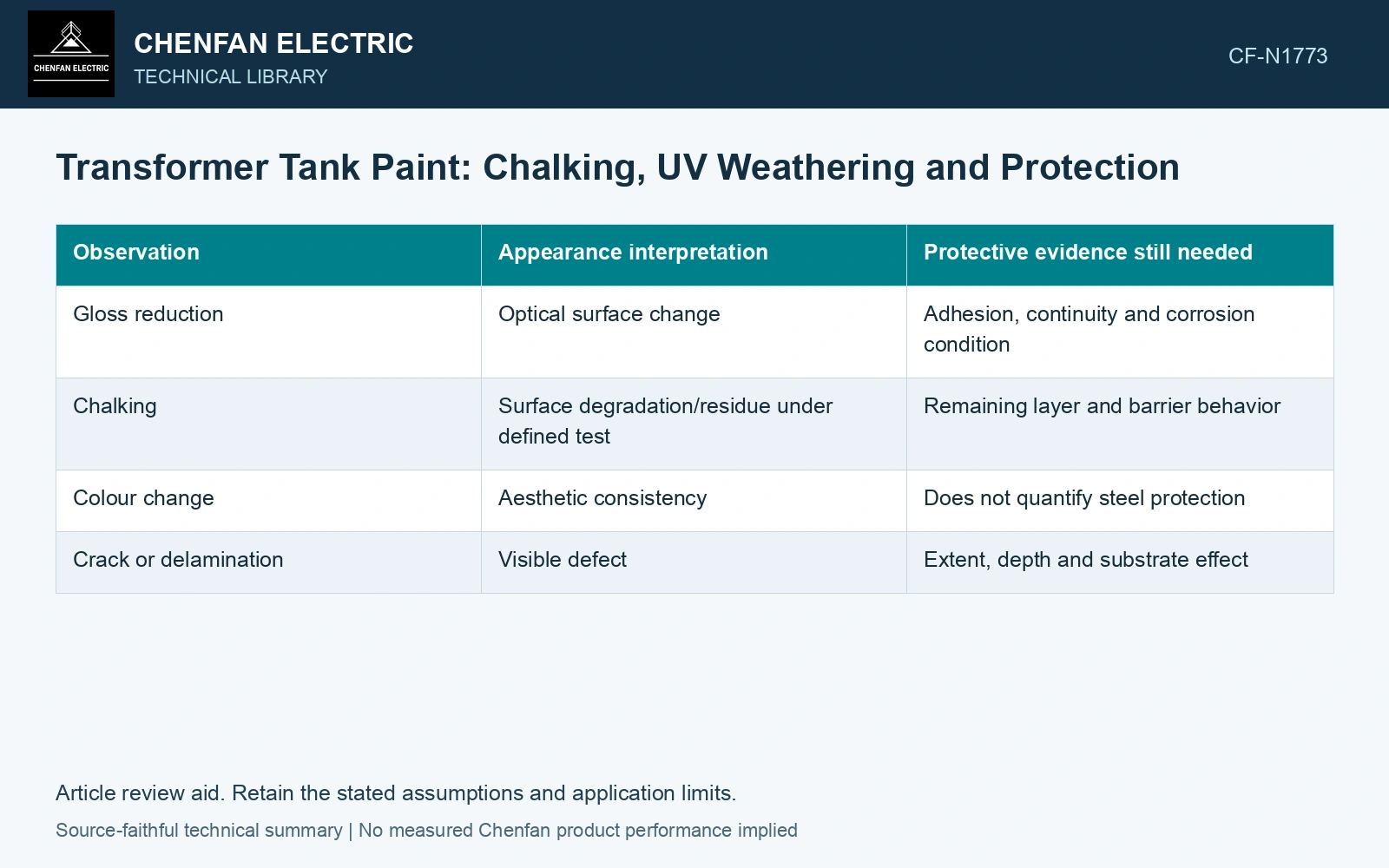
Chalking and gloss are different observations. ISO 4628-6 addresses chalking by tape assessment [1], while ISO 2813 addresses instrumental gloss at defined geometries. [2] Keep appearance results separate from the coating system’s protective condition.
Use two result columns
| Observation | Appearance interpretation | Protective evidence still needed |
|---|---|---|
| Gloss reduction | Optical surface change | Adhesion, continuity and corrosion condition |
| Chalking | Surface degradation/residue under defined test | Remaining layer and barrier behavior |
| Colour change | Aesthetic consistency | Does not quantify steel protection |
| Crack or delamination | Visible defect | Extent, depth and substrate effect |
Compare failure mechanisms before exposure time
Two artificial cycles with different moisture and radiation conditions can produce different changes. Do not rank them solely by hours. Match the laboratory observation with the field mechanism the specification intends to represent. [1]
Retain the topcoat and underlying primer conditions. A result on one layer or a different substrate preparation cannot automatically qualify the complete tank system.
Keep paint execution and supervision tied to the actual product and coated region; a finished appearance does not recover missing process evidence. [3]
Compare appearance and barrier observations independently
Assumptions: non-textured plane-panel gloss at a retained 60° measurement geometry changes from 80 to 40 gloss units after one declared exposure, giving 40/80 = 50% retention. [2] Against an assumed project appearance requirement of at least 60% retention, the result fails by 10 percentage points. Reject appearance conformity under that criterion, while keeping protective performance unresolved until the specified adhesion, continuity and corrosion results are available. Record chalking separately by its tape method; a 50% gloss result is not a chalking grade or a measure of lost corrosion protection. [1]
References
- ISO, ISO 4628-6:2023, Paints and varnishes — Evaluation of quantity and size of defects, and of intensity of uniform changes in appearance — Part 6: Assessment of degree of chalking by tape method.
- ISO, ISO 2813:2014, Paints and varnishes — Determination of gloss value at 20°, 60° and 85°.
- ISO, ISO 12944-7:2017, Paints and varnishes — Corrosion protection of steel structures by protective paint systems — Part 7: Execution and supervision of paint work.