

An internal paint’s oil-immersion assessment concerns both the film and the insulating liquid. An intact-looking coupon is only one observation. Extracted material or chemical interaction can change the liquid without an obvious coating failure. [1]
Define coating substrate, cure, oil type, exposure temperature and duration from the qualification plan. Link application and cure records to each coupon. Record coated area A and liquid volume V; A/V in m⁻¹ states the coating surface contacting each unit of liquid. [2]
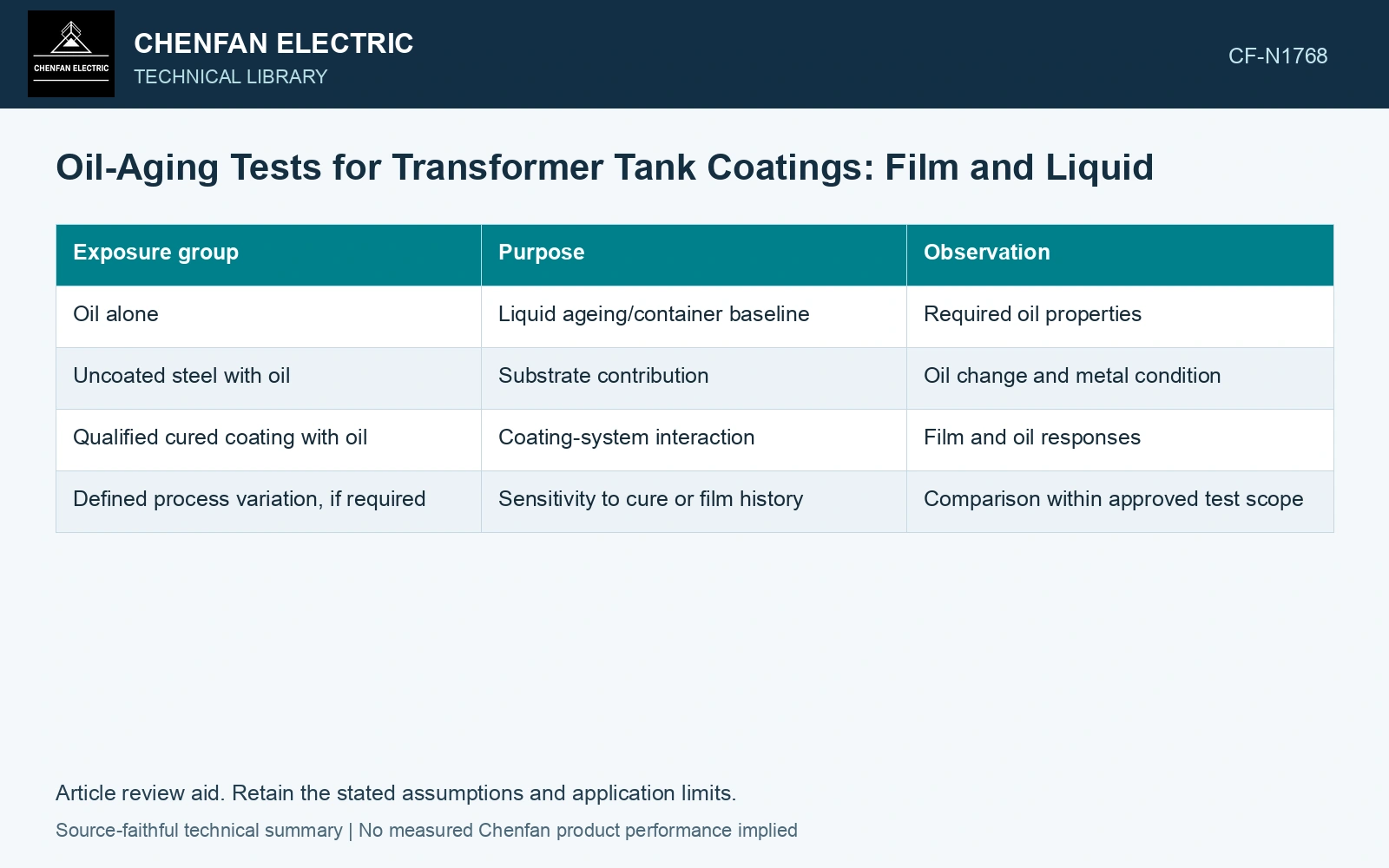
Use controls that separate the sources
| Exposure group | Purpose | Observation |
|---|---|---|
| Oil alone | Liquid ageing/container baseline | Required oil properties |
| Uncoated steel with oil | Substrate contribution | Oil change and metal condition |
| Qualified cured coating with oil | Coating-system interaction | Film and oil responses |
| Defined process variation, if required | Sensitivity to cure or film history | Comparison within approved test scope |
Do not compare unlike contact ratios
A coupon in a small jar can expose the liquid to much more coating area per volume than the tank. It may serve as a deliberate stress condition, but that basis should be stated. A low A/V test cannot automatically cover a higher installed exposure.
Containers, seals and sample handling can also contribute extractables. Use compatible controls and preserve the analytical method and uncertainty.
Compatibility testing concerns the specific construction material and insulating liquid; exposure ratio alone does not establish transferable ageing kinetics or acceptance. [1]
Normalize the coating-to-oil exposure
Assume a test coupon exposes 0.10 m² coating to 1 L oil, giving 100 m²/m³. An installed tank exposes 50 m² to 5 m³ oil, giving 10 m²/m³. The test has ten times the surface-area/volume ratio. Preserve that stress basis and evaluate both film and liquid properties rather than interpreting an unchanged coupon appearance as full compatibility.
References
- IEC, IEC 63177:2024, Test methods for compatibility of construction materials with electrical insulating liquids.
- ISO, ISO 12944-7:2017, Paints and varnishes — Corrosion protection of steel structures by protective paint systems — Part 7: Execution and supervision of paint work.