

Conductivity in drying condensate can respond to dissolved ions, contamination from pipework or collection containers and sample handling. It may be a useful process observation, but it is not a direct measurement of how much water remains in insulation. [1]
Define the liquid being measured. If condensate includes solvent and water phases, identify the sampled phase and separation method. A conductivity result from an undefined mixture cannot be compared with a pure-water reference as though the matrices were identical.
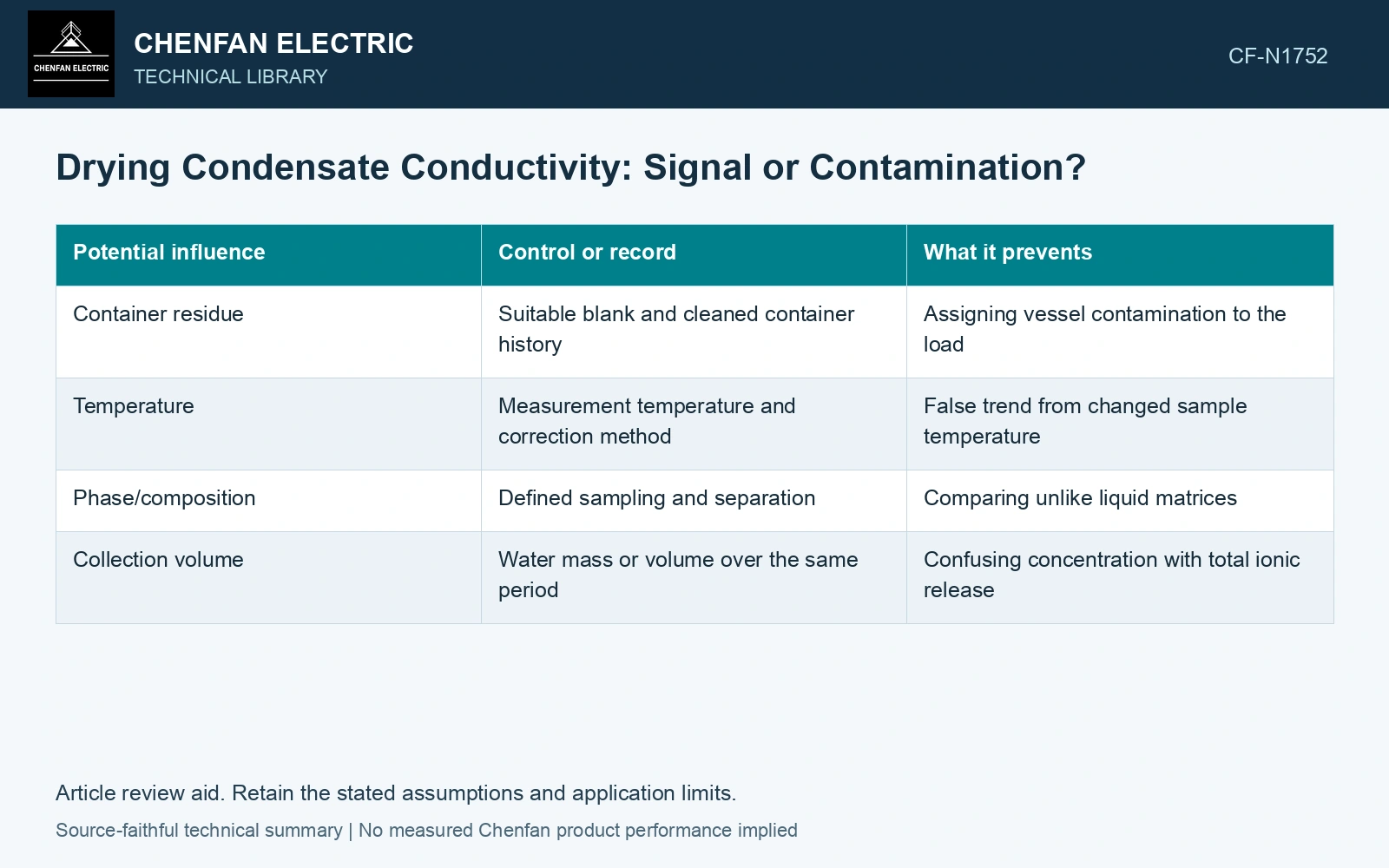
| Potential influence | Control or record | What it prevents |
|---|---|---|
| Container residue | Suitable blank and cleaned container history | Assigning vessel contamination to the load |
| Temperature | Measurement temperature and correction method | False trend from changed sample temperature |
| Phase/composition | Defined sampling and separation | Comparing unlike liquid matrices |
| Collection volume | Water mass or volume over the same period | Confusing concentration with total ionic release |
Compare the process history before interpreting a spike
Review separator drainage, line cleaning, container changes and recent equipment maintenance. A spike after an intervention may reflect that boundary rather than a new material condition. Repeat the sampling under matched conditions where the approved plan permits.
Compare conductivity with recovered water quantity and other relevant analysis. A small, concentrated sample and a large, diluted sample can have different conductivities while their total dissolved material follows another trend.
A difference between independently measured sample and blank carries uncertainty from both results. Report that combined uncertainty before interpreting a small excess. [2]
Compare sample and blank before interpretation
Assumptions: condensate conductivity is 15 μS/cm and a matched line/container blank is 10 μS/cm, both at 25 °C, with independent standard uncertainties of 2 and 3 μS/cm. The difference is 5 μS/cm; u = √(2² + 3²) = 3.606 μS/cm. Its k = 2 interval is −2.211 to 12.211 μS/cm. This does not resolve a positive excess under that decision rule: improve the blank and sampling evidence before assigning a signal to the load. Even a resolved excess would not measure remaining insulation water. [1] [2]
References
- R. H. Jameel, Y. C. Wu and K. W. Pratt, Primary Standards and Standard Reference Materials for Electrolytic Conductivity, NIST Special Publication 260-142, 2000, sections 1.3 and 2.
- B. N. Taylor and C. E. Kuyatt, NIST Technical Note 1297, Guidelines for Evaluating and Expressing the Uncertainty of NIST Measurement Results, 1994, sections 5 and 6.