

A vacuum chamber pressure rise after isolation can come from a physical leak, material outgassing, retained vapour or measurement effects. A loaded active part adds sources absent from an empty-vessel check. The same pressure-rise rate does not have the same interpretation in both tests. [1]
Start with a defined isolated volume
For fixed volume and approximately constant gas temperature, the gas-load balance gives q ≈ V dp/dt, with V in m³, pressure in pascals and q in Pa·m³/s. Treat this as total throughput, not identified leakage. Pressure-change testing needs the article and fixture volumes, pressure and temperature history, and demonstrated setup sensitivity. [1]
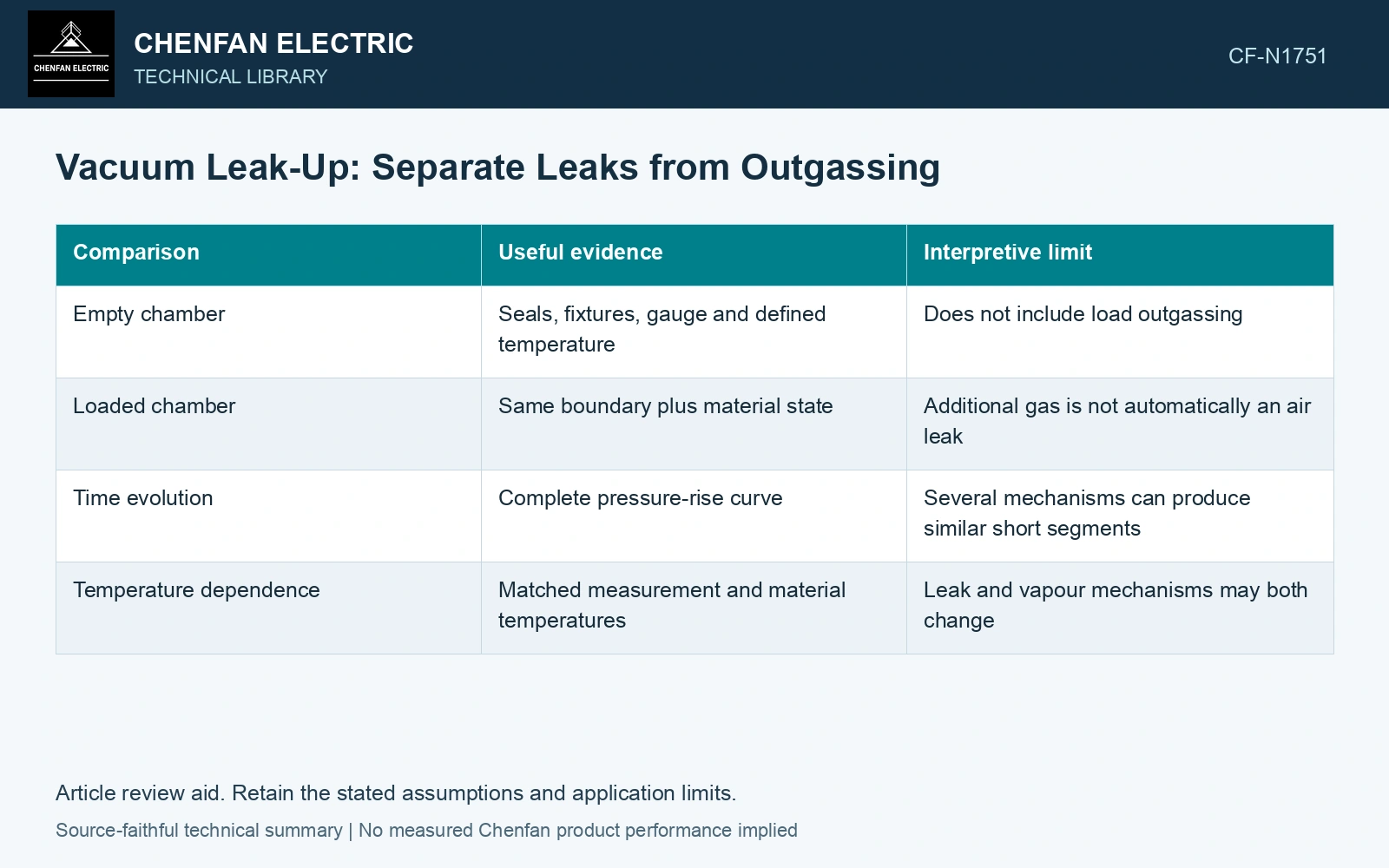
| Comparison | Useful evidence | Interpretive limit |
|---|---|---|
| Empty chamber | Seals, fixtures, gauge and defined temperature | Does not include load outgassing |
| Loaded chamber | Same boundary plus material state | Additional gas is not automatically an air leak |
| Time evolution | Complete pressure-rise curve | Several mechanisms can produce similar short segments |
| Temperature dependence | Matched measurement and material temperatures | Leak and vapour mechanisms may both change |
Use differences to choose a further check
If empty and loaded results differ, review the active part, fixtures and changed seals. If a baseline changes after a door intervention, examine that boundary. A decaying gas load can be consistent with outgassing, but the curve alone is not unique proof.
Record gauge type, location and range. Some gauges respond differently to gas composition, and a remote port can lag the chamber. Compare the method with the approved facility qualification rather than treating every reading as identical absolute pressure.
Water released from surfaces or unintentionally condensed in the measurement path changes the observed gas moisture. Preserve those boundaries before assigning loaded-state pressure rise to an air leak. [2]
Compare pressure-rise gas loads on one boundary
Assume a 10 m³ isolated chamber rises 20 Pa in 100 s at approximately constant temperature. Apparent gas load is VΔp/Δt = 2 Pa·m³/s. An empty-chamber baseline of 0.5 Pa·m³/s leaves 1.5 Pa·m³/s additional loaded-state contribution, which is not uniquely a leak or moisture. Identify outgassing and retained vapour before attribution.
References
- NASA, NASA-STD-7012A, Leak Test Requirements, 2023, sections 4.2 and 5.5.
- S. Bell, The Beginner’s Guide to Humidity Measurement, National Physical Laboratory, Measurement Good Practice Guide 124, 2013, sections 4.3, 4.4 and 9.