

Recovered drying liquid can contain solvent and water, and not all material reaches the collection vessel during the same time interval. A mass balance needs separate components and inventory locations. Otherwise, a rise in recovery can be mistaken for more insulation water removal. [1]
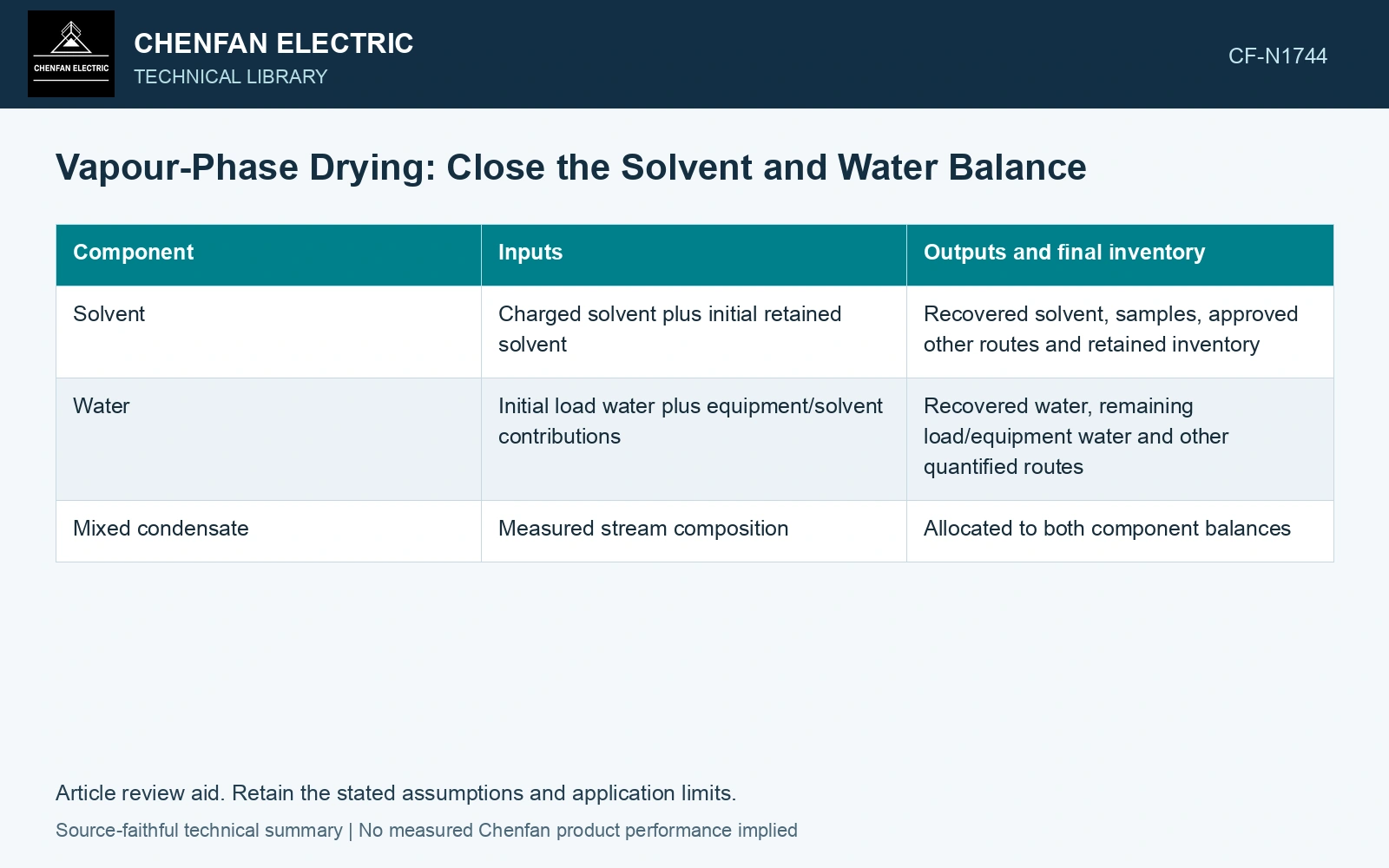
| Component | Inputs | Outputs and final inventory |
|---|---|---|
| Solvent | Charged solvent plus initial retained solvent | Recovered solvent, samples, approved other routes and retained inventory |
| Water | Initial load water plus equipment/solvent contributions | Recovered water, remaining load/equipment water and other quantified routes |
| Mixed condensate | Measured stream composition | Allocated to both component balances |
Use one boundary and one time window
For each component, mstart + min − mout − mend = munexplained, in kilograms. The residual is a signed closure discrepancy, not measured release. Place tanks, separators, pipework and sample containers inside or outside one explicit boundary; an internal transfer is not a new input or output. [2]
Record composition by a validated method appropriate to the stream. Liquid volume alone needs density and composition before it becomes component mass. Container heel, line hold-up and condensate arriving after the nominal endpoint can all affect reconciliation.
Keep solvent and water ledgers separate even when one condensate stream carries both. Total recovered liquid is not the water-removal denominator.
Separate recovered solvent from recovered water
Assumptions: 100 kg condensate has a validated 3% water mass fraction, giving 3 kg water and 97 kg solvent. A 100 kg solvent charge closes only if the ending path inventory contains 3 kg solvent. Separately, 100 kg dry cellulose starts with 5 kg water; 3 kg is collected and 1 kg enters recovery-path inventory. With all other water routes and initial equipment water assumed zero, 1 kg remains in cellulose: 1.0% dry basis. That fails an assumed 0.50% endpoint despite 100 kg liquid recovery. Hold release and verify component composition and inventories. [2]
Investigate a residual systematically
Check weighing, volume conversion and sample accounting.
Compare starting and ending inventories, including retained liquid.
Review timing between evaporation and collection.
Check known equipment routes and instrumentation.
Escalate unexplained differences through the facility’s approved process and safety system.
References
- Y. Brahami, A. Betie, F. Meghnefi, I. Fofana and Z. Yeo, Development of a Comprehensive Model for Drying Optimization and Moisture Management in Power Transformer Manufacturing, Energies 18, 789, 2025. DOI: 10.3390/en18040789.
- U.S. Department of Energy, DOE-HDBK-1012/3-92, Thermodynamics, Heat Transfer, and Fluid Flow, Volume 3, 1992.