

In vapour-phase drying, condensation on cooler surfaces can deliver heat through the phase-change process. Where condensation occurs and how the condensate drains influence the local heat input. The temperature of a bare metal surface does not directly describe the interior of thick insulation. [1]
Map surfaces exposed to vapour, shadowed regions and condensate drainage routes. Apply the facility’s qualified solvent, equipment and process envelope.
Separate delivered heat from interior heating
A simple latent-heat term is Q̇cond = ṁcondhfg, with rate in kg/s and latent heat in J/kg giving watts. Sensible heat and subsequent film cooling add separate terms. This converts a known condensation rate into heat delivery; it does not predict that rate. [2]
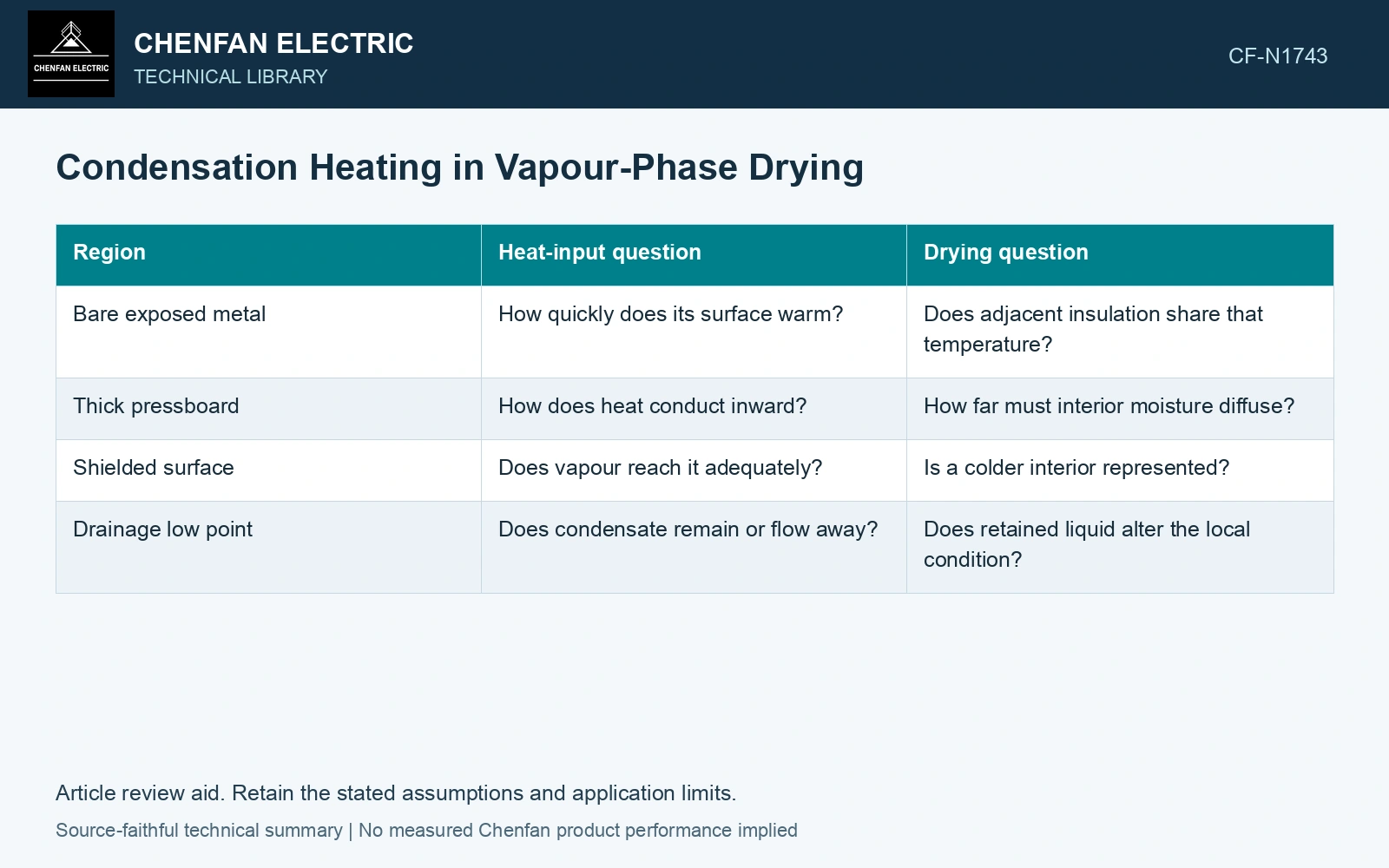
| Region | Heat-input question | Drying question |
|---|---|---|
| Bare exposed metal | How quickly does its surface warm? | Does adjacent insulation share that temperature? |
| Thick pressboard | How does heat conduct inward? | How far must interior moisture diffuse? |
| Shielded surface | Does vapour reach it adequately? | Is a colder interior represented? |
| Drainage low point | Does condensate remain or flow away? | Does retained liquid alter the local condition? |
Compare condensation heat with the local heat requirement and interior temperature history. An adequate surface input still needs conduction and moisture-transport evidence for the pressboard centre. [2]
Translate condensation rate into heat delivery
Assumptions: solvent condenses from a 90 °C saturated state onto an initially cooler region, with latent heat 300 kJ/kg. Rates of 0.020 and 0.040 kg/s deliver 6 and 12 kW, excluding sensible terms. An assumed local initial heat-input requirement of 8 kW leaves the low-rate region deficient by 2 kW while the high-rate region has 4 kW margin. Review vapour access and drainage in the deficient region and verify its interior temperature history; rapid warming of exposed metal does not close that gap. [2]
Watch the process change as surfaces warm
Condensation behavior changes as surface temperature approaches the vapour condition. The heating distribution can therefore move over the cycle. A single early temperature snapshot cannot establish a uniform later drying history.
References
- Y. Brahami, A. Betie, F. Meghnefi, I. Fofana and Z. Yeo, Development of a Comprehensive Model for Drying Optimization and Moisture Management in Power Transformer Manufacturing, Energies 18, 789, 2025. DOI: 10.3390/en18040789.
- U.S. Department of Energy, DOE-HDBK-1012/2-92, Thermodynamics, Heat Transfer, and Fluid Flow, Volume 2, 1992.