

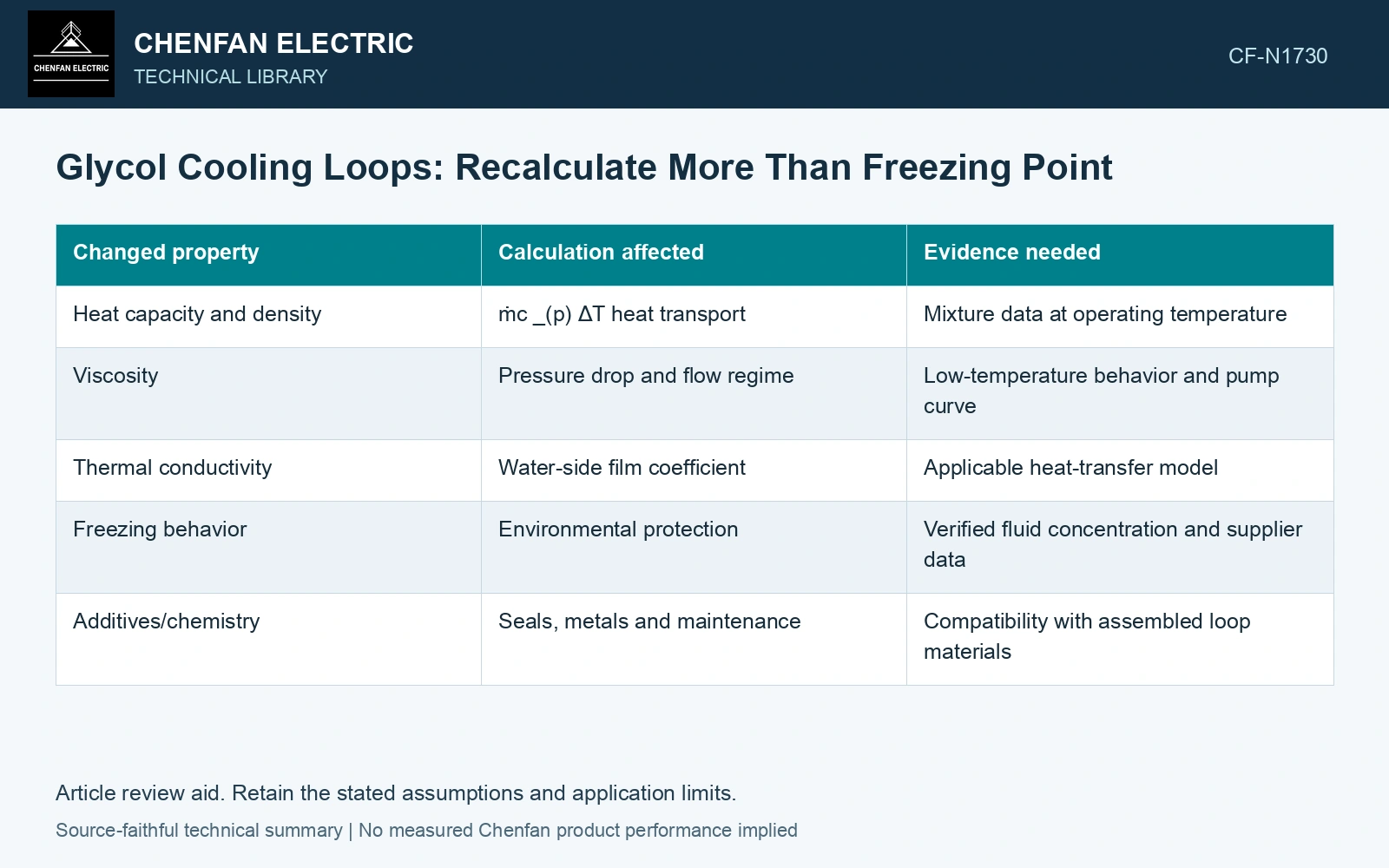
A glycol cooling loop needs properties for the specified mixture and temperature. Dow’s engineering guide tabulates density, viscosity, conductivity and specific heat by glycol concentration [1]. Its historical typical data illustrate the recalculation; the installed fluid needs its own current property sheet.
Identify glycol type, concentration convention and operating temperature range. Mass fraction and volume fraction are different specifications. Use property data for that actual mixture rather than averaging water and neat-glycol values linearly by assumption.
| Changed property | Calculation affected | Evidence needed |
|---|---|---|
| Heat capacity and density | ṁcpΔT heat transport | Mixture data at operating temperature |
| Viscosity | Pressure drop and flow regime | Low-temperature behavior and pump curve |
| Thermal conductivity | Water-side film coefficient | Applicable heat-transfer model |
| Freezing behavior | Environmental protection | Verified fluid concentration and supplier data |
| Additives/chemistry | Seals, metals and maintenance | Compatibility with assembled loop materials |
Distinguish fixed-flow and fixed-pump cases
At unchanged mass flow, the heat transported for a temperature rise is Q̇ = ṁcpΔT. Use kg/s, J/(kg K) and kelvin to obtain watts. At unchanged pump speed, viscosity and system resistance can change the actual flow, so the fixed-flow calculation may overstate performance.
Check startup at the coldest specified fluid temperature. It can be a different hydraulic condition from full-load hot operation. Include both in pump and pressure review.
Use the fluid energy balance for the heat-capacity comparison [2]. Hydraulic and film-coefficient calculations must use the changed viscosity and conductivity separately.
Compare fluids on a common heat-transport basis
For a catalogue comparison at 40 °C, Dow lists 30% and 50% propylene glycol by volume with specific heats 3.903 and 3.609 kJ/(kg·K), respectively [1]. Assume 2 kg/s flow, a 10 K rise and constant properties at that mean temperature: heat transport is 78.06 versus 72.18 kW, 7.53% lower. Listed viscosities also rise from 1.63 to 3.10 mPa·s, a factor of 1.90. Recalculate the actual pump point and convection before retaining the water-loop rating.
References
- The Dow Chemical Company, Engineering and Operating Guide for DOWFROST and DOWFROST HD Inhibited Propylene Glycol-based Heat Transfer Fluids, Form 180-01286-0901 AMS, September 2001, Tables 14 and 22.
- U.S. Department of Energy, DOE-HDBK-1012/2-92, Thermodynamics, Heat Transfer, and Fluid Flow, Volume 2, 1992.