

A measured load loss belongs to the complete test connection. Assigning it to one winding requires knowing the internal currents and which loss mechanisms the test excites. More measurements do not automatically create an independent allocation.
For each qualified test, derive series, common and tertiary currents from the actual connection. Use consistent reference temperatures and frequency. A terminal current is not sufficient when it differs from a section’s current.
Build an identifiable model
As a simplified illustration, write Pj = RS|ISj|² + RC|ICj|² + RT|ITj|² for test j. Effective coefficients R are in ohms and currents in amperes, giving watts. This model assumes fixed resistive coefficients and excludes or separately accounts for other loss terms.
The measurement matrix has one row [|ISj|², |ICj|², |ITj|²] per test. Independent identification of all three coefficients requires adequate rank and conditioning. Three tests with proportional current patterns cannot separate three coefficients.
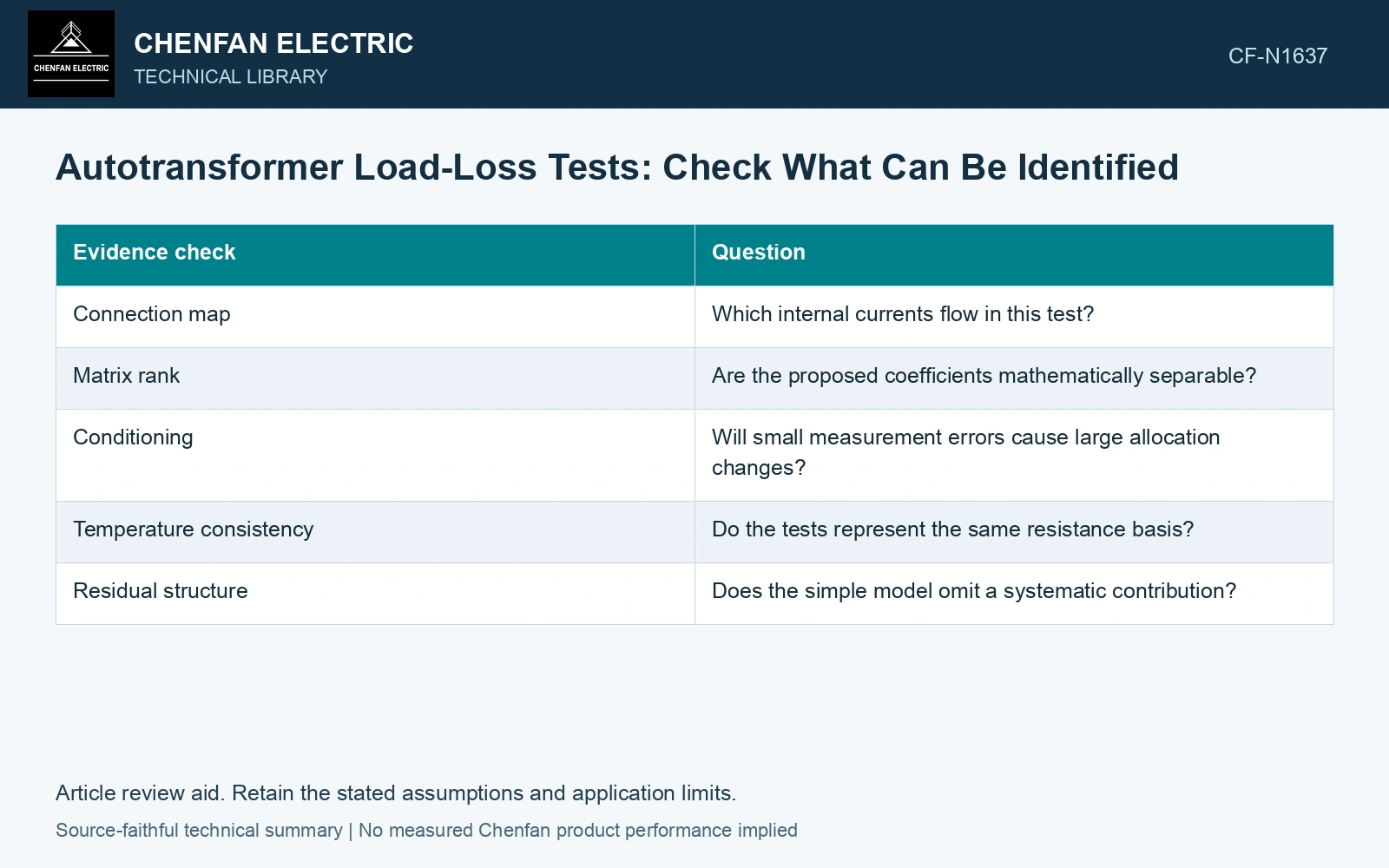
| Evidence check | Question |
|---|---|
| Connection map | Which internal currents flow in this test? |
| Matrix rank | Are the proposed coefficients mathematically separable? |
| Conditioning | Will small measurement errors cause large allocation changes? |
| Temperature consistency | Do the tests represent the same resistance basis? |
| Residual structure | Does the simple model omit a systematic contribution? |
Keep cross terms when physics requires them
Stray losses can depend on interacting fields from several winding currents. A quadratic form may include terms such as the real part of ISIC* multiplied by a coupling coefficient. Such terms cannot be attributed uniquely to one winding merely by labeling the total “series loss.”
Add terms only when they have a justified physical role and the observations can constrain them. A large parameter set fitted to a few tests is underdetermined even if its residual is small.
Independent DC resistance evidence can constrain copper-loss terms, while measured total load loss still includes other mechanisms. Keep those evidence types separate rather than treating their difference as a fully identified spatial stray-loss map.
Report unresolved combinations honestly
If the tests identify only a combined coefficient, report that combination and the conditions under which it applies. Do not assign an arbitrary split to make a table look complete.
Use additional approved test states or validated analysis where the decision requires a finer allocation. Choose states that change the relevant internal current pattern, not just the magnitude of the same pattern.
Report the per-winding allocations that the measurements constrain, together with the combinations they cannot distinguish. Use that uncertainty to select the next loss or temperature measurement before treating an allocation as a thermal-model input.
Reject three tests that carry only one independent pattern
Assume three same-temperature test states whose squared currents, normalized to one current base, form rows [1, 0.25, 0], [4, 1, 0] and [9, 2.25, 0]. Suppose their measured losses are 20, 80 and 180 kW. The matrix has rank 1, although there are three rows. It identifies only R′S + 0.25R′C = 20 kW on that normalization; the tertiary coefficient is unobserved. Both pairs (20, 0) and (15, 20) kW reproduce every result. Do not issue a unique winding-loss allocation. Seek a qualified connection with an independent current pattern and retain measurement uncertainty in the fit [1]. Record rated quantities and test conditions on the general power-transformer basis of IEC 60076-1 [2]. Assess the relevant measured quantities with a defined measurement model and propagated uncertainty [1]. Keep connection, tapping and network assumptions explicit in the application assessment [3].
References
- JCGM, JCGM 100:2008, Evaluation of measurement data — Guide to the expression of uncertainty in measurement, 2008.
- IEC, IEC 60076-1:2011, Power transformers – Part 1: General.
- IEC, IEC 60076-8:1997, Power transformers – Part 8: Application guide, 1997, official public scope.