

Two assemblies built to the same drawing can differ in contact seating, geometry and material response within their permitted variation. Those differences may change both the magnetic excitation and the structural transmission. A noise model fitted to one favorable assembly does not describe that spread automatically.
Define the population and operating condition before studying scatter. Mixing different designs, temperatures or auxiliary configurations produces a variation estimate that cannot be assigned to core manufacturing alone.
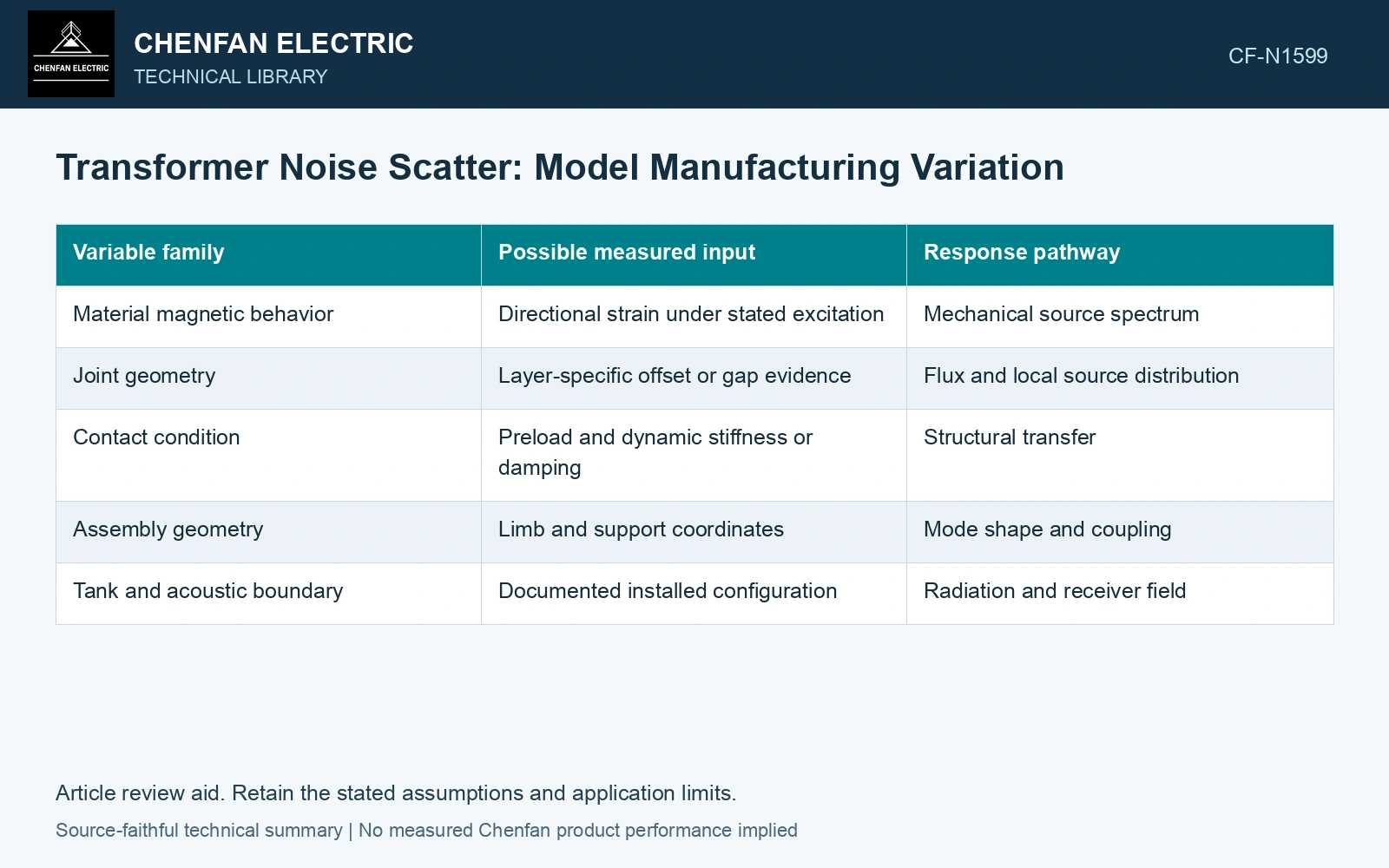
Separate source and transmission variables
| Variable family | Possible measured input | Response pathway |
|---|---|---|
| Material magnetic behavior | Directional strain under stated excitation | Mechanical source spectrum |
| Joint geometry | Layer-specific offset or gap evidence | Flux and local source distribution |
| Contact condition | Preload and dynamic stiffness or damping | Structural transfer |
| Assembly geometry | Limb and support coordinates | Mode shape and coupling |
| Tank and acoustic boundary | Documented installed configuration | Radiation and receiver field |
Use variables that can be measured or bounded. Assigning convenient probability distributions to unknown parameters creates numerical precision without production evidence.
Preserve correlations. Sheet thickness, stack height and clamp condition may be related through the assembly process. Sampling each independently can create combinations that production never makes, or omit combinations that occur together.
Start with sensitivity, then assess joint variation
A one-variable perturbation helps identify influential inputs near a baseline. It does not capture interactions or a resonance that moves across an excitation line. For those cases, evaluate combinations using measured correlations and realistic bounds.
Keep source variation and structural transfer variation visible. One study can hold the structure fixed while changing measured strain inputs. Another can hold a defined source fixed while changing contact and geometry. Their combined study then checks whether the effects reinforce or interact.
Use frequency-band power or clearly defined receiver metrics. Decibel outputs are logarithmic, so averaging or propagating them needs the intended statistical definition. A minimum, arithmetic mean and upper percentile describe different production questions.
Challenge the predicted spread with additional assemblies
Reserve representative assemblies for comparison. Check their measured input states and responses, not just whether the observed noise falls somewhere inside a wide predicted range. A broad uncertainty envelope can cover data while containing little useful information.
If a particular variable dominates the spread, investigate whether its manufacturing control is practical and whether the model’s sensitivity is independently supported. Tightening a low-impact tolerance adds cost without addressing the likely acoustic variation.
Report the tested population, sample coverage and unresolved variables with the predicted range. The value is a defensible prioritization of process controls and verification measurements. Selecting the quietest unit and presenting it as repeatable batch capability skips that work entirely.
Separate mass variation from an assumed acoustic distribution
Use catalogue nominal thickness 0.23 mm and catalogue assumed density 7,650 kg/m³ [1]. An assumed 500-sheet limb segment, 1.0 m long and 0.10 m wide, has steel mass 87.98 kg. If every sheet were instead 0.25 mm thick, at the catalogue upper thickness tolerance, the same count would weigh 95.63 kg. With assumed unchanged effective stiffness and an initial 100 Hz mode, mass-only scaling gives f₂ = 100√(87.975/95.625) = 95.92 Hz, a 4.08% decrease. This bounded sensitivity is not a production probability distribution. Check whether the shift approaches a forcing tone before assigning noise scatter to strain alone [2].
Sheet thickness and count set steel mass and stack build; joint registration, burr, interlaminar contact and clamp preload influence stiffness and transmission. Control and record these separately from directional magnetostrictive strain. A change in stock loss grade alone does not quantify the assembled core or transformer sound level. Directional strain under DC-biased and harmonic excitation requires its own source characterization [2].
References
- Nippon Steel Corporation, Grain-Oriented Electrical Steel Sheets, catalogue D004je_03_202004, 2020, Specifications; Size and Form Tolerances.
- Zhao, X., Du, Y., Liu, Y., Du, Z., Yuan, D., and Liu, L., Magnetostrictive Properties of the Grain-Oriented Silicon Steel Sheet under DC-Biased and Multisinusoidal Magnetizations, Materials 12, 2156, 2019. DOI: 10.3390/ma12132156.