

In a simplified shell-form magnetic circuit, central-limb flux returns through two outer branches. It is tempting to divide that flux equally when the outer areas match. Equal area does not guarantee equal reluctance: path length, joint condition and magnetic state also matter.
Build each return branch from its actual geometry and joint assumptions. Identify shared regions separately so that they are not counted twice. Use the model to test sensitivity, rather than assigning a split from the drawing silhouette.
The linear branch relationship
For two ideal parallel branches with reluctances R₁ and R₂, both experience the same branch magnetomotive-force difference F. Their fluxes are Φ₁ = F/R₁ and Φ₂ = F/R₂. If total returning flux is Φc, then Φ₁ = ΦcR₂/(R₁ + R₂) and Φ₂ = ΦcR₁/(R₁ + R₂).
Flux is in webers, F in ampere-turns and reluctance in ampere-turns per weber. The lower-reluctance branch carries more flux. Area-based division follows only under additional assumptions that make reluctance inversely proportional to area with otherwise equivalent paths.
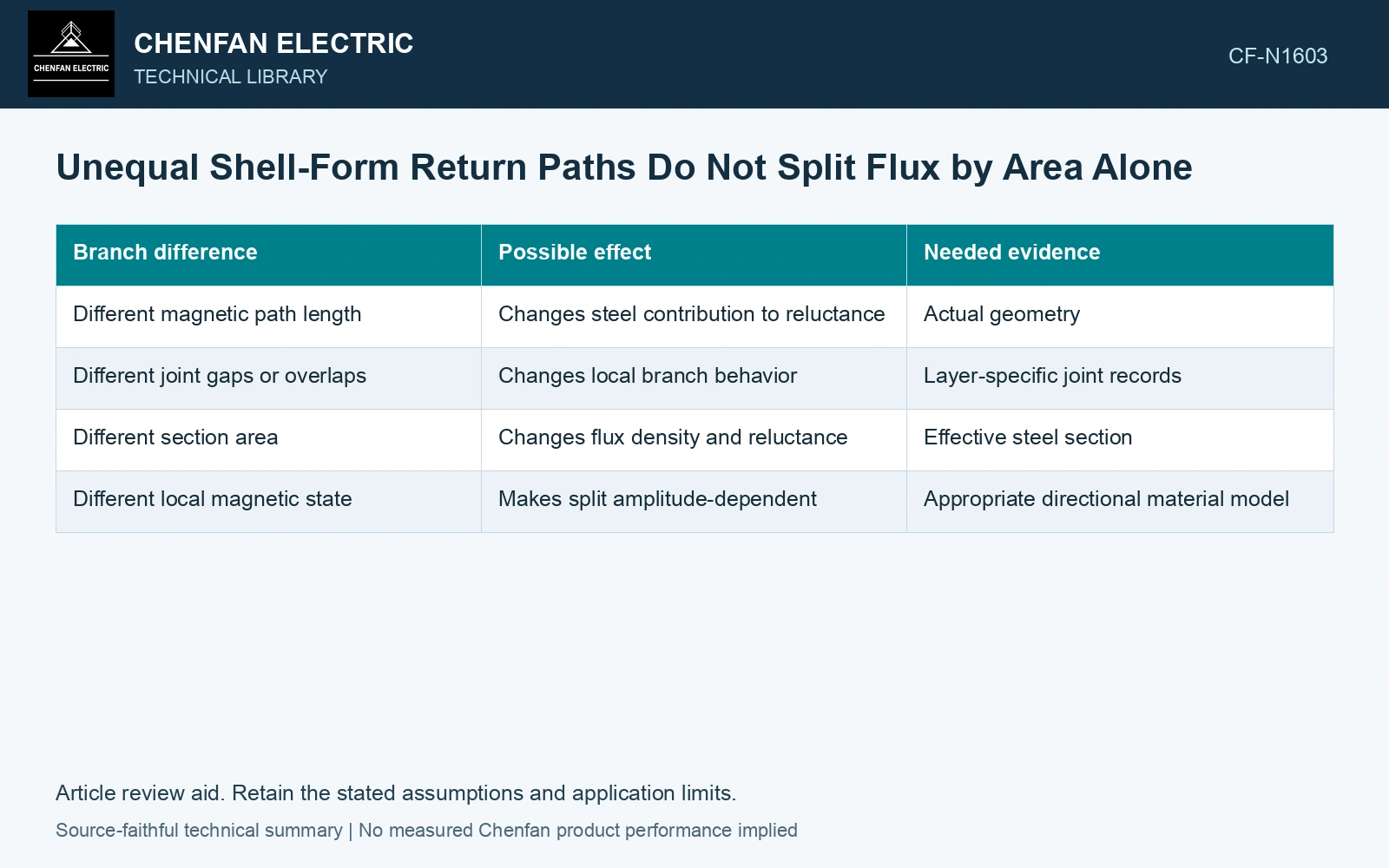
| Branch difference | Possible effect | Needed evidence |
|---|---|---|
| Different magnetic path length | Changes steel contribution to reluctance | Actual geometry |
| Different joint gaps or overlaps | Changes local branch behavior | Layer-specific joint records |
| Different section area | Changes flux density and reluctance | Effective steel section |
| Different local magnetic state | Makes split amplitude-dependent | Appropriate directional material model |
Replace fixed reluctances when the duty requires it
Near nonlinear operation, each branch has its own F–Φ relationship. Solve for a common branch F and the flux sum Φ₁ + Φ₂ = Φc. A single constant split may no longer apply through the cycle.
Calculate branch flux density using its actual effective area. A branch with more flux and less area can have a particularly demanding local state, but the magnitude must come from the model rather than a general statement that asymmetry causes saturation.
Check the shared corner and yoke regions. A lumped model may reproduce total branch flux while missing local crowding or transverse components. Use a three-dimensional analysis where those details control the design, and verify its geometry and material directions.
Compare positive and negative portions of the excitation cycle when asymmetry or magnetic history is relevant. A one-time peak plot does not establish the entire flux distribution.
The practical decision is whether the assumed flux split remains adequate under realistic branch variation. If it is sensitive to joint or section differences, prioritize those controls and the corresponding verification. Adding return area without addressing an unequal joint may change the average density while leaving the underlying branch imbalance unexplained.
Use the actual sheet section in the return-flux calculation
Use the catalogue’s 0.23 mm nominal sheet thickness [1]. Assume each return branch contains 1,000 sheets of 100 mm width, giving steel area 0.0230 m²; neglect coating and edge corrections. For assumed peak return flux 0.060 Wb and linear branch reluctances of 10,000 and 20,000 A·turn/Wb, the two branch fluxes are 0.040 and 0.020 Wb. Peak densities are 1.739 and 0.870 T. Equal area has not produced equal flux. The first branch exceeds the catalogue loss-test induction of 1.7 T at 50 Hz, so its loss cannot be assigned from the W17/50 value. Obtain a validated nonlinear directional model instead of extrapolating that catalogue datum.
Return-flux balance is controlled by effective sheet section, rolling direction, joint overlap, local gaps, packet alignment and clamp-induced geometry changes. Measure branch build and verify layer closure separately. A larger outer profile does not correct a discontinuous joint or establish the directional permeability used in the branch model. Keep the measured geometry, its reference state and its uncertainty together when evaluating the fit [2].
References
- Nippon Steel Corporation, Grain-Oriented Electrical Steel Sheets, catalogue D004je_03_202004, 2020, Specifications; Size and Form Tolerances.
- JCGM, JCGM 100:2008, Evaluation of measurement data — Guide to the expression of uncertainty in measurement, 2008.