

At one fan speed, a blade-passing component can coincide with a magnetically synchronized tone. The resulting spectral line may look like one source. Turning the fan off can change cooling and operating state, so it is not always a clean comparison.
Where approved operation allows it, record a controlled speed range with simultaneous fan tachometer, electrical reference and acoustic channels. The moving frequency pattern supplies information that a single spectrum lacks.
Build an order map
For a fan with Z blades rotating at n revolutions per minute, the ideal blade-passing frequency is fBPF = Zn/60 hertz. Its harmonics move proportionally with speed. A magnetically locked component follows its relationship to the electrical frequency instead.
Plot frequency against measured speed, retaining acoustic amplitude. Fan orders appear as speed-related traces; electrically locked tones remain near their electrical frequencies unless those also change. Use actual speed data rather than the controller’s requested setting.
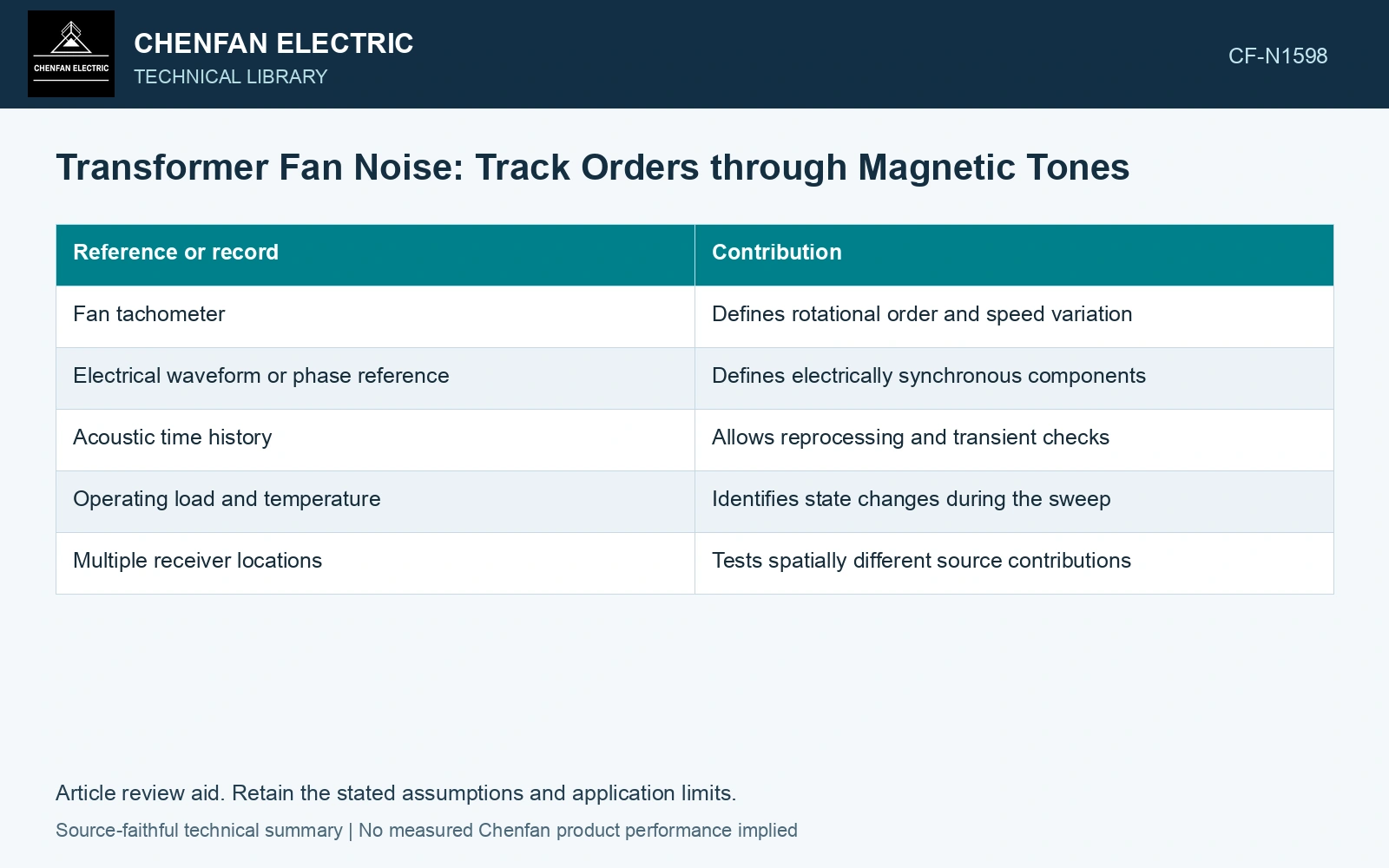
| Reference or record | Contribution |
|---|---|
| Fan tachometer | Defines rotational order and speed variation |
| Electrical waveform or phase reference | Defines electrically synchronous components |
| Acoustic time history | Allows reprocessing and transient checks |
| Operating load and temperature | Identifies state changes during the sweep |
| Multiple receiver locations | Tests spatially different source contributions |
Frequency resolution depends on record length and stationarity. A long record improves nominal frequency spacing but can smear a moving fan order if speed changes appreciably during that record. Use a processing method suited to the measured speed variation.
Treat crossings explicitly
Near an order crossing, two contributions occupy the same frequency band. Amplitude at that line alone cannot uniquely split them. Use tachometer-synchronous and electrical-synchronous averages or cross-spectral analyses when the references provide sufficient independent information.
If the fan speed is locked so that its phase relationship to the electrical tone remains fixed, the two references may not distinguish the sources well. Report that limitation and use another approved state or spatial measurement instead of forcing a numerical split.
Track nearby noninteger features too. Flow-related noise and mechanical fan motion need not appear only at the ideal blade-passing orders. The order model is a hypothesis to compare with data, not a filter that discards everything else. Use transformer and cooling-device sound measurements with defined operating and measurement conditions [1].
Keep cooling changes in the interpretation
A speed sweep can change temperature and therefore magnetic or structural behavior. Compare sufficiently stable states and record the timeline. A tone that changes slowly with heating is not necessarily a fan order simply because the fan setting changed earlier.
The resulting map should identify stable magnetic components, speed-tracking components and unresolved crossings. That supports a targeted fan or structural investigation without attributing the entire combined line to whichever source is easier to modify.
Move the blade order away from the electrical crossing
Assume a six-blade fan, a 50 Hz supply and a magnetic tone at 100 Hz. At 1,000 r/min, blade-passing frequency is 6×1,000/60 = 100 Hz, exactly the crossing. Assumed speeds of 900 and 1,100 r/min move that order to 90 and 110 Hz while the electrical tone stays at 100 Hz. A stationary 1 s record has nominal Fourier spacing 1 Hz, so the off-crossing separation is ten bins; this does not by itself establish leakage or amplitude accuracy. Compare synchronized off-crossing records and reserve the 1,000 r/min component as unresolved if the references cannot separate it [2].
References
- IEC, IEC 60076-10:2016, Power transformers – Part 10: Determination of sound levels, 2016, official public scope.
- JCGM, JCGM 100:2008, Evaluation of measurement data — Guide to the expression of uncertainty in measurement, 2008.