

A specimen mounted in a fixture may be easier to measure than a nearly free sheet. The fixture can also resist the magnetostrictive movement. The recorded strain then describes the specimen–fixture system, rather than the unconstrained material tendency alone.
Before using that reading as eigenstrain in a core model, identify the mechanical restraint, preload and measurement direction. A statement that the sensor is noncontact does not mean that the specimen itself is mechanically free.
A simple restraint model
Consider a uniform bar of length L, axial stiffness ks = EA/L and free magnetostrictive extension Δ₀. A linear fixture connects the same endpoints with resisting stiffness kf. Force balance gives ks(Δ − Δ₀) + kfΔ = 0, so Δ = Δ₀ks/(ks + kf).
Under these assumptions, the observed strain is λmeasured = λfree ks/(ks + kf). Recovering λfree requires the relevant fixture stiffness and a valid bar model. The relation shows the direction of bias: increasing restraint reduces observed extension.
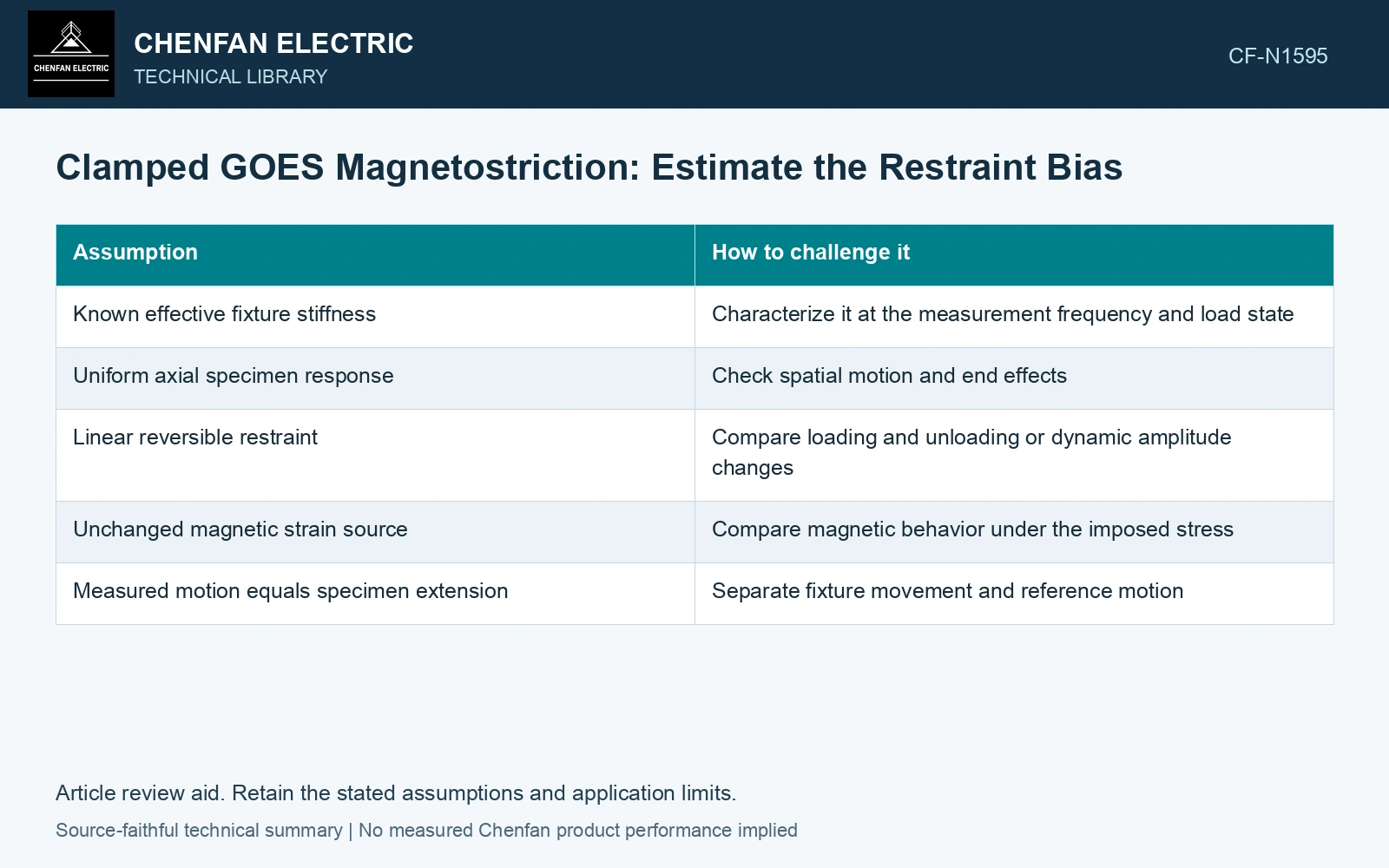
| Assumption | How to challenge it |
|---|---|
| Known effective fixture stiffness | Characterize it at the measurement frequency and load state |
| Uniform axial specimen response | Check spatial motion and end effects |
| Linear reversible restraint | Compare loading and unloading or dynamic amplitude changes |
| Unchanged magnetic strain source | Compare magnetic behavior under the imposed stress |
| Measured motion equals specimen extension | Separate fixture movement and reference motion |
Stress can change the source itself
GOES magnetomechanical behavior depends on stress as well as magnetic history. The fixture may therefore alter both the observed extension and the intrinsic strain response. Dividing by a mechanical attenuation factor cannot correct that coupled effect automatically.
Use a near-free reference measurement or several independently characterized restraint conditions. Compare the excitation waveform and magnetic response alongside strain. If a mechanical correction fails to bring the results into agreement, investigate stress-dependent material behavior and nonuniform constraint.
At dynamic frequencies, fixture stiffness can be complex and frequency-dependent. A static stiffness measured at the bench may not describe the restraint near a fixture resonance. Use synchronized force and motion where needed to characterize that effect.
Label the data by its physical meaning
Preserve the raw measured strain, the fixture state and any corrected estimate separately. Do not replace the original reading with a corrected “free strain” while hiding the model that produced it.
A core simulation should use data consistent with its constitutive formulation. Applying constrained total strain as free eigenstrain can understate the source; applying an uncertain correction can overstate it. The right choice follows demonstrated fixture behavior and magnetic-state agreement, with unresolved coupling retained as a model limitation rather than absorbed into a fitted vibration amplitude. Directional strain under DC-biased and harmonic excitation requires its own source characterization [1].
Calculate the fixture correction for a catalogue-thickness sheet
Use 0.23 mm nominal GOES thickness [2]. Assume a 0.60 m long, 0.10 m wide sheet, axial modulus E = 200 GPa and fixture stiffness kf = 1.0 MN/m at 100 Hz. Specimen stiffness is EA/L = 7.667 MN/m, so measured/free extension ratio is 7.667/(7.667 + 1.0) = 0.8846. An assumed measured 0.300 μstrain would imply 0.339 μstrain free strain in this uncoupled linear model, a 13.0% correction. Compare that estimate with another characterized restraint condition before using it as eigenstrain. Stress-dependent magnetic coupling can invalidate the purely mechanical correction [3].
Directional sheet selection, cutting-induced stress, edge burr and fixture or core clamping determine the restraint applied to the material. Keep specimen orientation, preload and support contact explicit. A noncontact displacement sensor removes sensor contact, not the mechanical bias caused by the fixture.
References
- Zhao, X., Du, Y., Liu, Y., Du, Z., Yuan, D., and Liu, L., Magnetostrictive Properties of the Grain-Oriented Silicon Steel Sheet under DC-Biased and Multisinusoidal Magnetizations, Materials 12, 2156, 2019. DOI: 10.3390/ma12132156.
- Nippon Steel Corporation, Grain-Oriented Electrical Steel Sheets, catalogue D004je_03_202004, 2020, Specifications; Size and Form Tolerances.
- COMSOL AB, Structural Mechanics Module User’s Guide: Magnetostriction and Piezomagnetism, version 6.3.