

An active controller minimizes sound at selected error microphones by adding a secondary acoustic field. A low residual at those microphones shows that the controller met its local objective. It does not establish the size of the quiet region.
The primary and secondary fields have different spatial patterns. Their amplitudes and phases may cancel at one point and reinforce at another. Define the required listening or boundary region before deciding whether the control arrangement is useful.
State the spatial objective
At one frequency and position r, linear superposition gives Ptotal(r) = Pprimary(r) + Psecondary(r). Cancellation requires both magnitudes and phases to match appropriately at that position. Moving r changes the propagation relationship.
A delay error τ introduces phase error ωτ at angular frequency ω. The same timing error therefore matters more at higher frequency. Source movement, changing temperature or a changed reflection path can also alter the transfer relationships used by the controller.
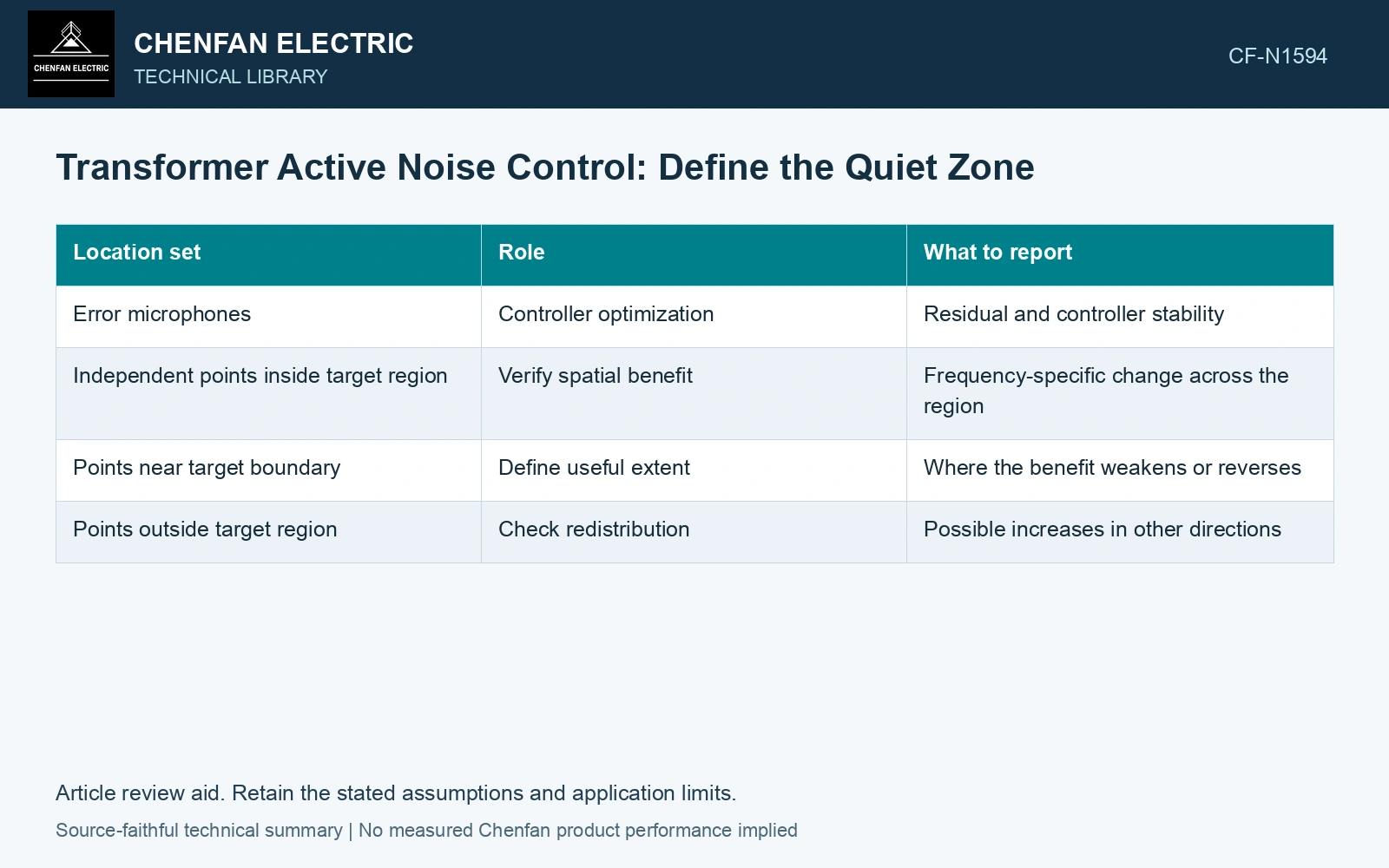
| Location set | Role | What to report |
|---|---|---|
| Error microphones | Controller optimization | Residual and controller stability |
| Independent points inside target region | Verify spatial benefit | Frequency-specific change across the region |
| Points near target boundary | Define useful extent | Where the benefit weakens or reverses |
| Points outside target region | Check redistribution | Possible increases in other directions |
Do not use every verification point as an error microphone and then call the same points independent validation. Reserve locations that challenge the spatial interpolation between controlled points.
Test changing conditions
Compare repeated operating states with a consistent primary source reference. Separate magnetic tones from fans and other sources. A controller synchronized to a stable electrical tone may not control a moving blade-passing component in the same way.
Evaluate frequency changes and phase delays over the intended range. Include secondary-source limits, sensor noise and actuator saturation. A mathematical cancellation requiring unavailable output is not a physical solution.
Use a map with consistent measurement conditions and color limits. Show the individual frequency bands as well as any overall metric, because improvement in a dominant tone can conceal an increase elsewhere. Keep uncontrolled background estimates in the interpretation when they limit observable benefit.
Judge the region, not the best microphone
Agree on the spatial decision rule before selecting favorable points. Depending on the task, the relevant output may be the maximum residual, a set of occupied locations or a boundary assessment. State that choice openly.
When the control zone moves or shrinks with operating conditions, report that sensitivity. It may still suit a specific workstation or receiver, but it cannot support a wider claim. Active control becomes a useful engineering option when its verified region matches the required use and remains acceptable under the conditions the transformer actually experiences.
Quantify the residual caused by timing error
Assume equal primary and secondary 100 Hz pressure amplitudes at one receiver, with intended opposite phase. A delay error of 1.0 ms adds 2πfτ = 0.6283 rad, giving residual/source amplitude 2|sin(πfτ)| = 0.6180. The local change is 20 log₁₀(0.6180) = −4.18 dB. Reducing the assumed delay error to 0.10 ms gives a ratio of 0.06282 and −24.04 dB. These are local coherent-tone results, not whole-region sound-power reductions. Verify independent receiver locations and actuator headroom before judging the quiet-zone boundary. Judge the acoustic outcome using defined transformer and cooling-device sound conditions [1]. The frequency-domain pressure field and its structural coupling require the stated acoustic boundary conditions [2].
References
- IEC, IEC 60076-10:2016, Power transformers – Part 10: Determination of sound levels, 2016, official public scope.
- COMSOL AB, Acoustics Module User’s Guide: The Pressure Acoustics, Boundary Elements Interface, version 6.3.