

A boundary-element method can model an unbounded acoustic region without meshing the entire exterior volume. That advantage does not remove verification requirements. The surface discretization, numerical integration and solver approximations must still resolve the frequency and geometry.
Begin with an acoustic problem that has an independent analytical solution, such as a defined spherical scattering or radiation case. Match its boundary condition, material properties and incident or source field exactly. A benchmark with the wrong physical setup cannot test the implementation.
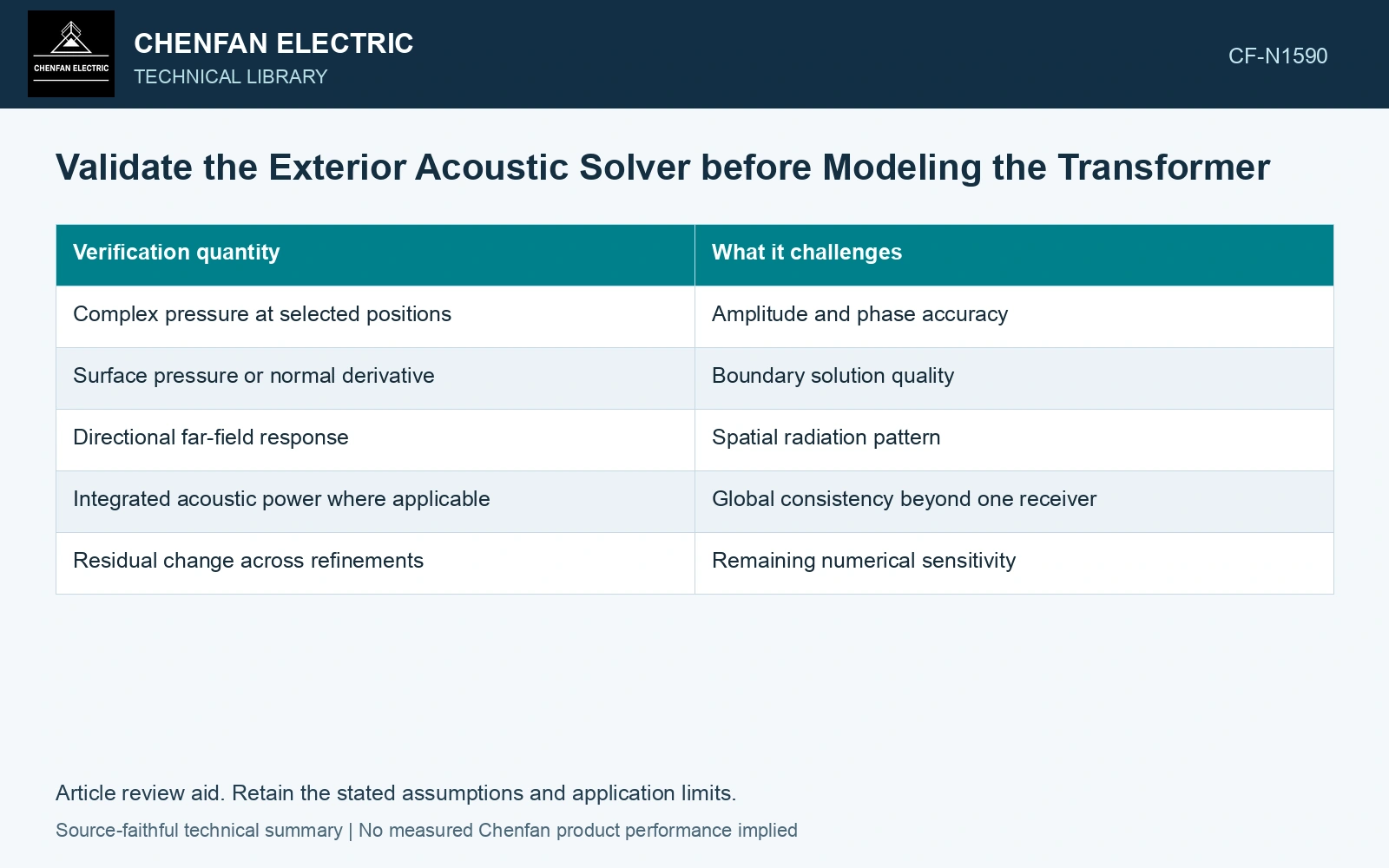
Check several outputs
| Verification quantity | What it challenges |
|---|---|
| Complex pressure at selected positions | Amplitude and phase accuracy |
| Surface pressure or normal derivative | Boundary solution quality |
| Directional far-field response | Spatial radiation pattern |
| Integrated acoustic power where applicable | Global consistency beyond one receiver |
| Residual change across refinements | Remaining numerical sensitivity |
Use both magnitude and phase. A pressure magnitude can agree while the phase is wrong, which matters when several sources are combined coherently.
The acoustic wavelength is λ = c/f, with sound speed c in metres per second and frequency f in hertz. Mesh adequacy must follow the shortest relevant wavelength and geometric features. The required number and order of elements depend on the formulation; a generic fixed ratio is not a universal accuracy guarantee.
Refine one numerical contribution at a time
First study surface discretization with sufficiently accurate integration and solver tolerances. Then vary quadrature treatment, particularly for elements separated by narrow gaps. Finally assess iterative tolerance and any far-field matrix approximation. Changing all settings together may improve the answer without revealing the limiting contribution.
Near-touching surfaces can demand more accurate quadrature even when the acoustic wavelength is long. A tank detail that looks small relative to wavelength can still create a numerically difficult interaction between neighboring elements.
For an exterior problem, verify the outgoing-wave condition and any symmetry or ground assumptions. An infinite reflecting plane cannot be used indiscriminately for a surface containing an opening through which sound propagates. The model’s boundary construction must match the method’s restrictions.
Keep the benchmark separate from validation
After the solver passes its benchmark, apply comparable checks to the transformer geometry. Compare successive discretizations using the engineering outputs that control the decision, including receiver locations and power bands. A finely rendered pressure image is a postprocessing choice, not evidence of a fine solution mesh.
Only then compare the predicted transformer field with measurements under matching operating conditions. Disagreement may come from source strain, structural transmission, acoustic boundaries or numerical error. A verified acoustic solver narrows that investigation; it does not certify the preceding magnetic and structural models automatically.
Use a complex-pressure benchmark before the tank calculation
Assume a 100 Hz analytical benchmark gives 0.1000 Pa RMS at a defined receiver and sound speed is 343 m/s, so wavelength is 3.43 m. Coarse and fine numerical meshes give assumed in-phase pressures of 0.1020 and 0.1005 Pa. Relative amplitude errors are 2.0% and 0.5%; only the fine result meets an assumed 1% amplitude criterion. Phase, integrated power and other receiver positions still require their own checks. Use the benchmark to select numerical controls, then repeat sensitivity checks on the transformer geometry; passing this example does not validate the magnetic source or tank motion [1]. Judge the acoustic outcome using defined transformer and cooling-device sound conditions [2].
References
- COMSOL AB, Acoustics Module User’s Guide: The Pressure Acoustics, Boundary Elements Interface, version 6.3.
- IEC, IEC 60076-10:2016, Power transformers – Part 10: Determination of sound levels, 2016, official public scope.