

A magnetostriction butterfly curve plots strain against magnetic excitation. It does not directly show when each strain occurs. For a vibration model, that timing matters because the excitation at each frequency has both amplitude and phase.
Keep the original synchronized time records alongside the loop. Identify the excitation waveform, material direction, mechanical constraint and magnetic preparation. Two curves with similar extrema can produce different harmonic spectra when their time trajectories differ.
Extract complex coefficients
For N equally spaced samples covering an integer number of steady periods, a discrete coefficient is cₖ = (1/N)Σ λⱼ exp(−i2πkj/N). The strain λ is dimensionless. For a real waveform and a positive-frequency component away from the sampling limits, its peak sinusoidal amplitude is 2|cₖ| and its phase is arg(cₖ).
Use a stated common time origin. Changing the trigger shifts phase without changing amplitude. The DC coefficient describes mean strain, while the nonzero coefficients describe periodic excitation. Keep them separate when applying the mechanical model.
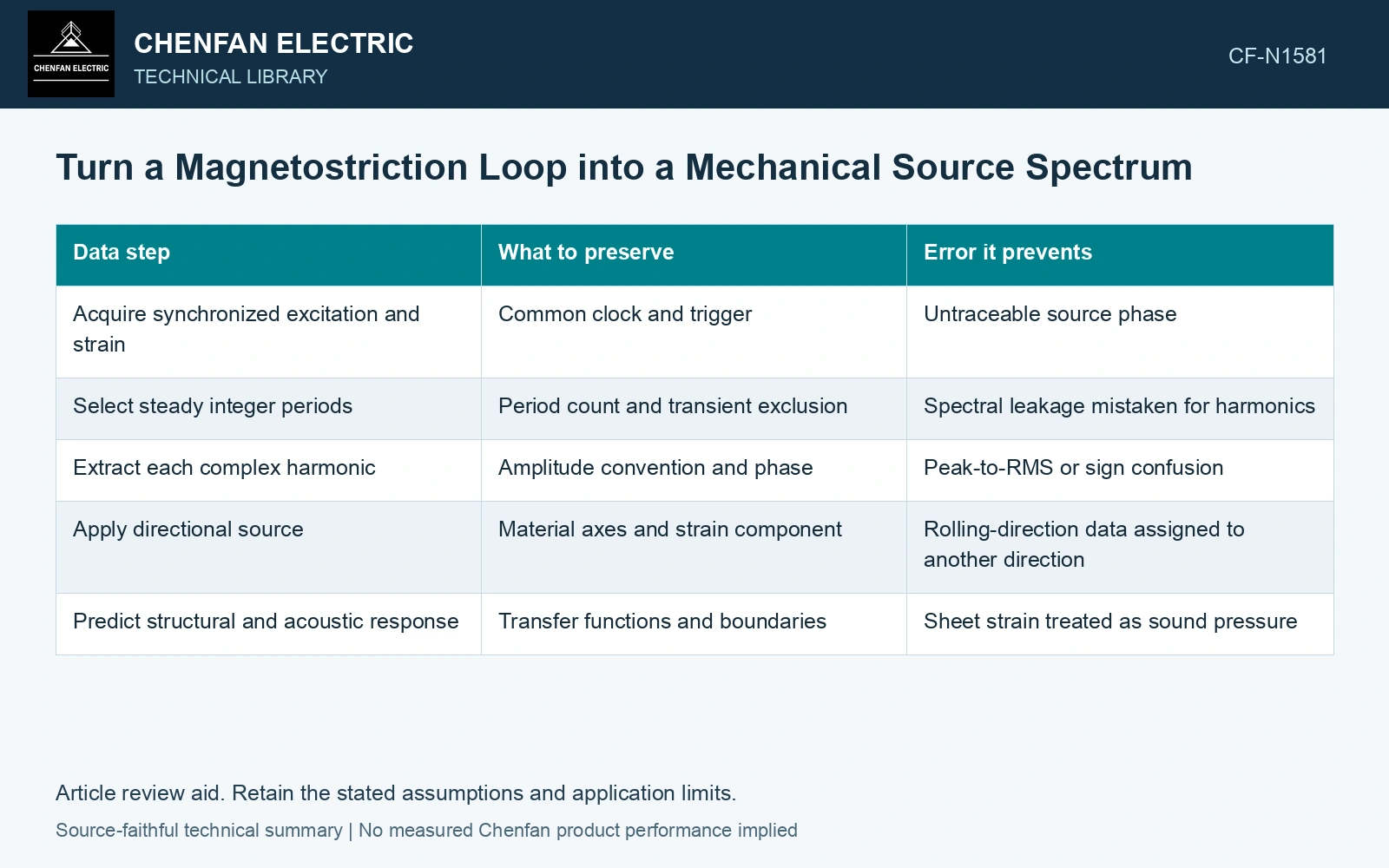
| Data step | What to preserve | Error it prevents |
|---|---|---|
| Acquire synchronized excitation and strain | Common clock and trigger | Untraceable source phase |
| Select steady integer periods | Period count and transient exclusion | Spectral leakage mistaken for harmonics |
| Extract each complex harmonic | Amplitude convention and phase | Peak-to-RMS or sign confusion |
| Apply directional source | Material axes and strain component | Rolling-direction data assigned to another direction |
| Predict structural and acoustic response | Transfer functions and boundaries | Sheet strain treated as sound pressure |
If noninteger records or changing conditions require a window, state its amplitude correction and frequency resolution. A narrow spectral line can spread into adjacent bins; summing or selecting those bins needs a consistent method.
Keep the three spectra distinct
The strain-source spectrum is not the structural velocity spectrum. Constraints, contacts and resonances determine the latter. For a harmonic displacement phasor U at angular frequency ω, velocity is iωU under the exp(iωt) convention. That frequency weighting changes the relative importance of displacement harmonics.
The velocity field is not yet the radiated pressure spectrum. Different vibrating regions can reinforce or cancel, and their radiation efficiency changes with frequency and shape. A sheet-based noise indicator cannot replace this structural and acoustic chain.
Compare source reconstructions against the measured strain waveform before proceeding. Rebuild λ(t) from the retained coefficients and check peaks, timing and asymmetry. If the reduced spectrum loses a feature important to contact motion or a structural resonance, retain the necessary harmonics.
The resulting source specification should contain the complex coefficients, material orientation and test state. A single peak-to-peak magnetostriction value remains useful for material comparison, but it cannot tell a transformer model how its mechanical sources combine in time.
Convert harmonic strain into a stated restraint load
23ZH90 has a catalogue nominal thickness of 0.23 mm [1]. For a demonstration, assume a 100 mm wide sheet, full axial restraint, uniform strain, and harmonic peak strains of 1.0 µm/m at 100 Hz and 0.3 µm/m at 200 Hz, with zero relative phase. Use E = 200 GPa as the model value reported by Zhao et al. [2], not a certificate for this grade. Area is 23 mm² and F = EAλ gives peak restraint loads of 4.60 N and 1.38 N. Their ratio is 3.33. Preserve both harmonic loads and phases in the structural model; actual partial restraint requires its own transfer model and uncertainty [3].
Manufacturing controls. Rolling direction, cutting stress, annealing condition, joint pattern and clamp pressure affect the material excitation and its transmission. Sheet strain data must match those conditions before being assigned to an assembled transformer core.
References
- Nippon Steel Corporation, Grain-Oriented Electrical Steel Sheets, catalogue D004je_03_202004, 2020, Specifications; Size and Form Tolerances.
- Zhao, X. et al., Magnetostrictive Properties of the Grain-Oriented Silicon Steel Sheet under DC-Biased and Multisinusoidal Magnetizations, Materials 12, 2156, 2019, sections 2.1 and 2.3; DOI: 10.3390/ma12132156.
- JCGM, JCGM 100:2008, Evaluation of measurement data — Guide to the expression of uncertainty in measurement, 2008.