

A coupled model can use the correct stress values and correct material orientation yet combine them incorrectly. This happens when stress is stored in global axes and magnetostrictive strain is evaluated in rolling/transverse axes without a consistent transformation.
The physical interaction cannot depend on how the analyst labels the coordinate frame. That invariance supplies a practical implementation check before a model is trusted to predict a transformer core’s response.
Put both tensors in one frame
For an illustrative coupling term, write energy density as u = −sigma:epsilon_mag, where sigma is the symmetric mechanical stress tensor in pascals, epsilon_mag is a magnetostrictive strain tensor with dimensionless components, and the colon denotes the sum of component-wise products. The resulting energy density is in joules per cubic metre.
This expression describes a coupling bookkeeping check. The actual constitutive law that produces epsilon_mag must represent the anisotropic material and the model’s thermodynamic assumptions. An isotropic single-coefficient formula should not be silently adopted for GOES.
In two dimensions, the contraction includes sigma_rr epsilon_rr + sigma_tt epsilon_tt + 2 sigma_rt epsilon_rt when both tensors are symmetric. Omitting the factor of two, or mixing engineering shear strain with tensor shear strain, creates an implementation error.
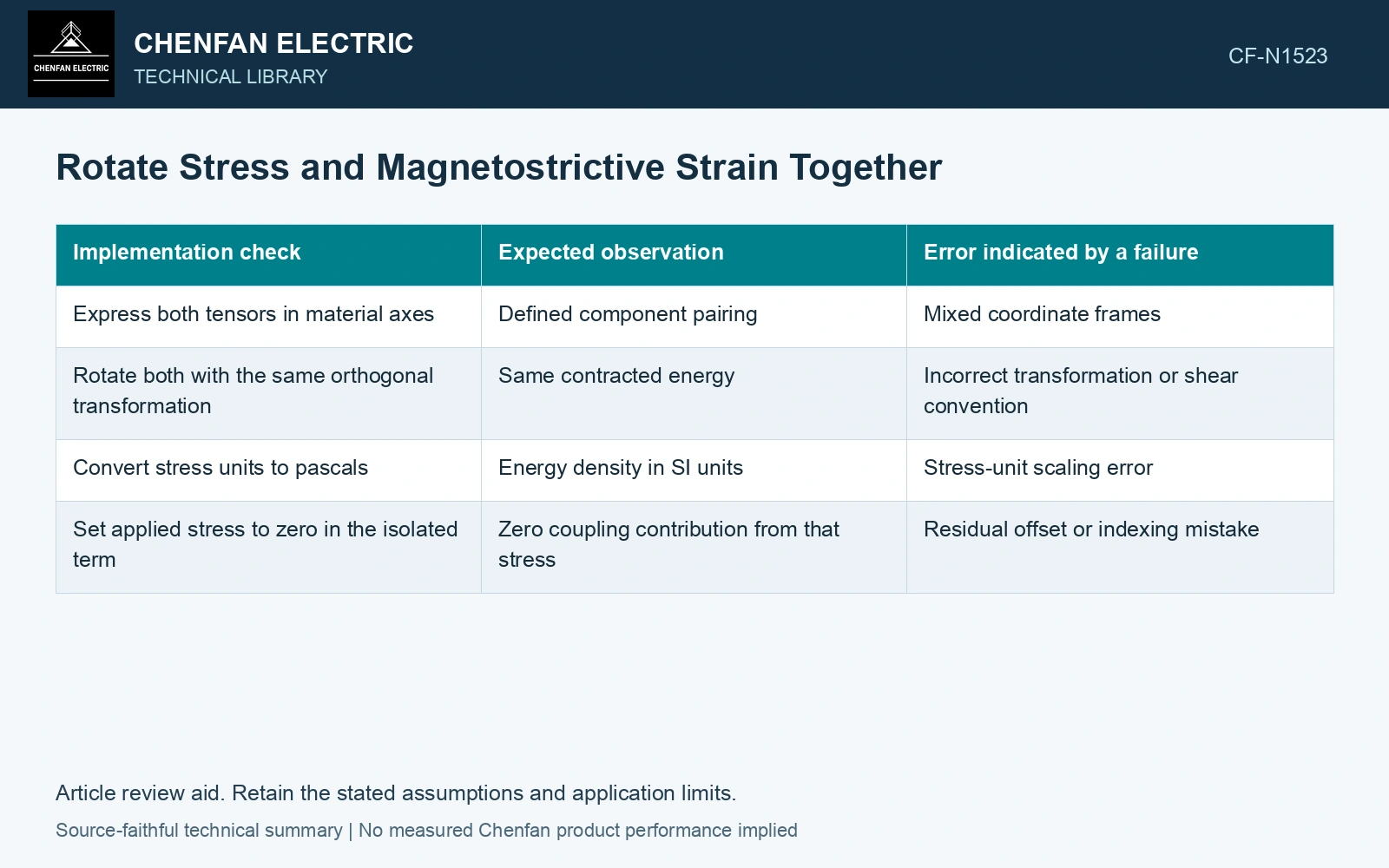
| Implementation check | Expected observation | Error indicated by a failure |
|---|---|---|
| Express both tensors in material axes | Defined component pairing | Mixed coordinate frames |
| Rotate both with the same orthogonal transformation | Same contracted energy | Incorrect transformation or shear convention |
| Convert stress units to pascals | Energy density in SI units | Stress-unit scaling error |
| Set applied stress to zero in the isolated term | Zero coupling contribution from that stress | Residual offset or indexing mistake |
The zero-stress check concerns the selected term only. It does not require the material to have zero residual strain or zero total magnetic energy.
Use an intentionally simple numerical test
Choose a symmetric stress tensor and a strain tensor with nonzero normal and shear components. Compute the contraction directly. Rotate both tensors through a chosen angle with Q sigma Q-transpose and Q epsilon Q-transpose, where Q is the orthogonal rotation matrix. Recompute the contraction in the rotated frame.
The two values should agree within numerical precision. Repeat with a material-axis rotation that is different from the mechanical principal-axis direction. This makes accidental use of principal stresses without their orientation easier to detect.
Then reconnect the constitutive behavior
Once the coordinate check passes, examine how the material law uses magnetic direction, stress state and history. Energy invariance does not prove that those inputs are physically correct. It only removes one class of implementation error.
For a core joint, retain the transformation associated with each local material direction and confirm that stress and magnetic outputs can be traced into that frame. A model should produce the same physical prediction when the entire geometry and its coordinate labels are rotated together. If it does not, material orientation and tensor transformation need correction before further parameter fitting.
Technical references
- Materials / MDPI. Magnetostrictive Properties of the Grain-Oriented Silicon Steel Sheet under DC-Biased and Multisinusoidal Magnetizations.
- NIST. NCAL: Diffraction Stress Measurement Under Applied Load.