

A tension-compression comparison can show apparent magnetic asymmetry because the material responds differently, because the fixture creates different stress states, or because both occur. Thin CRGO makes the second explanation particularly important: compression can introduce buckling or support contact that a tensile trial does not share.
Choose paired loading levels with equal absolute nominal stress and identical material direction. Then verify the actual specimen state. The force divided by nominal section is a useful loading descriptor, but it does not reveal bending or frictional restraint in the magnetically evaluated region.
Establish a comparable measurement region
Mark rolling direction and measure strain at locations that can reveal bending. Opposite-face observations, where feasible, help distinguish average extension from a strain gradient. Confirm that compression supports do not introduce an unmeasured transverse load or allow a local buckle.
If the intended compression state cannot be sustained uniformly, report the limitation. Comparing an unbuckled tensile strip with a bowed compression specimen would answer a combined geometry-and-stress question, not an isolated tension-compression question.
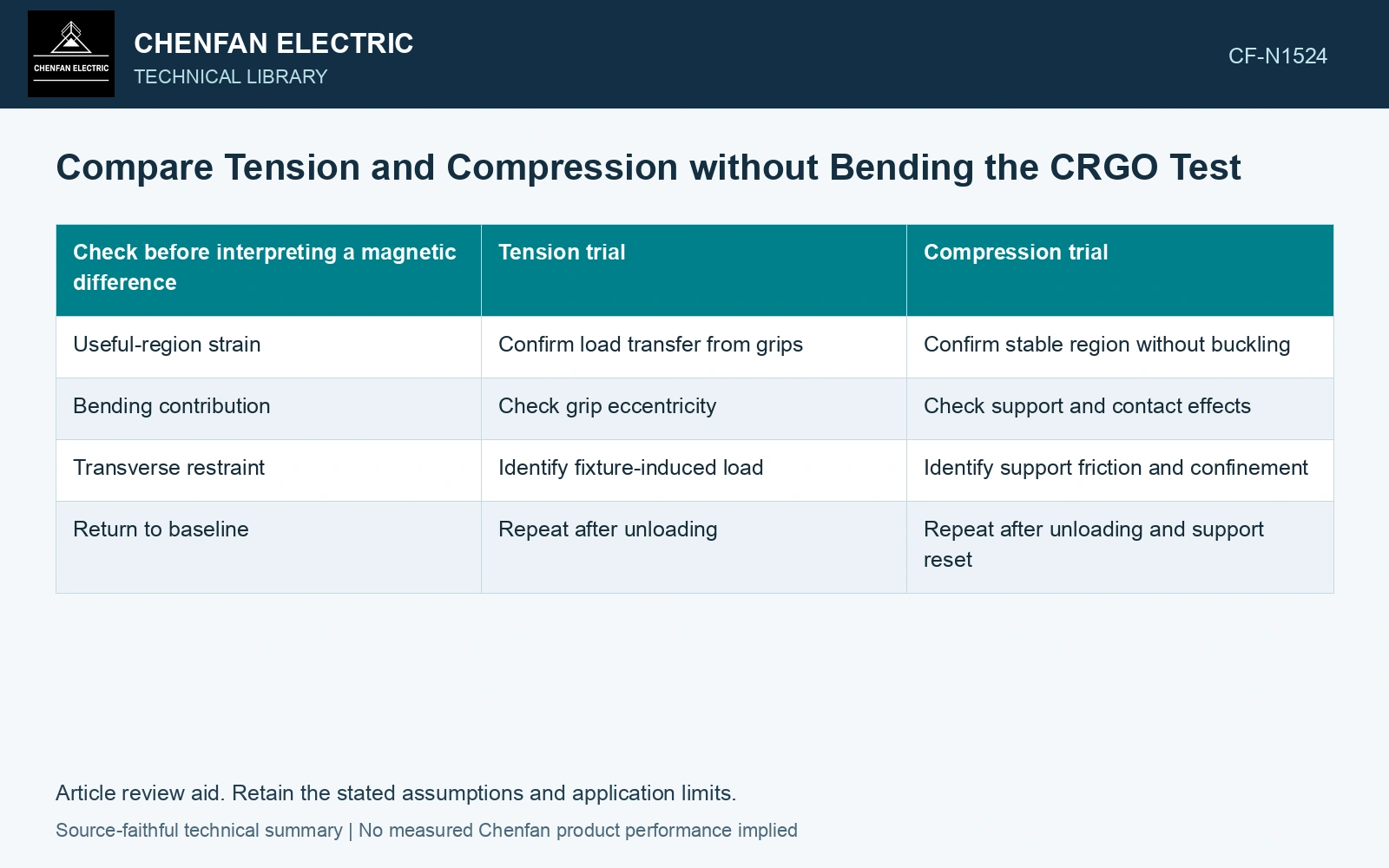
| Check before interpreting a magnetic difference | Tension trial | Compression trial |
|---|---|---|
| Useful-region strain | Confirm load transfer from grips | Confirm stable region without buckling |
| Bending contribution | Check grip eccentricity | Check support and contact effects |
| Transverse restraint | Identify fixture-induced load | Identify support friction and confinement |
| Return to baseline | Repeat after unloading | Repeat after unloading and support reset |
The final row helps distinguish an in-load effect from a residual change caused by the test history.
Hold magnetic history and excitation steady
Use the same preparation sequence, specimen temperature, waveform, frequency and selected flux-density condition. Read the actual excitation rather than assuming that identical commanded settings produce identical waveforms under changed mechanical loading.
Measure loss and excitation current separately. A stress condition can affect their relationship; an improvement in one quantity does not establish a favorable response in the other. If magnetostriction is part of the design question, retain its measurement direction and mechanical constraint as additional identified inputs.
Interpret asymmetry at the tested conditions
Compare +sigma and −sigma with their verified specimen states and the unloaded reference. Repeat the loading order or use matched specimens to assess whether one trial changes the starting state of the next. Apparent asymmetry that depends strongly on test order requires an investigation of history as well as stress sign.
Avoid the generalizations that tension is always beneficial or compression always harmful. The result belongs to the identified steel condition, direction, excitation and loading path. A material curve used in a core model should preserve those boundaries.
If the magnetic asymmetry remains after fixture contributions are controlled, the data can support different tensile and compressive model branches. If it disappears when bending is corrected, the important finding is that the earlier comparison measured a fixture effect. Either outcome is useful because it changes what evidence the design should rely on.
Technical references
- Materials / MDPI. Magnetostrictive Properties of the Grain-Oriented Silicon Steel Sheet under DC-Biased and Multisinusoidal Magnetizations.
- NIST. NCAL: Diffraction Stress Measurement Under Applied Load.