

A bonding process and an annealing process can each look acceptable in isolation while being incompatible in sequence. The adhesive may face a later thermal exposure it was never intended to survive. Alternatively, an earlier annealing step may change the coating or surface that the bonding qualification assumed.
Write the full sequence before choosing either process. Include steel condition on receipt, cutting, any heat treatment, cleaning, bonding, conditioning and later active-part processing. The relevant exposure is the specimen’s actual temperature and atmosphere through the entire route.
Begin with the material’s intended route
CRGO products differ in coating systems and domain-refinement treatments. The permitted treatment route must follow identified supplier information rather than an assumption that all grain-oriented steel benefits from the same heat treatment. Bonding adds a further material system with its own thermal and chemical behavior.
The question is not whether an adhesive is broadly heat-resistant. It is whether the identified joint retains its required function after the proposed duration, atmosphere, mechanical restraint and subsequent conditioning. A transient temperature rating does not answer that question by itself.
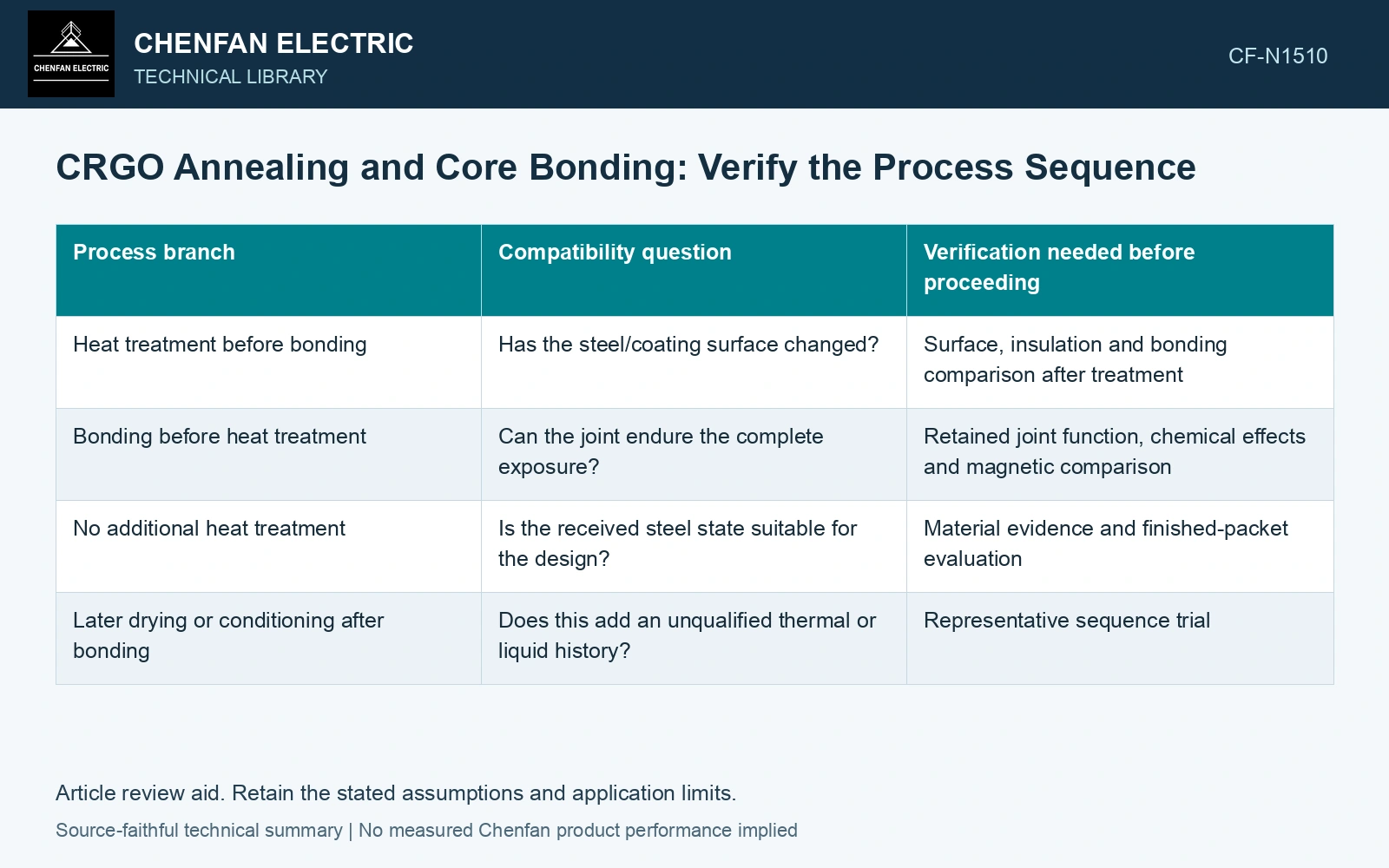
| Process branch | Compatibility question | Verification needed before proceeding |
|---|---|---|
| Heat treatment before bonding | Has the steel/coating surface changed? | Surface, insulation and bonding comparison after treatment |
| Bonding before heat treatment | Can the joint endure the complete exposure? | Retained joint function, chemical effects and magnetic comparison |
| No additional heat treatment | Is the received steel state suitable for the design? | Material evidence and finished-packet evaluation |
| Later drying or conditioning after bonding | Does this add an unqualified thermal or liquid history? | Representative sequence trial |
If an essential branch has no supporting evidence, mark it unresolved. Choosing the branch with the lowest nominal temperature does not resolve atmosphere or dwell-time effects.
Test the sequence, not two unrelated coupons
Use specimens that pass through the proposed order of operations. Compare them with controls chosen to isolate the changed step. A specimen bonded onto untreated steel and a separately annealed unbonded strip cannot reveal the performance of adhesive on the treated surface.
Record actual temperatures at representative locations, especially where stack size introduces thermal lag. Inspect coating condition and failure location after the cycle. Examine whether the adhesive has moved, cracked, released material or changed the packet geometry. Where liquid exposure follows, carry the qualified sequence into that comparison.
Keep magnetic recovery separate from joint survival
The heat treatment may alter magnetic response while weakening the joint, or preserve the joint while failing to provide the intended magnetic outcome. Measure both. Equivalent excitation, temperature and mechanical restraint are needed to attribute a magnetic difference to the process sequence.
If joint survival requires a route that conflicts with the steel supplier’s permitted treatment, the combination needs redesign or additional supplier-supported qualification. It may be necessary to change sequence, adhesive system, material condition or the decision to bond. The process map makes that incompatibility visible early, before a completed packet turns an unverified assumption into an expensive manufacturing constraint.
Technical references
- voestalpine. Backlack: Lamination bonding.
- voestalpine. Backlack: Testing methods and production of test specimens.