

An adhesive supplier may report a high lap-shear strength while a packet edge still opens during handling. The two observations are compatible. Sliding an overlap and peeling a flexible lamination impose different stress distributions and different demands on the joint.
The test name should follow the failure mode under investigation. First locate where the packet experiences relative in-plane movement, opening, or a combination of the two. Then ask whether the specimen reproduces that movement without another component dominating the result.
Read the units before comparing the numbers
Nominal lap-shear stress divides applied force by overlap area. With force in newtons and area in square millimetres, the result is in megapascals. This average does not mean shear stress is uniform across the overlap. End effects, bending and specimen support can affect initiation.
Peel resistance commonly reports force per width, such as newtons per millimetre. Part of the measured response can involve bending or deformation of the peeled sheet. It cannot be compared numerically with megapascals or converted into packet shear capacity by multiplying by an unrelated bond area.
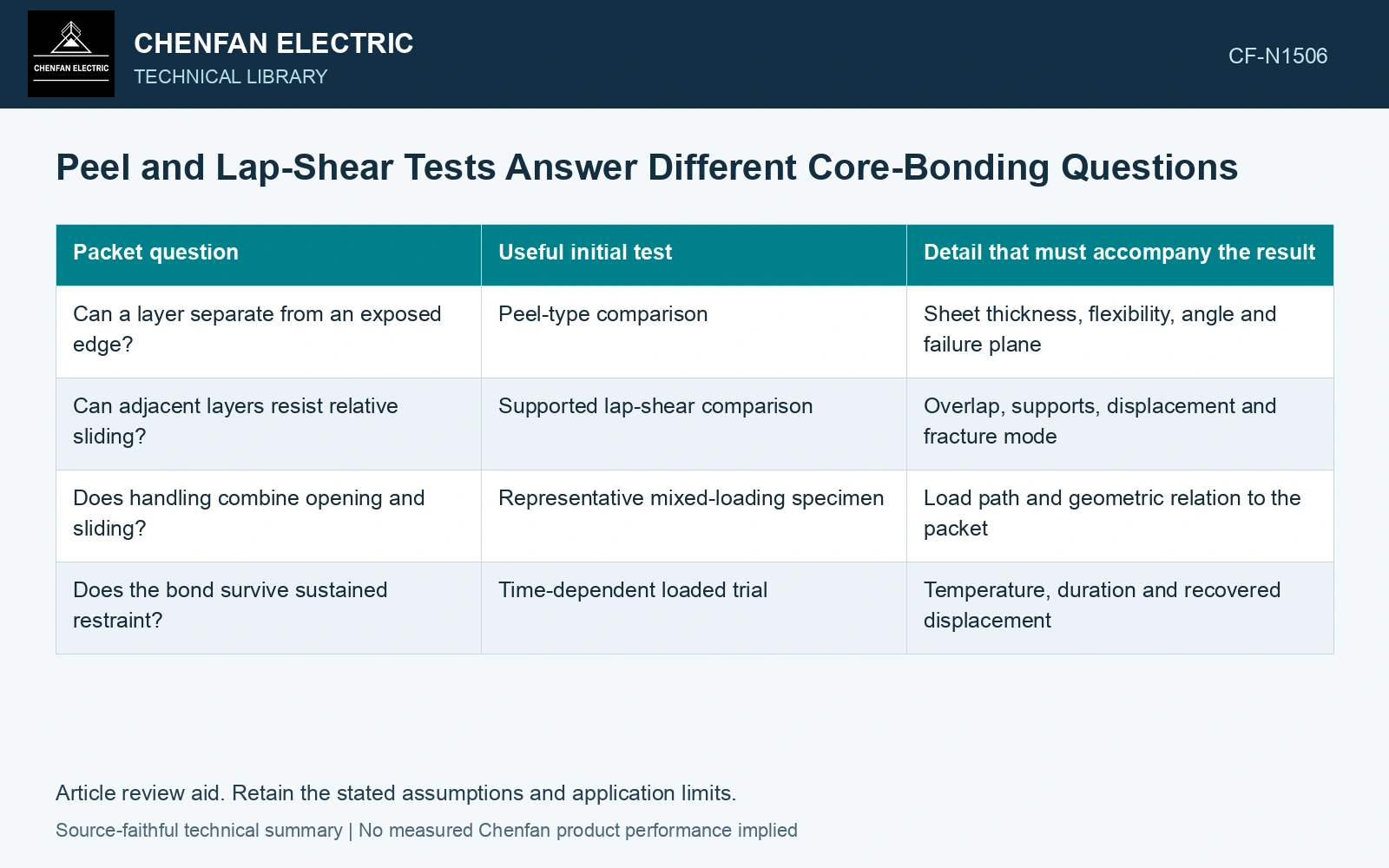
| Packet question | Useful initial test | Detail that must accompany the result |
|---|---|---|
| Can a layer separate from an exposed edge? | Peel-type comparison | Sheet thickness, flexibility, angle and failure plane |
| Can adjacent layers resist relative sliding? | Supported lap-shear comparison | Overlap, supports, displacement and fracture mode |
| Does handling combine opening and sliding? | Representative mixed-loading specimen | Load path and geometric relation to the packet |
| Does the bond survive sustained restraint? | Time-dependent loaded trial | Temperature, duration and recovered displacement |
These are starting points, not a replacement for a qualified test method. A specimen chosen for convenience may provide a repeatable number that is poorly connected to the core’s actual demand.
Check which component gave way
Record the complete load-displacement trace and inspect the separated faces. If the steel yields or tears before the joint fails, the maximum force may be a specimen limit. If the original coating separates, the adhesive strength is not the limiting property of the tested construction.
Manufacturer descriptions of self-bonding electrical steel illustrate how specimen preparation, rolling direction and support arrangements are specified to improve repeatability. Those controls matter even when an engineer only wants a relative comparison between two proposed formulations. Use equivalent material orientation and preparation so that the comparison does not silently include a different substrate response.
Build the comparison around the weakest relevant mode
Test the same material combination in the modes that the intended assembly creates. Keep results separate rather than averaging unlike strength values. A layout can resist sliding effectively and remain vulnerable to edge opening, particularly where the load path ends or changes direction.
Use the coupon to compare a defined load mode and failure plane, then qualify the full packet under its actual assembly and service conditions. Neither a peel value nor a lap-shear strength establishes the load capacity of a finished transformer core.
Technical references
- voestalpine. Backlack: Lamination bonding.
- voestalpine. Backlack: Testing methods and production of test specimens.