

Short answer
Technical nontechnical losses at a transformer are separated by an energy balance. Energy measured into the transformer’s service area, minus energy billed to its customers, equals technical losses plus everything else: meter errors, unmetered loads, billing period mismatches and unauthorised use. In an illustrative month, a transformer meter records 50,000 kWh and customer meters 46,500 kWh. Transformer no-load loss of about 0.8 kW over 720 hours gives about 576 kWh, load loss about 400 kWh, and low-voltage line and service losses about 900 kWh. That leaves about 1,624 kWh, 3.2 %, unexplained, with meter uncertainty of several hundred kWh around it. Before subtraction, reading periods must be aligned and meter accuracy considered. The remaining difference is unexplained energy, not proof of theft, and should be reported with its uncertainty.
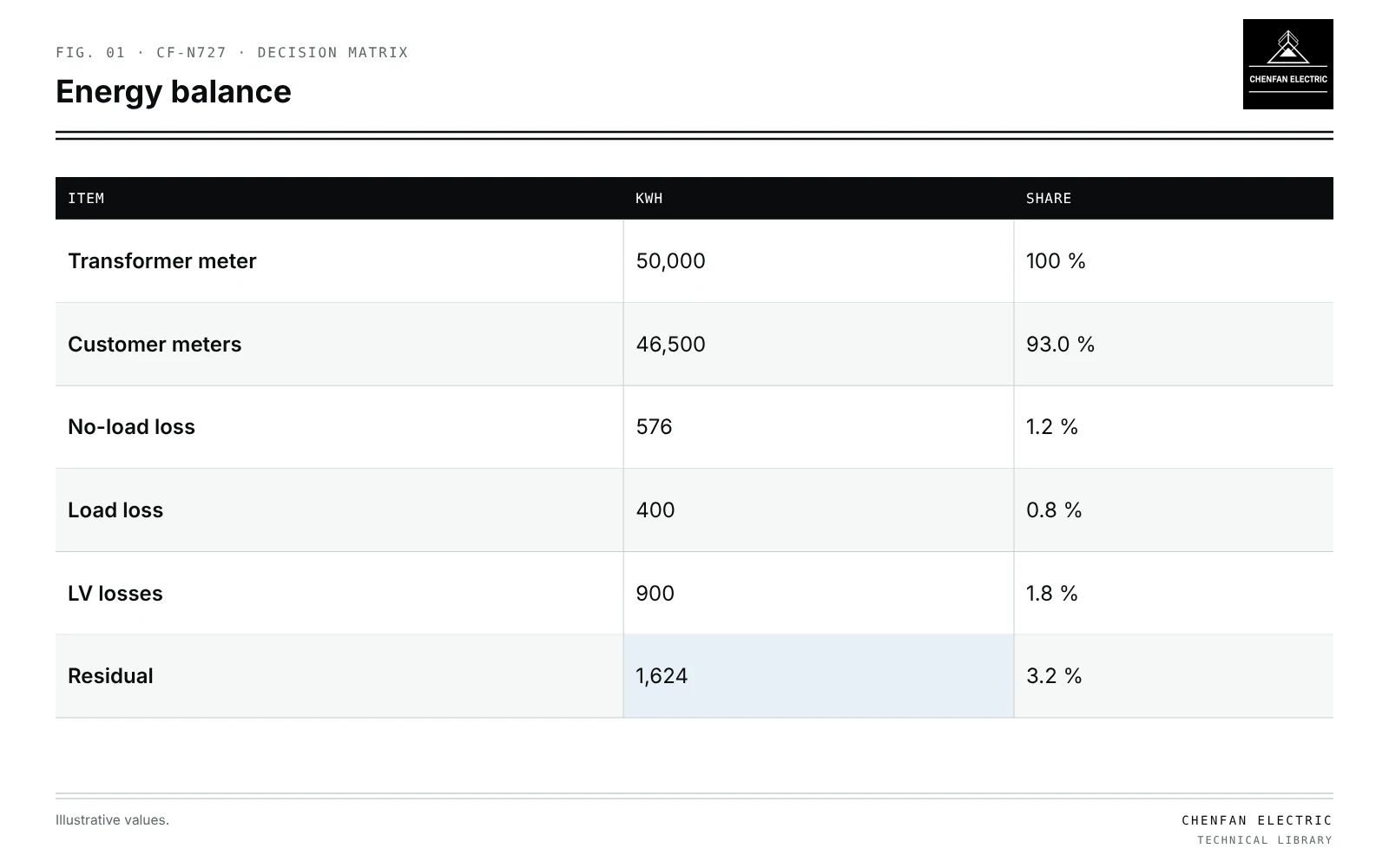
The energy balance
| Item | kWh | Share |
|---|---|---|
| Transformer meter | 50,000 | 100 % |
| Customer meters | 46,500 | 93.0 % |
| No-load loss | 576 | 1.2 % |
| Load loss | 400 | 0.8 % |
| LV losses | 900 | 1.8 % |
| Residual | 1,624 | 3.2 % |
Ein − Ebilled = Etechnical + Eresidual
Technical losses include transformer no-load and load losses, conductor and service losses, and meter losses where significant.
Illustrative month
Illustrative example. Transformer meter 50,000 kWh in 720 h; customer meters 46,500 kWh; transformer no-load loss 0.8 kW; load loss estimated from load profile 400 kWh; LV conductor losses from load flow 900 kWh. Values chosen for demonstration.
no-load = 0.8 × 720 = 576 kWh
residual = 50,000 − 46,500 − 576 − 400 − 900 = 1,624 kWh (3.2 %)
Uncertainty
| Source | Effect |
|---|---|
| Transformer meter accuracy (e.g. 0.5 %) | ± 250 kWh |
| Customer meter accuracy (aggregate) | ± a few hundred kWh |
| Reading period mismatch | Days of consumption shifted |
| Load loss estimate | Depends on load profile resolution |
The residual should be stated as a range, for example 1,624 ± 500 kWh.
Aligning periods
- Same start and end times for transformer and customer meters; interval data make this possible.
- Estimated reads flagged.
- Meter replacements within the period handled.
- Customers linked to the right transformer; see calibrating transformer load allocation with AMI data.
Calculating technical losses
- No-load loss from the transformer test report, constant while energised.
- Load loss from rated load loss scaled by (load / rating)² over intervals.
- LV losses from load flow with metered loads; four-wire models where unbalance is high; see unbalanced load flow with an explicit neutral.
Lower no-load loss transformers reduce the constant part of technical losses, which dominates at low load.
Using the residual
- Investigate unlinked or unmetered loads first.
- Compare across transformers to find outliers.
- Field checks where residual is persistently high.
Feeder-level reconciliation is covered in reconciling feeder-head measurements with transformer-level estimates.
What this article does not cover
It does not identify the residual as theft; that requires separate evidence and procedures.
Where this reasoning stops. Loss values are illustrative; use test reports and measured profiles.
Practical takeaway
Align metering periods, calculate transformer and LV technical losses from test data and load flow, report the residual with its uncertainty, and investigate mapping and unmetered loads before drawing conclusions.
Reference framework
- IEC 60076-1, Power transformers: general (loss measurement).