


Transformer Core Engineering Notes · CF-N285
Oil containment design needs a coordinated equipment and site data package. Transformer liquid volume is important, but the required containment arrangement can also depend on rainfall, firefighting provisions, shared equipment, drainage and local requirements. The transformer supplier should provide reliable inputs while the qualified civil and fire designers determine the applicable design.
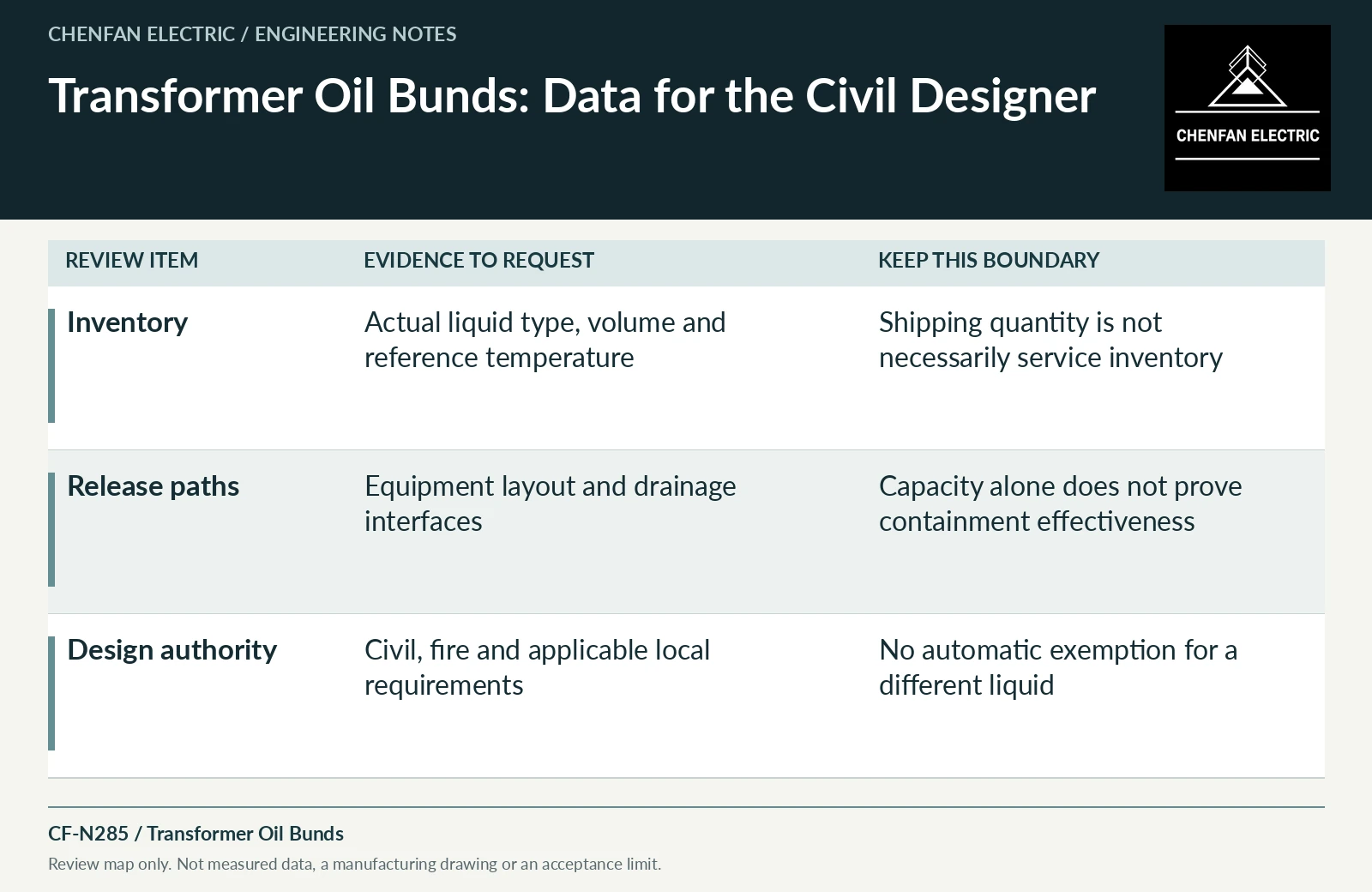
Provide the actual liquid inventory
Identify the liquid type and volumes in the main tank, radiators, conservator, separate compartments and relevant pipework. State the temperature basis and distinguish service inventory from shipping quantity. If the supplier reports mass instead of volume, use the appropriate density for the specified liquid and reference condition. A catalogue value for a similar model should be treated as preliminary, not as the final civil design input.
Define what can reach the containment
Coordinate the locations of tanks, coolers, valves and discharge interfaces with the civil layout. A containment volume on paper is not sufficient if a credible release path bypasses it. Shared arrangements require identification of the equipment and scenarios included. The responsible designers should determine how the site’s drainage and isolation strategy interacts with potential releases, without relying on an assumed universal percentage of oil inventory.
Keep fire and environmental decisions separate
A liquid’s biodegradability or higher fire point does not automatically remove containment obligations. Product properties and local installation rules answer different questions. The applicable authority and qualified designers must assess the site requirements for the selected liquid. This article does not give a legal exemption, a universal bund ratio or a fire-separation distance, and older technical manuals should not be treated as current local law.
Reconcile revisions before construction
A change in radiator arrangement, liquid or tank design can alter the inventory and release interfaces. Establish final confirmed data and a notification process for later changes. The civil drawing should remain aligned with the OEM’s final general arrangement and liquid schedule. Include access and maintenance requirements so the containment solution does not prevent safe inspection or operation of the transformer accessories.
| Review item | Evidence to request | Boundary to preserve |
|---|---|---|
| Inventory | Actual liquid type, volume and reference temperature | Shipping quantity is not necessarily service inventory |
| Release paths | Equipment layout and drainage interfaces | Capacity alone does not prove containment effectiveness |
| Design authority | Civil, fire and applicable local requirements | No automatic exemption for a different liquid |
References and scope
- IEC 60076-1:2011 — Power transformers: GeneralPublic standard abstract · General transformer scope, interfaces and controlled equipment specification.
- Transformer Fire Protection (FIST 3-32), redacted releaseHistorical technical manual · Fire protection and installation interfaces; local authority and project requirements remain separate.
- IEEE C57.166-2026 — Acceptance and Maintenance of Insulating Liquids in Transformers and Related EquipmentPublic standard abstract · Acceptance and maintenance of insulating liquids; equipment type, liquid family and compartment must be identified.