


Transformer Core Engineering Notes · CF-N275
An oil-level indication must be interpreted using the transformer’s preservation system, liquid temperature and defined reference condition. The same pointer position can mean different things on different designs. Before deciding that a unit needs topping up or has lost liquid, check what space the instrument measures and which operating state its reference marks describe.
Identify the measured compartment
The indicator may serve a main conservator, a separate tap-changer preservation system or another arrangement. Record that identity on the drawing and instrument list. A normal level in one compartment does not establish the level in another isolated circuit. For designs with bladders, diaphragms or gas spaces, use the OEM’s interpretation rather than assuming every instrument directly shows an unrestricted free surface in the main tank.
Use temperature references correctly
Liquid volume changes with temperature, so an observed level needs its associated thermal condition. Ask which temperature and equipment state the filling mark or reference scale assumes. Compare trends under comparable conditions instead of treating every movement as leakage. A product-specific temperature reference is not a universal scale that can be copied onto a different tank or used after a liquid substitution without review.
Check indication before changing liquid quantity
A stuck mechanism, damaged linkage, altered instrument orientation or an incorrectly identified circuit can mislead an observer. Qualified personnel should investigate the complete indication chain under the approved procedure. Do not add liquid merely to move a pointer to a familiar position. An unnecessary addition can create a new operating problem, while a genuine low-level condition requires investigation of its cause as well as its immediate disposition.
Record trends and alarm responsibilities
The handover package should define local indications, alarm contacts and the responsible response. Record observed level with date, temperature and operating context so later comparisons are meaningful. Following maintenance or a liquid change, verify the approved reference conditions and instrument configuration. A level alarm is an operational signal to be assessed through the site’s procedure, not a stand-alone diagnosis of tank integrity or insulation condition.
| Review item | Evidence to request | Boundary to preserve |
|---|---|---|
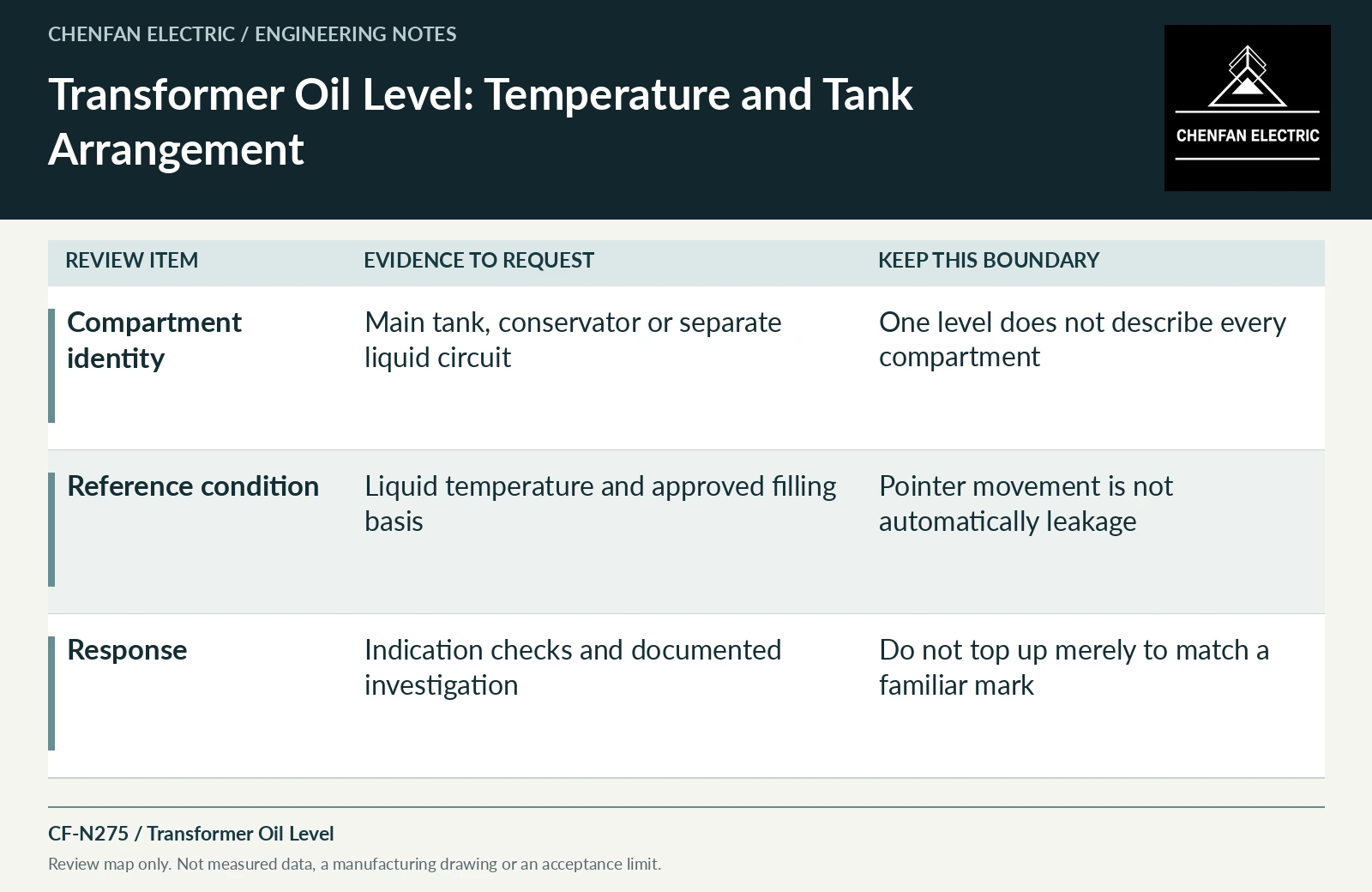
| Compartment identity | Main tank, conservator or separate liquid circuit | One level does not describe every compartment |
| Reference condition | Liquid temperature and approved filling basis | Pointer movement is not automatically leakage |
| Response | Indication checks and documented investigation | Do not top up merely to match a familiar mark |
References and scope
- IEC 60076-1:2011 — Power transformers: GeneralPublic standard abstract · General transformer scope, interfaces and controlled equipment specification.
- IEEE C57.166-2026 — Acceptance and Maintenance of Insulating Liquids in Transformers and Related EquipmentPublic standard abstract · Acceptance and maintenance of insulating liquids; equipment type, liquid family and compartment must be identified.