

Transformer Core Engineering Notes · CF-N269
A visible line or crack on a cast-resin winding deserves documented assessment, but appearance alone does not establish its depth, cause or electrical significance. Neither immediate dismissal as cosmetic nor an unsupported declaration of imminent failure is appropriate. Preserve the observation and have the OEM define the qualified inspection and diagnostic response.
Record the observation without altering it
Document the unit identity, location, orientation and visible extent using an appropriate scale and dated photographs. Note when the feature was first observed and whether transport, thermal cycling or another event preceded it. Do not probe, grind, coat or fill the area as an improvised investigation. Altering the surface can obscure evidence or introduce additional damage before the manufacturer has assessed the condition.
Separate possible causes from confirmed causes
Manufacturing features, mechanical damage and thermal stresses can require different investigations. A photograph may support a description but rarely resolves the entire mechanism. Ask the OEM to compare the observation with the design, material and production history. Avoid assigning blame or a root cause solely from the shape of a line. The assessment should state which explanations remain possible and what evidence would distinguish them.
Choose diagnostics for the actual concern
Qualified specialists should determine whether electrical, mechanical or other examination is needed and under what safe conditions. A satisfactory result from one test does not automatically exclude every form of internal damage. Equally, a visible surface feature does not establish partial discharge without appropriate evidence. Keep the purpose and limitations of each selected test explicit, and avoid an arbitrary retest voltage chosen without reference to the equipment’s condition and approved procedure.
Document disposition and follow-up
The final disposition may involve acceptance with a justified basis, further investigation, an approved repair or replacement. Record who authorized the decision and any monitoring conditions. Repair materials and methods must be compatible with the qualified insulation system and supported by the OEM. A cosmetic cover applied without that assessment is not evidence that the underlying issue has been resolved.
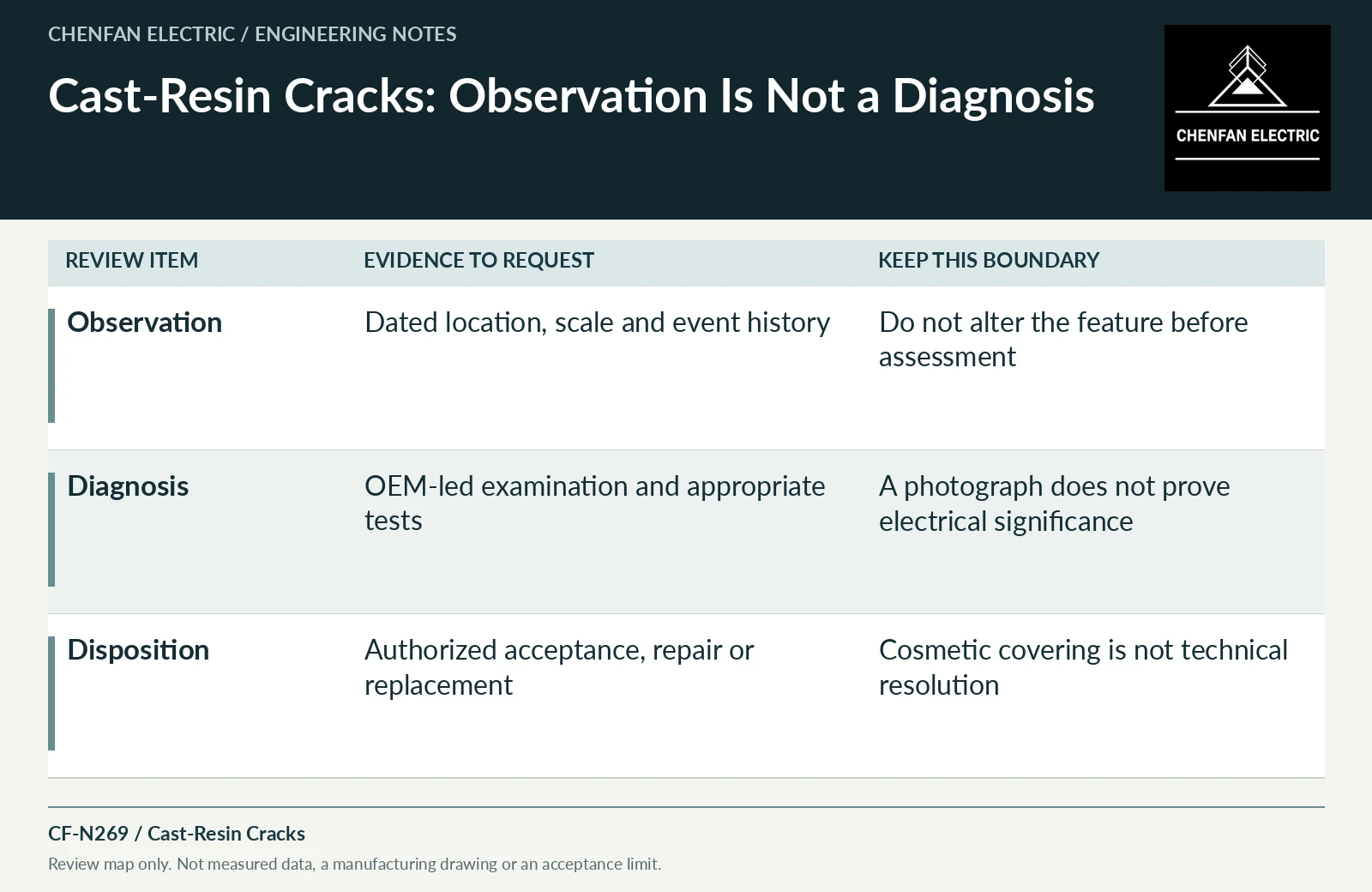
| Review item | Evidence to request | Boundary to preserve |
|---|---|---|
| Observation | Dated location, scale and event history | Do not alter the feature before assessment |
| Diagnosis | OEM-led examination and appropriate tests | A photograph does not prove electrical significance |
| Disposition | Authorized acceptance, repair or replacement | Cosmetic covering is not technical resolution |
References and scope
- IEC 60076-11:2018 — Dry-type transformersPublic standard abstract · Dry-type requirements and classification within the standard’s voltage/product scope; not a blanket reference for every LV product.
- IEC 60270:2025 — Charge-based measurement of partial dischargesPublic standard abstract · Charge-based PD measurement, calibration and interference framework; acceptance criteria remain equipment- and contract-specific.