


Transformer Core Engineering Notes · CF-N271
A transformer bushing must satisfy an electrical duty and fit a mechanical, thermal and environmental interface. Matching rated voltage alone is not enough. The purchase specification should connect current capability, insulation requirements, terminal forces and mounting details to the complete transformer design and the conductors that will be connected at site.
Define the electrical service
Specify the required insulation coordination, current duty, frequency and applicable service environment. Review the bushing’s actual current path and connection arrangement rather than assuming every construction with the same voltage designation is interchangeable. The transformer OEM should coordinate its dielectric test requirements with the selected bushing. A component rating does not automatically establish the complete transformer’s insulation performance at the internal and external interfaces.
Provide a controlled mounting drawing
Record flange dimensions, bolt pattern, mounting inclination, internal projection and terminal position. Include gasket interfaces and the relevant liquid-side arrangement. A bushing that fits the bolt holes may still conflict with internal leads or required clearances. Use the supplier’s approved drawing revision and check the complete dimensional chain before ordering a replacement or accepting an alternative product.
Coordinate terminal forces and movement
The connected conductor system can apply weight, thermal movement, short-circuit forces and installation misalignment to the terminal. Obtain the allowable forces and moments for the actual bushing arrangement and communicate them to the bus or cable designer. An external support close to the transformer can change the load path. Do not treat a bushing terminal as an unrestricted structural support for adjacent equipment.
Plan identification, access and replacement
Include identification, inspection access and any monitoring or test interfaces specified by the OEM. Access to a test feature does not authorize an improvised live test; qualified procedures remain essential. Check the removal envelope and replacement mass against the site plan. A technically suitable bushing can still create an avoidable outage problem if its installation prevents safe inspection or replacement without major unplanned dismantling.
| Review item | Evidence to request | Boundary to preserve |
|---|---|---|
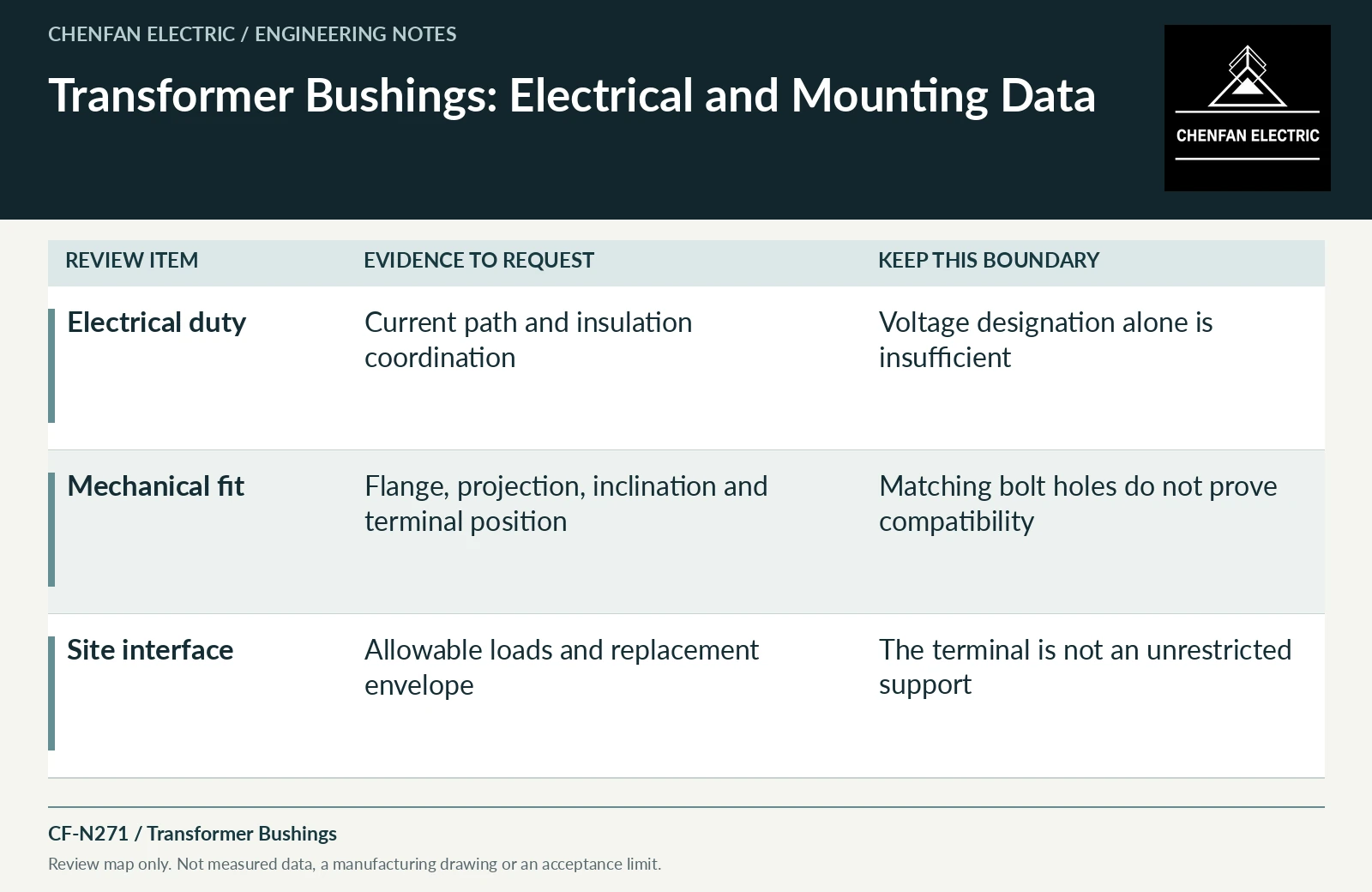
| Electrical duty | Current path and insulation coordination | Voltage designation alone is insufficient |
| Mechanical fit | Flange, projection, inclination and terminal position | Matching bolt holes do not prove compatibility |
| Site interface | Allowable loads and replacement envelope | The terminal is not an unrestricted support |
References and scope
- Bushing Maintenance (FIST 3-2)Historical technical manual · Bushing components, connection and maintenance interfaces.
- IEC 60076-3:2013+AMD1:2018 CSV — Insulation levels and dielectric testsPublic standard abstract · Insulation levels, dielectric testing and external clearances; the article does not reproduce test values or design distances.
- IEC 60076-1:2011 — Power transformers: GeneralPublic standard abstract · General transformer scope, interfaces and controlled equipment specification.