


Transformer Core Engineering Notes · CF-N256
A monthly average ambient temperature can describe a climate, but it cannot reproduce the sequence of hot afternoons, cool nights and transformer loading. The right temperature record depends on the decision being made. Separate contractual service conditions, dynamic loading inputs and local cooling-air measurements rather than substituting one convenient weather statistic for all three.
Match the statistic to the calculation
A steady design assessment may use a specified ambient basis, whereas a transient study needs a time sequence aligned with the load. A monthly mean hides extremes and their duration. It can also hide whether the highest loads coincide with the hottest hours. State the averaging interval and intended use of each weather value. Avoid mixing hourly loads with a monthly ambient series without explaining the resulting approximation.
Check the local cooling environment
A regional weather station may not represent air entering a transformer radiator or dry-type enclosure. Walls, roofs, adjacent equipment and recirculated exhaust can change the local condition. Identify the temperature reference needed by the equipment specification and how site measurements relate to it. A sheltered room sensor should not silently replace a cooling-inlet condition that is consistently warmer during operation.
Keep extreme events and outages visible
A loading review may need a heatwave sequence rather than an isolated annual maximum. A cold-start review concerns the liquid and equipment state after a defined outage and exposure history, not just the lowest instantaneous air reading. These scenarios should be separately specified. Do not assume that one “worst temperature” captures every thermal, dielectric and accessory constraint at the site.
Document gaps, time zones and representativeness
Keep timestamps, units, source location and the method used to fill missing records. Check that load and weather clocks are aligned, including any time-zone or daylight-saving conversion. Identify the period represented by historical data and the basis for any future design allowance. A procurement decision should be able to trace the selected ambient profile back to a source and a stated engineering assumption, rather than an unexplained copied average.
| Review item | Evidence to request | Boundary to preserve |
|---|---|---|
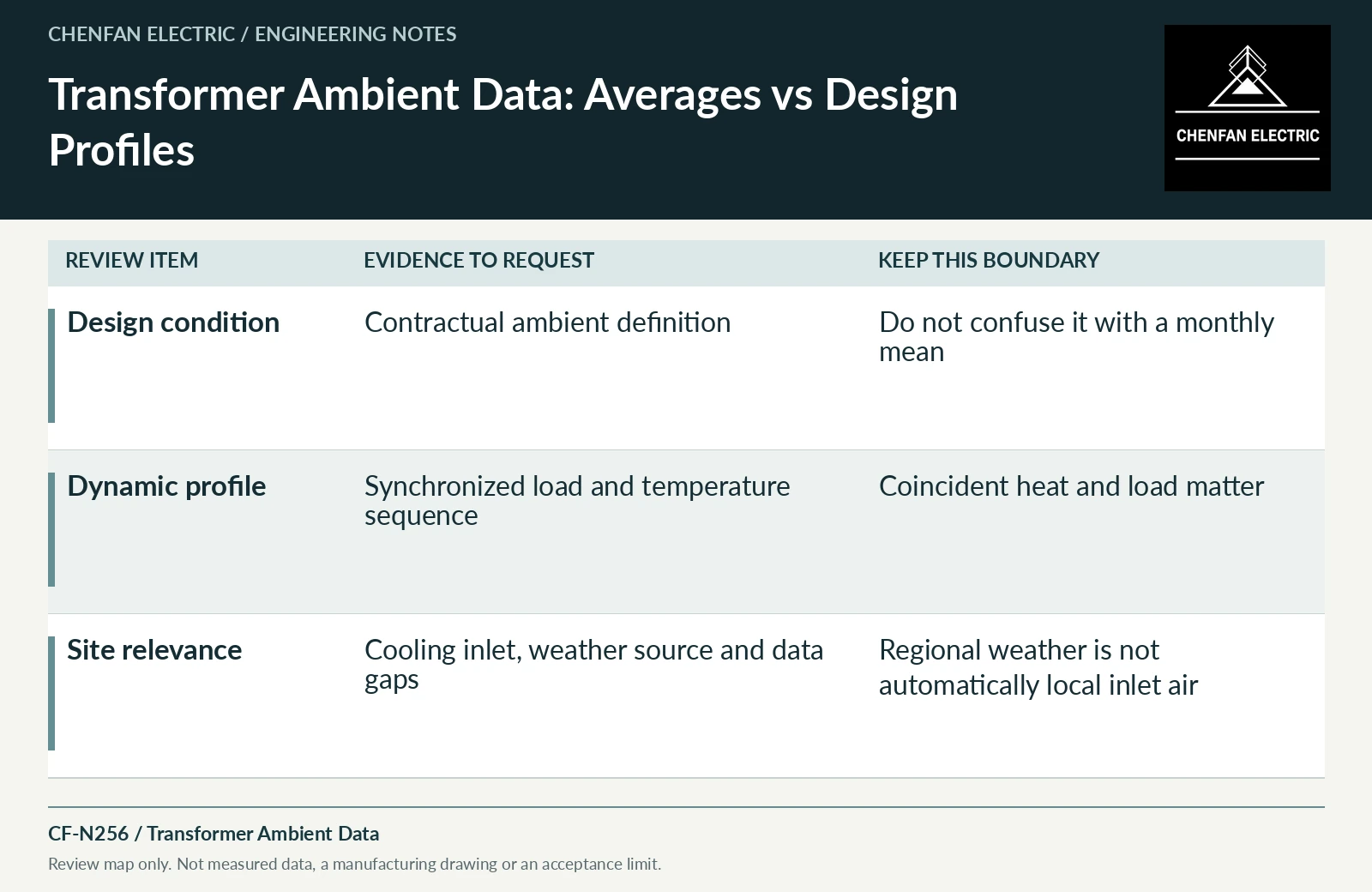
| Design condition | Contractual ambient definition | Do not confuse it with a monthly mean |
| Dynamic profile | Synchronized load and temperature sequence | Coincident heat and load matter |
| Site relevance | Cooling inlet, weather source and data gaps | Regional weather is not automatically local inlet air |
References and scope
- IEEE C57.91-2025 — Loading Mineral-Oil-Immersed Transformers and Step-Voltage RegulatorsPublic standard abstract · Mineral-oil loading, thermal duty and loading beyond nameplate; do not transfer the scope automatically to ester or dry-type equipment.
- IEC 60076-7:2018 — Loading guide for mineral-oil-immersed power transformersPublic standard abstract · Mineral-oil transformer loading and thermal-ageing framework, not a universal asset-life prediction.
- FR3 fluid behavior in cold temperature environmentsManufacturer PDF · Cold-soak, liquid behaviour and the need for an equipment-specific cold-start assessment.