


Transformer Core Engineering Notes · CF-N247
Natural cooling relies on an available path for cooler air to enter and warmer air to leave. An enclosure, wall or acoustic treatment can change that path. A transformer rating established in an open arrangement should not be assumed valid inside a restricted space without the OEM’s assessment of the actual installation.
Distinguish room temperature from inlet temperature
The air entering the transformer or radiator may be warmer than a room sensor suggests if hot discharge air recirculates. Review inlet and outlet positions, internal obstructions and nearby heat sources. A large room volume does not guarantee a useful airflow path. The thermal basis should use the conditions at the equipment’s cooling interface, while the building design must provide a way to remove the heat released into the space.
Evaluate openings as installed
Louvres, screens, filters and weather protection reduce or redirect the free path through an opening. Their geometric area alone does not define the available cooling performance. Include the final enclosure configuration and the intended maintenance condition. A design that works with doors open may not meet its closed-door duty. Do not use an arbitrary percentage derating for every enclosure; the effect depends on the equipment and airflow arrangement.
Coordinate electrical and thermal clearances
The required space can serve several functions: insulation clearance, air circulation, access and removal. Meeting one dimension does not prove the others are satisfied. The OEM installation drawing should distinguish these requirements. If a wall moves closer or a bus duct occupies an air path, review both the electrical and thermal consequences. A compact outline drawing should not hide the additional space needed for the transformer to operate at its declared rating.
Accept the complete installed arrangement
Request the approved rating for the intended enclosure and ambient conditions, with the applicable calculation or test evidence. Identify restrictions on filters, panels or acoustic additions introduced later. For dry-type transformers, enclosure performance is explicitly part of the IEC 60076-11 scope discussion. For liquid-filled equipment, evaluate the radiator and room arrangement on its own basis. Do not transfer a result between these equipment types without review.
| Review item | Evidence to request | Boundary to preserve |
|---|---|---|
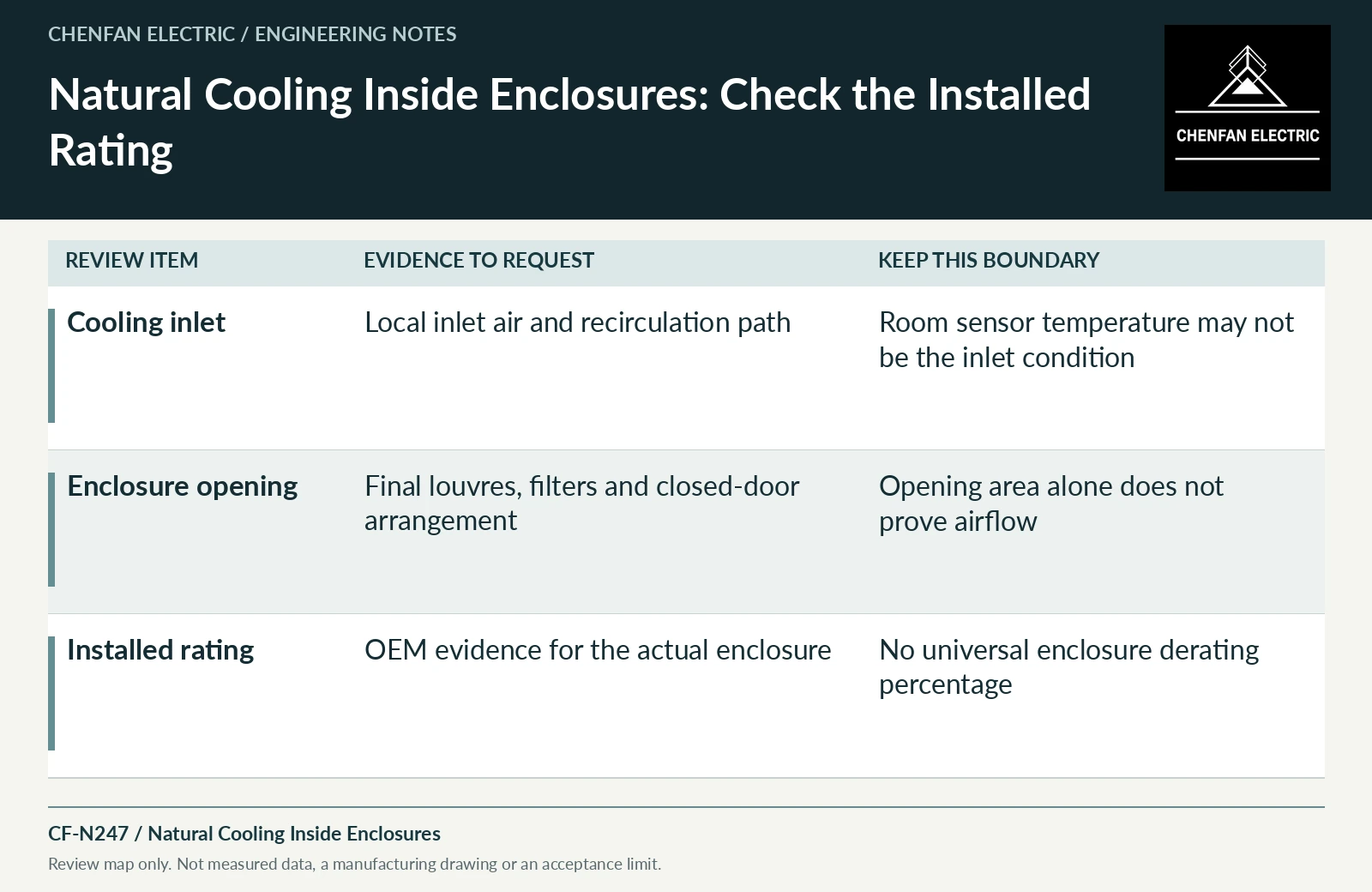
| Cooling inlet | Local inlet air and recirculation path | Room sensor temperature may not be the inlet condition |
| Enclosure opening | Final louvres, filters and closed-door arrangement | Opening area alone does not prove airflow |
| Installed rating | OEM evidence for the actual enclosure | No universal enclosure derating percentage |
References and scope
- IEC 60076-11:2018 — Dry-type transformersPublic standard abstract · Dry-type requirements and classification within the standard’s voltage/product scope; not a blanket reference for every LV product.
- IEC 60076-2:2011 — Temperature rise for liquid-immersed transformersPublic standard abstract · Temperature-rise requirements, cooling identification and the distinction between test conditions and installed duty.
- Dry-Type Transformers 1000 Volts and Below — Instruction Bulletin 43006-850-01Manual listing / metadata only · Example of why handling and installation instructions must match the actual product and voltage range.