


Transformer Core Engineering Notes · CF-N222
Natural ester and synthetic ester are different fluid families, not interchangeable versions of the same product. Compare the specific formulations and their qualified applications. Low-temperature behaviour, exposure to air, material compatibility and supply requirements may be as important as fire point when selecting a liquid for a particular transformer and location.
Start with the project environment
State minimum storage and starting temperatures, normal operating conditions and the preservation system. IEC 62770:2024 limits natural-ester applications to sealed or otherwise appropriately air-protected equipment; a freely breathing mineral-oil arrangement cannot simply be carried over. Synthetic ester must be assessed for the particular product and OEM-approved configuration. A favourable pour point does not, by itself, verify circulation or loading at a cold start.
Do not compare unmatched datasheet values
Use the corresponding liquid specification: IEC 61099:2010 addresses unused synthetic organic esters, whereas IEC 62770:2024 addresses unused natural esters. These are fluid-specification references, not complete-transformer approvals. Compare named grades at matching temperatures and by matching test methods, and separate typical data from agreed acceptance limits. When a property is particularly important to the site, request the relevant supporting report or certificate rather than relying on a colour-coded marketing comparison. One FR3 product datasheet cannot establish the performance of every synthetic ester or every natural ester.
Check the liquid-solid system
The fluid choice can change the assumptions used for impregnation, thermal performance and moisture interpretation. Review the paper, pressboard, coatings and seals as an identified material combination. A claim of extended insulation life needs to state the tested materials and ageing conditions. Likewise, an elevated temperature rating must cover the complete insulation system and other limiting components. The fluid name alone cannot justify hotter operation of an unchanged transformer.
Include service logistics in the decision
Consider approved top-up fluid, local sampling capability, laboratory interpretation and the supply chain for the selected grade. Do not assume emergency mixing is harmless because both liquids are esters. The maintenance plan should identify who approves a substitute and what evidence is needed. A technically attractive choice can be difficult to support if the site cannot obtain the correct fluid or interpret its condition data on the appropriate basis.
| Review item | Evidence to request | Boundary to preserve |
|---|---|---|
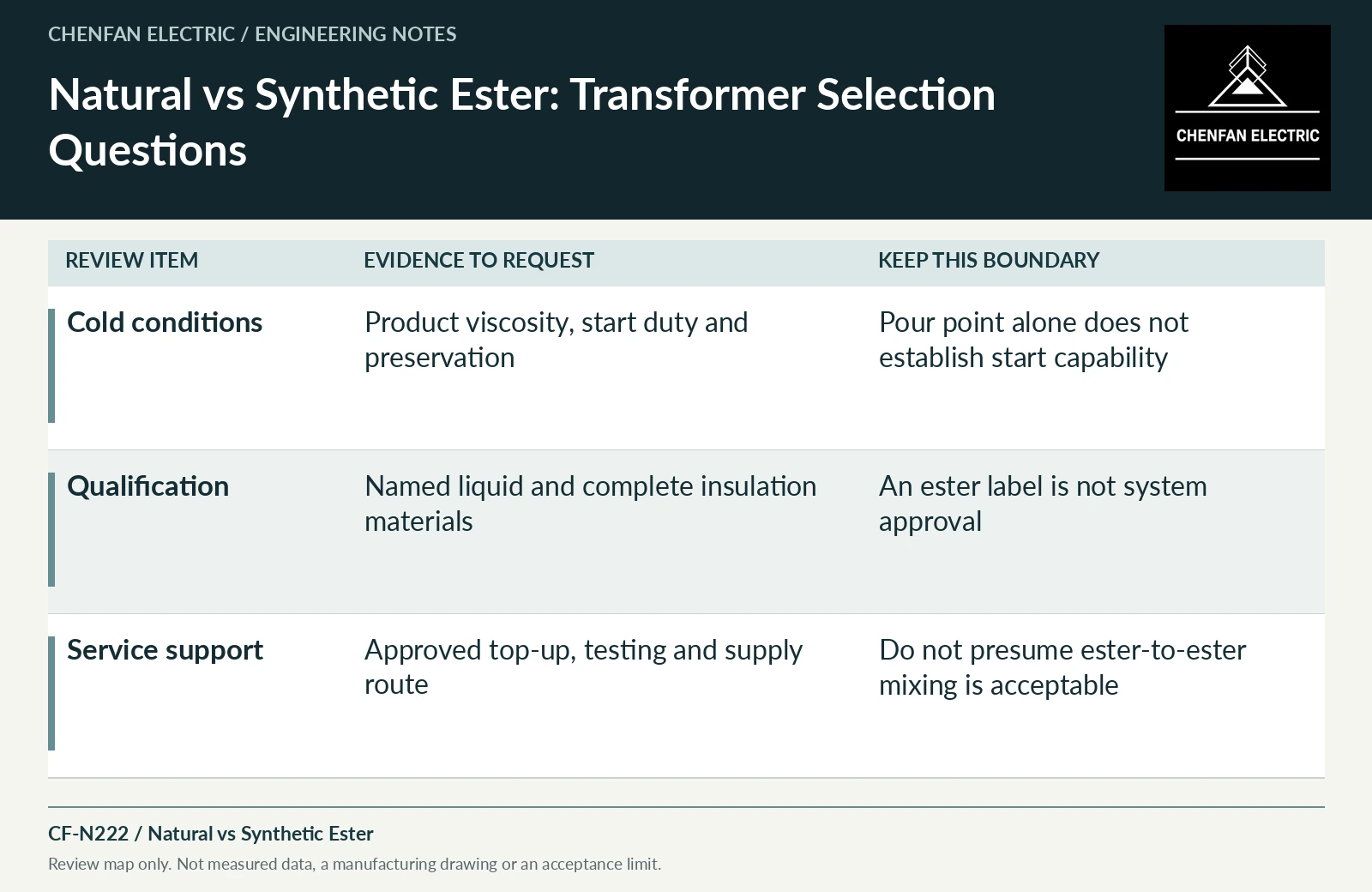
| Cold conditions | Product viscosity, start duty and preservation | Pour point alone does not establish start capability |
| Qualification | Named liquid and complete insulation materials | An ester label is not system approval |
| Service support | Approved top-up, testing and supply route | Do not presume ester-to-ester mixing is acceptable |
References and scope
- IEC 61099:2010 — Unused synthetic organic estersPublic standard abstract · Specification and test-method scope for unused synthetic organic esters; not complete-equipment qualification.
- IEC 62770:2024 — Unused natural estersPublic standard abstract · Unused natural-ester specification; application is restricted to sealed or suitably air-protected systems.
- IEEE C57.100-2022 — Thermal Evaluation of Insulation Systems for Liquid-Immersed TransformersPublic standard abstract · Thermal evaluation of insulation systems for liquid-immersed transformers; not a dry-type qualification reference.
- IEEE C57.166-2026 — Acceptance and Maintenance of Insulating Liquids in Transformers and Related EquipmentPublic standard abstract · Acceptance and maintenance of insulating liquids; equipment type, liquid family and compartment must be identified.