


Transformer Core Engineering Notes · CF-N224
Water concentration and relative saturation describe different aspects of moisture in an insulating liquid. A result in mg/kg states how much water is present per mass of liquid. Relative saturation compares that amount with the liquid’s water capacity at the relevant conditions. The same concentration can therefore mean different things at different temperatures or in different fluids.
Record temperature with the sample
The interpretation needs the fluid identity, sample location, sampling conditions and temperature. Cooling can reduce the amount of water that a liquid can hold in solution. A concentration that appears unremarkable when warm may therefore deserve different attention at a colder condition. Avoid comparing samples from different seasons as though concentration alone captures the change in insulation condition. Use an appropriate liquid-specific relationship and the diagnostic method agreed for the asset.
An illustrative calculation, not a limit
If a hypothetical liquid at a stated temperature has a saturation concentration of 100 mg/kg and the measured concentration is 20 mg/kg, the simplified relative saturation is 20%. If its saturation concentration at a colder temperature were 40 mg/kg, the same 20 mg/kg would correspond to 50%. These invented values demonstrate the ratio only. They are not mineral-oil or ester property data and must not be used as acceptance thresholds.
Do not turn an oil result into paper moisture automatically
Water is distributed between the liquid and solid insulation, and that distribution changes with temperature and time. A sample taken during a transient may not represent equilibrium. Estimating paper moisture from liquid data therefore needs a suitable model and operating history, not just a conversion chart used without conditions. IEEE C57.162 addresses moisture-related parameters; its public scope is not a source of universal paper-moisture acceptance values for every transformer.
Make trends comparable before taking action
Use consistent sampling points and laboratory methods, record temperature and recent loading, and identify any fluid treatment or top-up. A sudden change may reflect sampling contamination or operating conditions as well as a genuine moisture issue. The asset specialist should interpret the full evidence and decide on follow-up testing. A single number without context should not be used to prescribe drying, declare the paper dry or guarantee continued service.
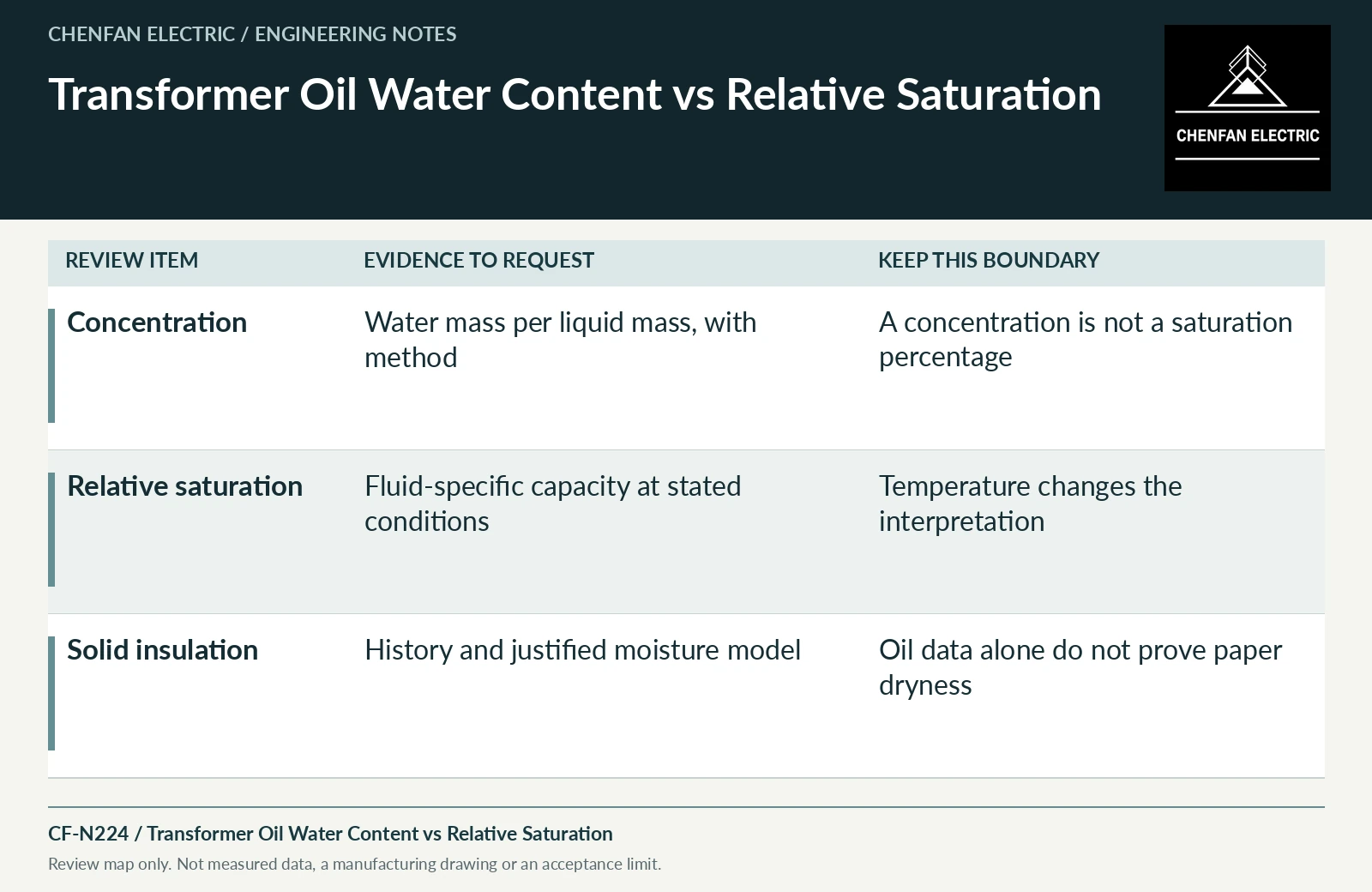
| Review item | Evidence to request | Boundary to preserve |
|---|---|---|
| Concentration | Water mass per liquid mass, with method | A concentration is not a saturation percentage |
| Relative saturation | Fluid-specific capacity at stated conditions | Temperature changes the interpretation |
| Solid insulation | History and justified moisture model | Oil data alone do not prove paper dryness |
References and scope
- IEEE C57.162-2025 — Interpretation of Moisture Related Parameters in Liquid Immersed Transformers and ReactorsPublic standard abstract · Moisture-related interpretation for liquid-immersed transformers; this is not a DGA guide.
- IEEE C57.166-2026 — Acceptance and Maintenance of Insulating Liquids in Transformers and Related EquipmentPublic standard abstract · Acceptance and maintenance of insulating liquids; equipment type, liquid family and compartment must be identified.