

A transformer on a floating power plant needs an in-service motion and connection review separate from its transport requirements. The floating structure can impose repeated movement while the transformer is energized, and electrical or cooling connections may cross boundaries with different motion. A transport qualification or marine label alone does not establish suitability for that installed duty.
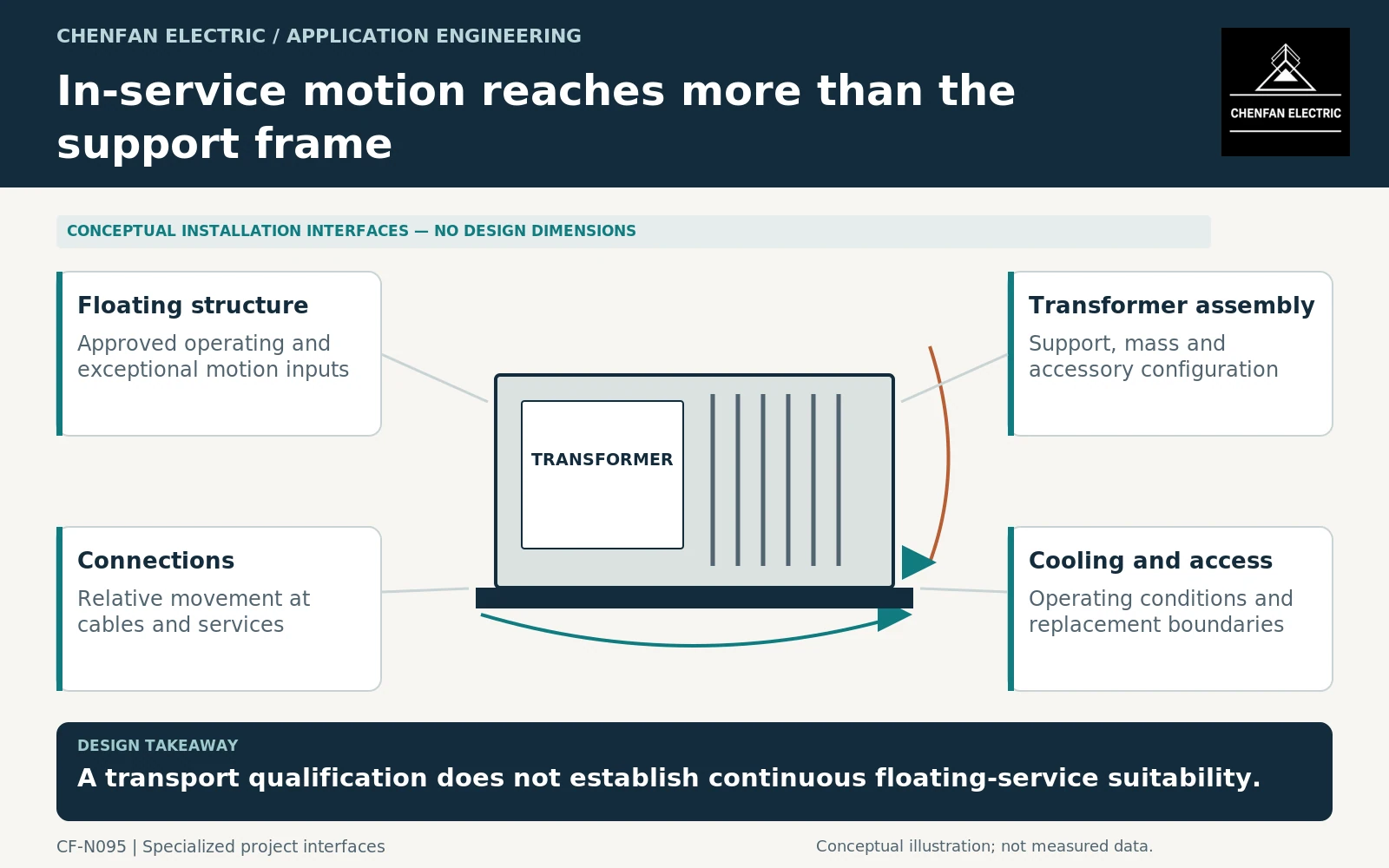
Obtain motion inputs from the structure designer
The platform or vessel designer should provide the relevant operating and exceptional motion conditions, support interfaces and load assumptions. State the transformer’s location and the configuration of attached accessories.
Do not infer the motion environment from the word floating. A sheltered barge, an exposed installation and equipment mounted in different structural locations can require different assessments.
Shipboard transformer requirements may be relevant where the installation falls within their scope, but applicability must follow the actual project classification and equipment role. [1] General transformer requirements likewise need the unusual service conditions explicitly stated. [2]
This article does not prescribe structural loads, restraints or mooring design. Those are project engineering inputs that the transformer assessment must use.
Review relative movement at every service connection
Cables, cooling lines, control wiring and grounding-related interfaces can connect structures or assemblies with different movement. The design must identify the required displacement and equipment-interface loads rather than assuming that a flexible-looking connection is adequate.
The transformer’s internal construction and external accessories also need assessment for the specified orientation and motion conditions. Evidence from a different mounting arrangement should not be transferred without confirming applicability.
A useful interface register identifies both ends of each connection, their support ownership, expected relative movement and the evidence required for acceptance. It is not a fabrication drawing or a field installation procedure.
Keep service motion separate from movement during towing, transport or lifting. Those states may use different configurations and impose different load histories.
Coordinate cooling with the floating operating state
The cooling assessment should state the supplied medium and inlet conditions under the relevant operating configurations. Pumps, exchangers and external utility circuits must use compatible assumptions.
IEC 60076-22-4 addresses insulating-liquid-to-water heat exchangers, and IEC 60076-22-5 addresses defined insulating-liquid pumps, for liquid-immersed power transformers and reactors. These component references do not qualify the complete floating cooling installation. [3] [4]
Loss of circulation, unavailable cooling equipment and suspected leakage should have explicit design ownership and an approved response. Do not treat a component’s nominal capacity as a guarantee that the entire platform provides the required transformer cooling boundary.
Preserve access and configuration evidence
The procurement package should include the motion schedule, support arrangement, service-connection register, cooling boundaries and removal configuration. Record the masses and dimensions relevant to replacement, not only initial installation.
Acceptance should compare the delivered assembly and connections with the configuration represented by the assessment. Changes to accessory positions, support details or connection routes may require review even when the transformer rating remains unchanged.
The useful claim is that a specific transformer assembly and its interfaces are supported for the defined floating-service conditions. It should not be expanded into a general statement that any land-based transformer becomes suitable for continuous marine motion once placed inside a container or given a corrosion-resistant coating.
Core procurement checkpoint: Name the core and support configuration on a floating plant
Motion-related requirements should reach procurement as an approved interface between the core, supplied clamps and the surrounding transformer structure. A steel certificate does not qualify flexible connections, supports or a floating power installation. State which parts are included and what records are required, with complete mechanical, cooling and marine acceptance assigned to the appropriate equipment and platform teams.
For the core enquiry: Core/clamp interface drawings; supplied-part schedule; mass/envelope requirements; preservation plan; qualification configuration and approval owner.