

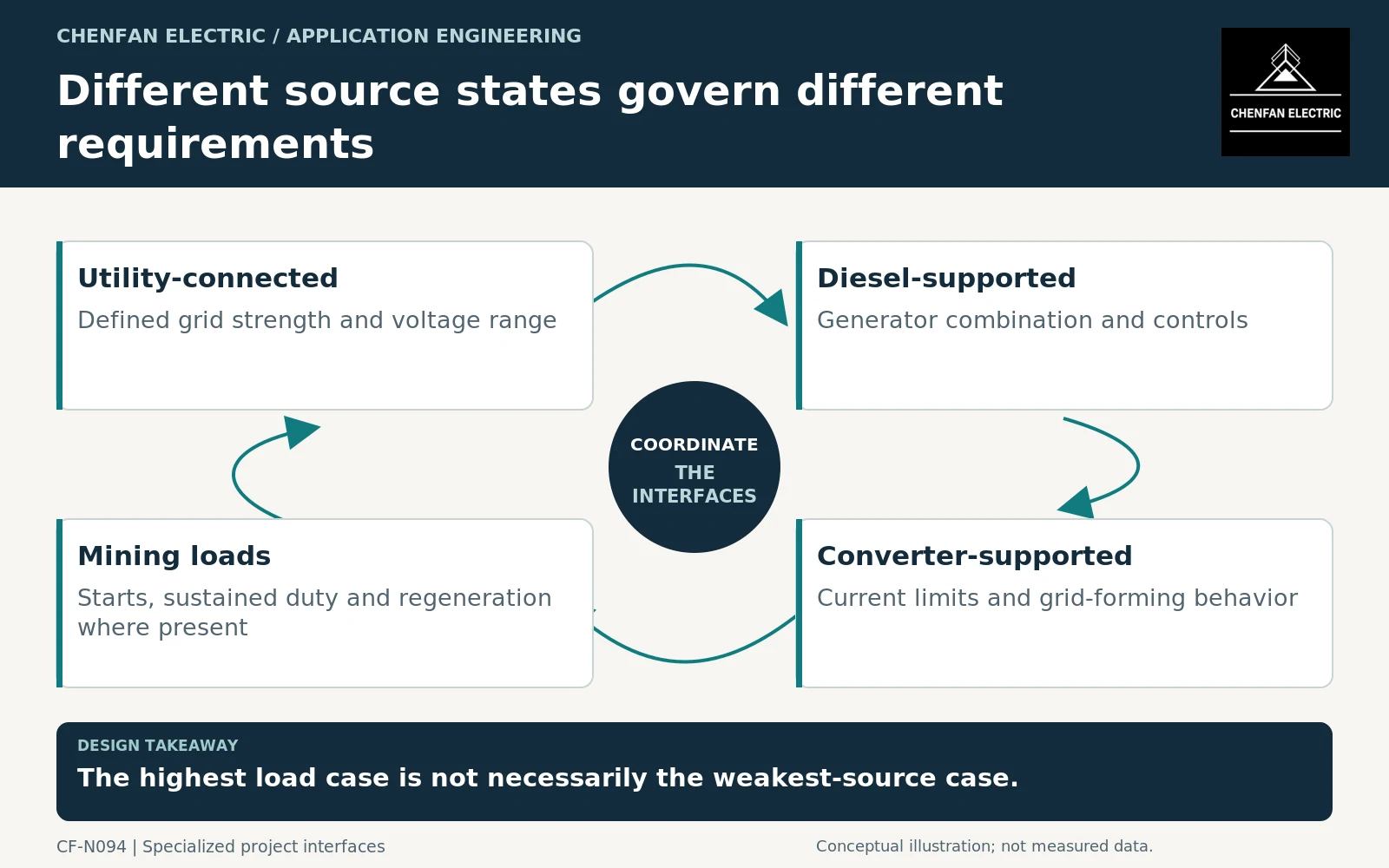
A mining microgrid transformer should be assessed against each permitted source configuration, not only the site’s maximum demand. Utility, diesel and converter-supported states can have different source strength, current limits and control behavior. One state may govern motor-start voltage response, another fault coordination and another sustained transformer heating.
Define source states before selecting bounding cases
List the permitted combinations of utility connection, generators, solar and storage. Identify which source establishes voltage and frequency in islanded operation and which combinations are prohibited.
Grid-forming research treats converter controls, protection and system interactions as coordinated questions. It does not establish that a converter-supported microgrid behaves like a conventional strong source under every disturbance. [1]
The source model should include relevant control and current-limit behavior. A single fixed short-circuit value may not represent every converter operating state or time interval needed by the study.
Match each engineering question to its governing state
Motor starts can be sensitive to the available source and starting method. Sustained process operation determines a different thermal sequence. Protection requires the actual fault contributions and grounding arrangement in each mode.
General transformer application guidance addresses connections, voltage behavior and ratings. The microgrid case register supplies the actual conditions to which those principles are applied. [2]
| Assessment | Source-state information required |
|---|---|
| Motor acceleration | Source voltage response and starting-device model |
| Transformer heating | Chronological current and cooling conditions |
| Energization | Excitation model and source-control behavior |
| Fault coordination | Relevant contributions, grounding and time behavior |
| Source transition | Approved connection and control sequence |
Do not assume that the maximum-load state is also the minimum-source-strength state. A smaller operating load on a restricted generator or converter configuration may govern a voltage or control question.
Include process and restoration constraints
Mining loads can include large motors, drives, ventilation and other services whose availability requirements differ. The process design should identify which loads can be deferred or shed and which must remain supported in a limited-source state.
Motor-starting analysis tools explicitly represent starting devices and dynamic behavior. Their use requires the actual motor, process and source inputs; software availability is not evidence of a completed study. [3] [4]
Transformer energization and black-start capability should be treated separately from supporting an established island. A source that carries normal demand may still need a coordinated energization strategy for the transformer and connected network.
Purchase a model and a bounded duty envelope
The enquiry should include source-state diagrams, converter and generator data, load-start sequences, winding duties and environmental conditions. Ask the supplier to provide parameters suitable for the agreed studies and identify their limitations.
Acceptance should separate transformer equipment conformity from integrated microgrid performance. The system integrator should own the combined source-transition and load-support claims, with explicit restrictions where evidence is incomplete.
Changing the minimum online generator count or enabling a new storage control mode can alter the electrical system without increasing peak site demand. Such changes should trigger review of transformer interfaces, protection and starting cases.
The useful specification is therefore a matrix of supported source and load states. It avoids selecting one apparently conservative MVA value and assuming that it resolves the different voltage, fault, excitation and thermal questions created by a changing microgrid.
Core procurement checkpoint: Retain the weakest-source operating assumptions
As mining-microgrid sources change, the responsible designer should confirm the transformer’s permitted voltage-frequency envelope and any energization constraints before approving the core. A drawing-based order should retain that design revision and the scope of requested excitation records. The core supplier’s inspection does not establish stable operation with every future generator, storage inverter or mine expansion.
For the core enquiry: Approved source-mode reference; core drawing; excitation-data scope; material specification; responsibility for future system change assessment.