

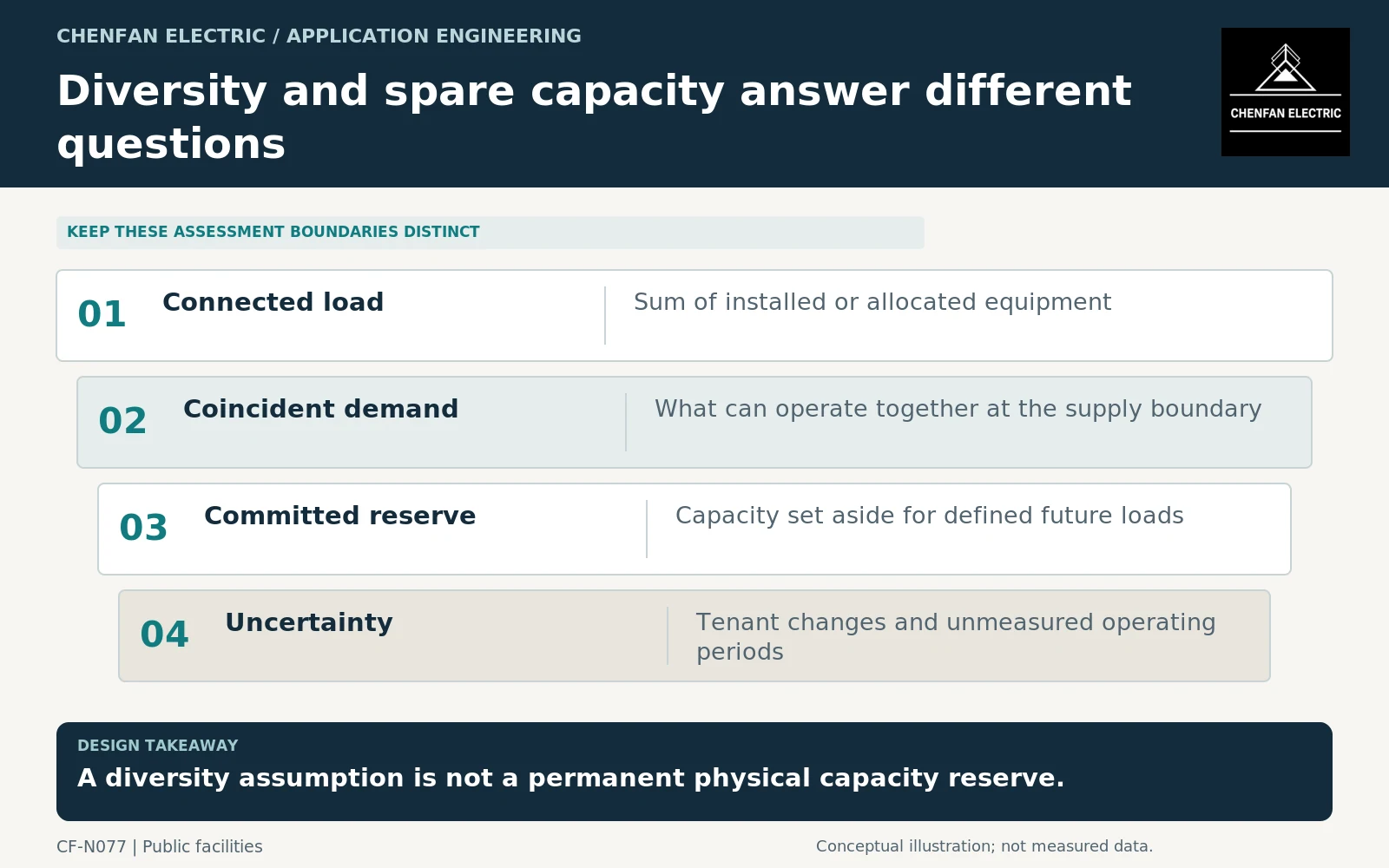
Tenant diversity and transformer spare capacity are different concepts. Diversity describes how loads coincide; spare capacity describes the remaining supported duty after present and committed future requirements are accounted for. A commercial building should not treat an optimistic diversity factor as permanent reserve for any future tenant or equipment change.
Establish the demand boundary and evidence
Separate connected load, lease allocation, measured peak demand and transformer terminal current. These quantities may differ substantially. Identify the survey period, occupancy level, seasonal conditions and any excluded loads.
A partially occupied building can have a low measured peak without demonstrating the duty at full occupancy. Likewise, a tenant’s contracted allocation is not necessarily a measured load profile. Keep contractual and electrical data in separate fields.
General transformer application guidance addresses ratings and operating conditions. It does not prescribe a universal tenant-diversity factor for every building. [1]
Test plausible occupancy changes
A new tenant may add heating, ventilation and air conditioning (HVAC), kitchen equipment, electric vehicle (EV) charging, information technology (IT) loads or process equipment with different timing and waveform. The review should consider those characteristics, not only additional kilowatts.
An illustrative building with 1.2 MVA of measured peak demand on a 2 MVA transformer does not automatically have 0.8 MVA of unrestricted reserve. The measurement may represent incomplete occupancy, and cables, switchgear, cooling or contingency requirements can impose additional limits.
A useful scenario set distinguishes present occupied demand, committed fit-outs, a credible full-occupancy case and identified exceptional events. Record which assumptions are supported by measurement and which are planning allowances.
Do not combine every lease maximum if that creates a physically impossible condition, but do not assume diversity will persist after tenants change. The basis should be reviewable rather than embedded as an unexplained percentage in a spreadsheet.
Define reserve as a controlled allocation
Reserve should identify the future load or operating flexibility it supports. State whether it is held for a known tenant, additional building services, contingency transfer or general growth. The same capacity should not be allocated to several purposes simultaneously unless their noncoincidence is justified.
Thermal assessment should use the actual transformer construction and operating sequence. Mineral-oil and dry-type loading guides provide different frameworks and should not be treated as interchangeable reserve-capacity calculators. [2] [3]
Physical interfaces matter too. A transformer may have electrical headroom while the distribution board lacks a suitable outgoing circuit or the building lacks a viable cable route. Reserve capacity is useful only when the complete path can support the addition.
Preserve the decision in the tenant-change process
The procurement or capacity-review record should contain the demand evidence, occupancy scenarios, committed allocations and remaining restrictions. Define which tenant changes require electrical review, including significant nonlinear loads or altered operating hours.
Acceptance should confirm that metering and documentation use the same supply boundary. A building-management total that excludes a major auxiliary load should not be used as though it measures the whole transformer.
The practical outcome is a transparent capacity ledger: supported present demand, committed future duty and genuinely unallocated capability. That is more defensible than announcing a percentage of spare capacity based on average occupancy or a diversity factor that no one can trace to the building’s actual operation.
Core procurement checkpoint: Make repeatability explicit before reserving spares
A commercial building’s diversity allowance is not a core manufacturing specification. For an approved transformer design, record the exact core drawing and material revision so that future orders can be checked for compatibility. Where future tenant loads remain uncertain, mark the associated core variant as provisional rather than presenting an existing lamination set as guaranteed capacity for a later building expansion.
For the core enquiry: Released/provisional core schedule; drawing and material revisions; spare quantity; substitution approval rules; inspection and identification requirements.