

Flood-prone transformer installations should be planned around the site’s design water conditions and the elevation of all essential interfaces. Raising the transformer body may leave cable entries, control cabinets, cooling equipment or auxiliary supplies exposed. An enclosure ingress rating is not a substitute for a flood-risk and installation design, and it does not guarantee continued operation after an unspecified inundation.
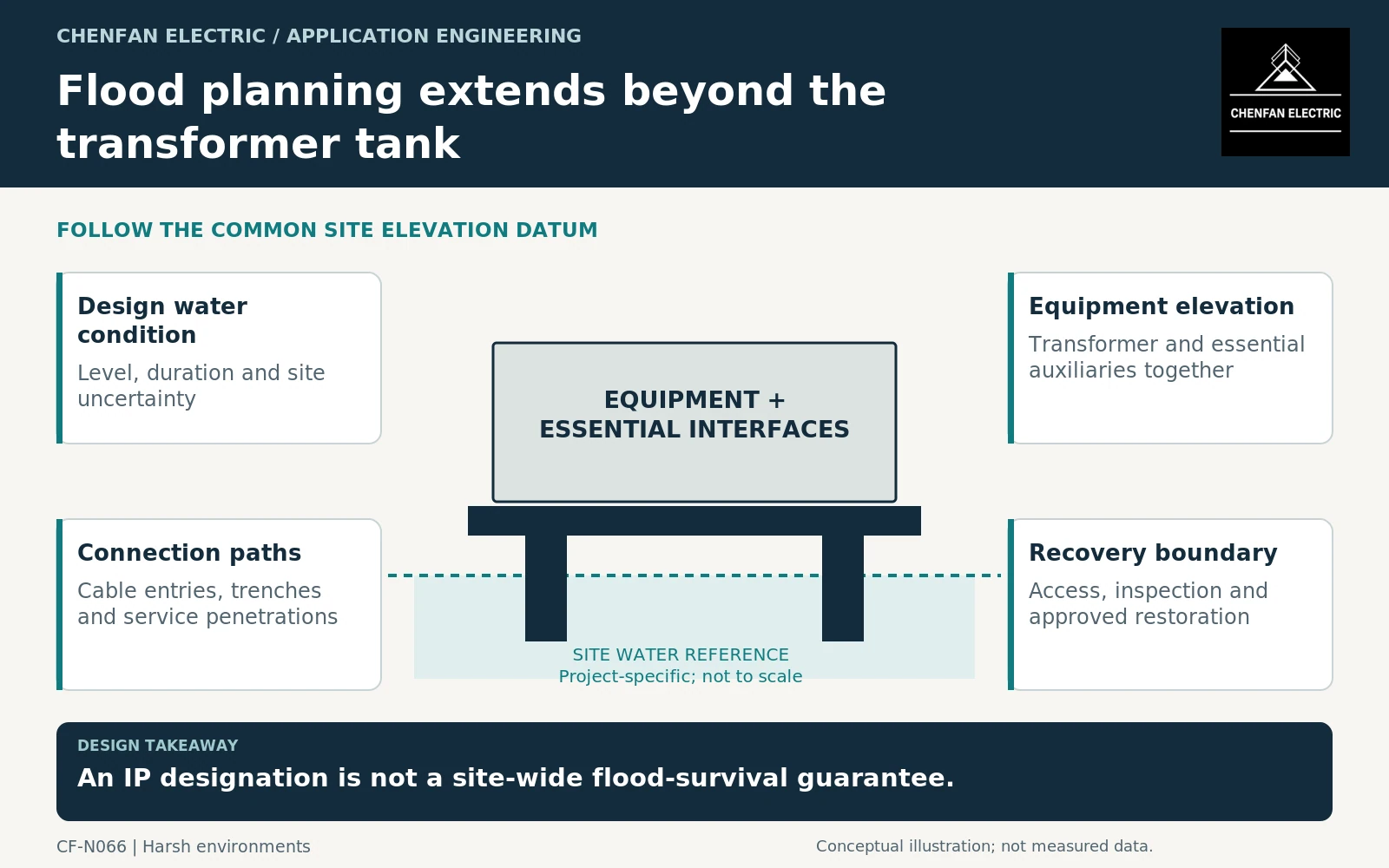
Establish the site water boundary first
The civil and environmental design should identify the relevant water level, duration, drainage conditions and uncertainty for the project. Include the possibility that access routes and adjacent equipment are affected even when the transformer itself remains above water.
This article does not prescribe a statutory flood level or a universal elevation margin. Those values depend on the site’s approved design basis and applicable requirements.
General transformer requirements address equipment service conditions, while IEC 60529 addresses enclosure ingress classifications. Neither establishes a complete substation flood-survival claim from a product label alone. [1] [2]
Record the design reference level clearly so equipment, building and cable drawings use the same datum. Conflicting elevation references can defeat an otherwise sensible arrangement.
Follow water-sensitive interfaces beyond the main assembly
Review cable trenches and entries, low-mounted controls, cooling auxiliaries, monitoring devices and independent power supplies. Water can affect the installation through paths that do not involve the main transformer tank.
The layout should identify which components must remain functional during the defined event and which are allowed to become unavailable. A raised transformer with submerged control power may not provide the intended service continuity.
A useful interface register groups items by elevation, exposure and operational consequence. For each item, state the responsible discipline and the evidence required to close the design. Keep drainage, structural supports, electrical insulation and equipment preservation as distinct responsibilities that must be coordinated.
Do not interpret a coating or sealing feature as proof of indefinite submersion suitability. The tested component, water conditions, duration and operational state would need to match the claim. A generic IP designation should not be stretched beyond its actual classification scope.
Define loss-of-service and restoration boundaries
The operating philosophy should state what happens when the design water condition is approached or exceeded, which information remains available and how the site is assessed before restoration. Protective and emergency actions require the approved project procedure; this article does not provide switching or post-flood energization instructions.
The cited communication and protective-accessory standards address accessories of liquid-immersed power transformers and reactors, within their own equipment scopes. They do not establish that flooded sensors, cables or auxiliaries remain reliable. [3] [4]
After an exposure event, the condition of the complete installation may require assessment even when the exterior appears intact. Avoid a procurement claim that “the transformer can simply be restarted after flooding” without equipment-specific evidence and an approved restoration process.
The handover should include the common elevation datum, flood-interface register, access assumptions and restoration responsibility map. Any later relocation of controls or cable entries should be checked against that record.
The practical objective is to prevent one overlooked low-level interface from defeating the intended resilience of the whole installation. Flood planning is a site-system task supported by equipment data, not an extra adjective added to the transformer quotation.
Core procurement checkpoint: Keep flood resilience outside a bare-core certificate
Flood elevation, sealing, cable interfaces and restart procedures belong to the complete installation. For core procurement, state the storage and delivery protections required before assembly and identify who controls receiving conditions. Neither a CRGO certificate nor a bare-core inspection report establishes that a finished transformer, its accessories or its control wiring remains safe after water exposure.
For the core enquiry: Approved core drawing; shipping and storage protection; receiving inspection; supplied component boundary; flood-system acceptance responsibility.