

Data-center expansion can be supported by installing transformer capacity early or by reserving a complete future installation path. These strategies create different costs, losses, outage risks and flexibility. The decision should follow a phased demand plan and a credible construction interface, not an assumption that unused nameplate capacity and empty floor space are equivalent reserves.
Define the phases and confidence levels
Separate committed near-term demand from uncertain later growth. For each phase, state facility load, redundancy requirements and the electrical topology. A future tenant or computing load may change power quality and load-step behavior as well as total demand.
General transformer application guidance provides the basis for assessing ratings, connections and operating conditions. It does not choose the commercial growth forecast. [1]
Use a scenario range rather than one precise forecast when growth is uncertain. Record which capacity decisions remain reversible and which become fixed by building or switchgear construction.
Understand what installed headroom provides
Additional installed capacity can reduce the need for later construction at a live facility, but its value depends on the rest of the electrical path. Busbars, cables, protection and cooling must support the intended future duty.
An energized lightly loaded transformer still has an excitation duty and relevant auxiliary consumption. Compare annual operation using supplier-supported loss inputs and the same phase schedule. Do not claim a universal efficiency penalty or saving without the actual designs and loading assumptions.
Oversizing can also change network characteristics that require study. More MVA is not automatically a neutral substitute for the original transformer in a fault-level or coordination model.
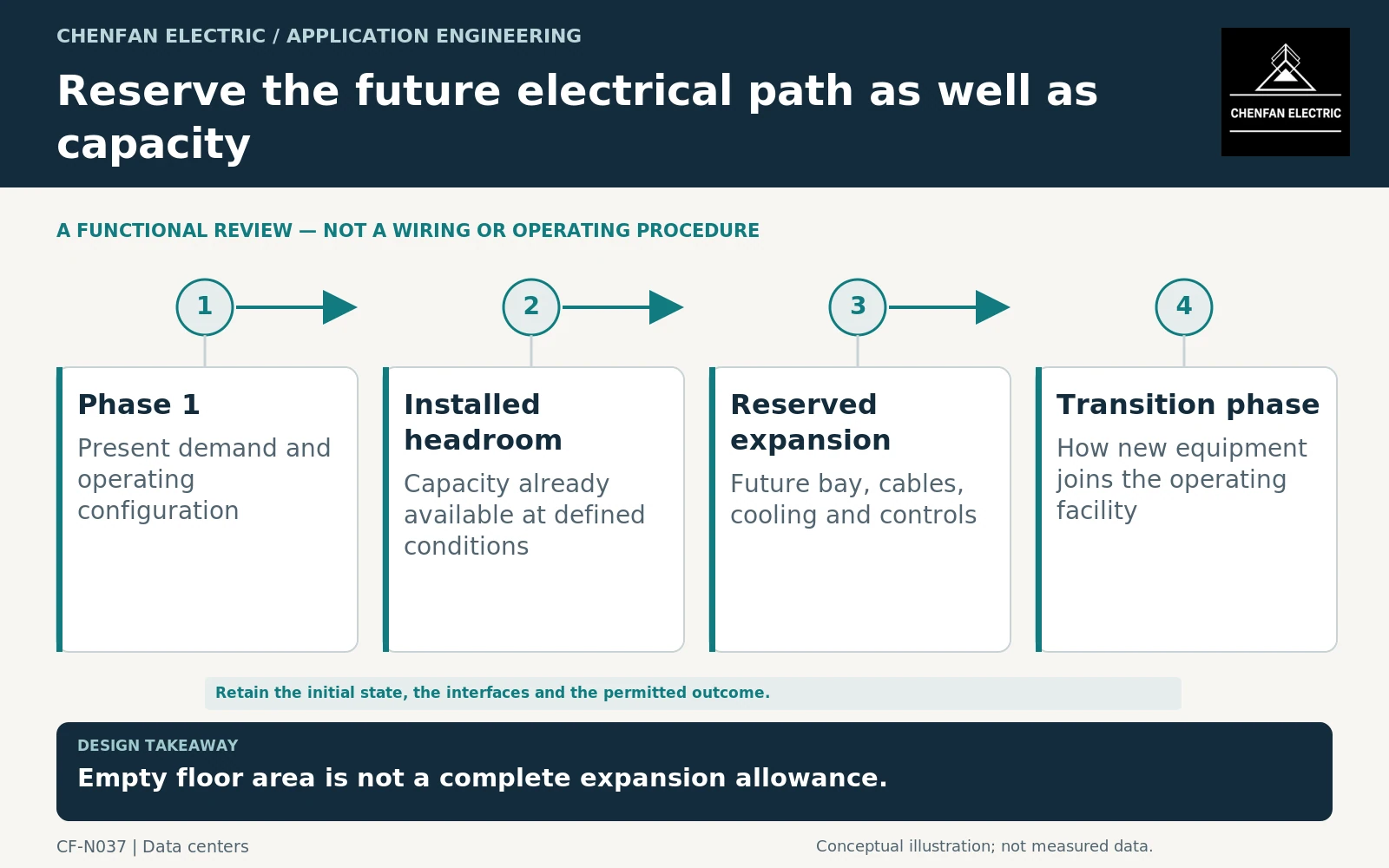
Make reserved space a complete interface package
| Reserved item | Future requirement to retain |
|---|---|
| Equipment bay | Body, service and removal envelopes |
| Electrical path | Cable route, bus interface and switchgear provision |
| Cooling | Heat-rejection capacity and local airflow or liquid interface |
| Controls | Monitoring, metering and protection integration |
| Construction access | Route that remains usable after facility completion |
A spare bay that cannot receive the transformer through the completed building is not a practical reserve. Likewise, an available floor area without a cable route or cooling allowance may create a major later modification.
Identify how the future unit will be connected while the existing facility operates. The approved construction and switching plan is a separate engineering deliverable; it should not be assumed possible merely because the single-line diagram contains a dashed future transformer.
Compare the transition, not only the end state
The expansion interval can temporarily reduce redundancy or redistribute load. Assess the duty on existing transformers during installation, testing and transfer. Loading guides support construction-specific thermal assessment, but they do not authorize an indefinite temporary overload. [2] [3]
Include the possibility that the future converter or uninterruptible power system (UPS) architecture differs from today’s selection. Reserving dimensional and electrical interfaces with sensible flexibility may be more valuable than freezing every future component prematurely.
The decision record should compare early installed capacity, fully prepared future space and a hybrid strategy using the same growth scenarios. Identify the cost boundary, energized-duty assumptions and availability consequences of each.
A sound expansion plan reserves what will actually be difficult to add later: electrical path, cooling, access and a workable transition. Nameplate headroom alone cannot replace those interfaces, and empty space alone cannot replace ready electrical capacity.
Core procurement checkpoint: Distinguish a repeatable core from an undefined future upgrade
Spare space can support future equipment, but it does not make the existing transformer’s core suitable for a higher rating. For phased purchasing, establish which core designs are released now and which remain provisional. A repeat-order record should retain the exact drawing, material and inspection revision; substitutions require design approval rather than reliance on the data-center expansion plan.
For the core enquiry: Released versus provisional variants; approved drawings; repeat-order quantities; material revision; permitted substitutions and approval owner.