

Reverse active-power flow does not, by itself, define a special photovoltaic (PV) transformer rating. The review must identify what changes when the plant imports instead of exports: voltage regulation, winding current, tap assumptions, metering and protection logic. A conventional transformer can transfer active power in either direction within its applicable operating limits, but that does not establish the suitability of a complete installation. Its actual operating states and connected equipment still need to be checked.
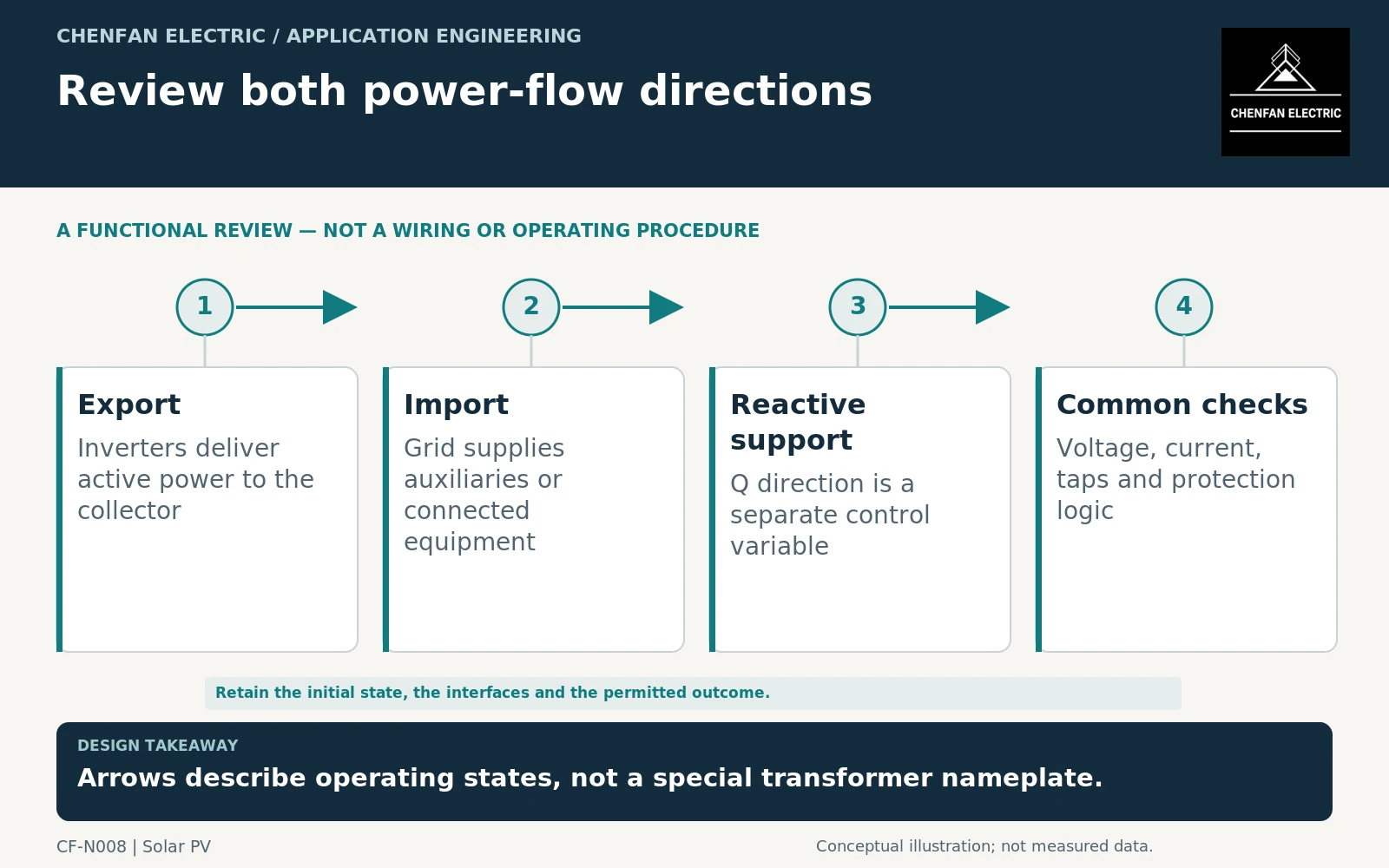
Name the import states precisely
Import may supply station auxiliaries, support inverter assemblies during reactive operation, or feed other equipment connected within the plant boundary. These cases can differ greatly in magnitude and duration. Some require the main transformer energized continuously; others occur only during startup or maintenance.
Use a consistent sign convention. Define positive P and Q at a specified terminal or metering point, and retain it in the inverter schedule, load-flow model and controls documents. Reversing an arrow in a diagram without changing the associated convention can produce contradictory requirements.
A product manual describing nighttime reactive-power operation confirms that an inverter may remain grid connected and consume active power in that mode. It does not establish the import behavior of every PV plant. [1]
Separate electromagnetic duty from installation restrictions
For the same balanced sinusoidal apparent power and terminal voltage, current magnitude follows the same three-phase relationship regardless of the active-power sign. That observation does not prove that tap settings, converter controls or protection elements are suitable for both directions.
Voltage change across network impedance depends on the operating power flow. A ratio position satisfactory during export may need reassessment during a materially different import case. Transformer application guidance covers these operating and voltage considerations, while the project study determines the required cases. [2]
Also check which winding terminals and accessories remain energized when an inverter group is disconnected. The word “reverse” should not obscure the more important distinction between an isolated circuit and one still connected to an energized magnetic system or external supply.
Review the states as a coordinated matrix
| State | Transformer input | System interface to review |
|---|---|---|
| Normal export | Simultaneous P, Q and voltage | Export control and collector voltage |
| Auxiliary import | Import demand and duration | Metering and supply continuity |
| Night reactive support | Reactive current and active consumption | Converter mode and voltage control |
| Maintenance configuration | Remaining energized connections | Isolation and protection boundaries |
Where parallel transformers or multiple collector feeders are involved, include the actual switching configuration. A power-flow reversal through one branch can occur without the entire plant becoming an importer. The study should distinguish local circulation from net power at the connection point.
Do not specify protection settings from this matrix alone. Settings depend on instrument transformers, network grounding, fault levels and the coordinated protection design. The matrix identifies what the protection team must evaluate, not how to wire or set a relay.
Ask for confirmation against defined cases
An enquiry should ask the supplier to confirm the listed import and export cases against winding ratings, voltage assumptions and applicable accessory limits. Request any restrictions explicitly. A vague statement that a transformer is “bidirectional” leaves the operative limits undefined.
For assemblies incorporating specialized converters, the converter’s permitted modes and relevant converter-transformer application requirements also need review. A generic transformer statement does not override a converter’s own operating restrictions. [3]
The final evidence package should connect the operating-state matrix to the single-line diagram, tap schedule and protection philosophy. Reverse power is then treated as a set of traceable conditions, rather than either an automatic prohibition or an unsupported assurance that nothing changes.
Core procurement checkpoint: Do not invent a separate reverse-power steel grade
For the core supply boundary, require the transformer designer to confirm the applicable voltage and frequency cases in both operating directions. Reverse active-power flow is not, by itself, a specification for a different CRGO grade. Preserve separate checks for connections, protection, excitation and cooling, and do not treat a core quotation as confirmation that the installed transformer can be back-fed safely.
For the core enquiry: Forward and reverse operating cases; approved magnetic design; unchanged or revised core drawing; agreed inspection scope.