

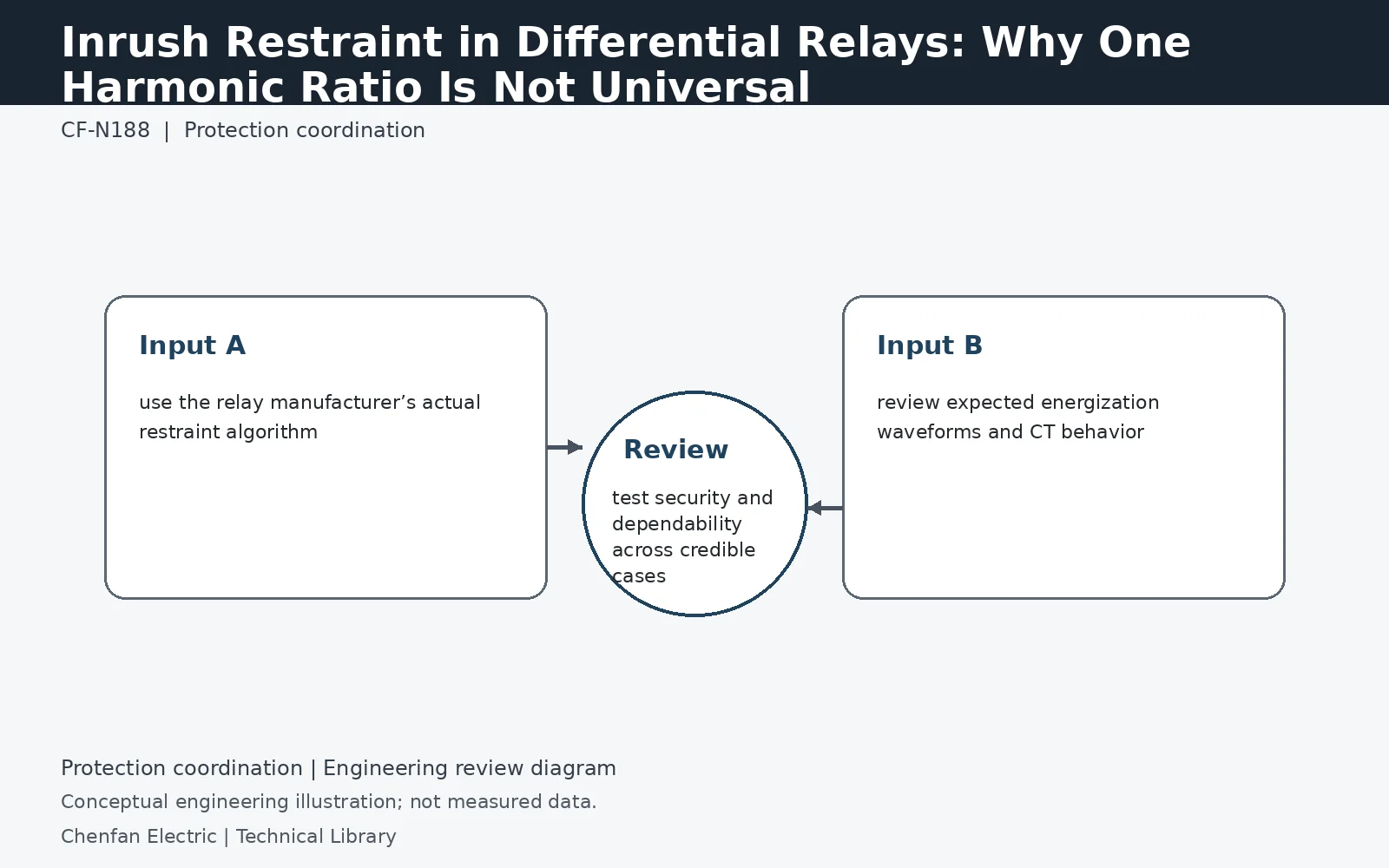
Inrush restraint cannot be reduced to one universal second-harmonic percentage. Modern transformer design, residual flux, controlled switching and CT behavior can change harmonic content, while internal faults may also contain harmonics. Relay settings should therefore follow the specific relay algorithm, transformer energization evidence and security/dependability study rather than a copied ratio.
A harmonic percentage depends on how the relay measures it
A second-harmonic ratio normally relates an extracted second-harmonic quantity to a fundamental quantity, but the filtering, phase treatment and timing depend on the relay. A ratio computed from an offline waveform using a different window may not match the relay's operating signal. Ask which quantities and logic drive restraint or blocking in the selected product. The manufacturer's application guidance and actual configuration take precedence over a familiar percentage copied from another scheme.
Low harmonic content does not prove an internal fault
Transformer design, initial flux, source conditions and closing timing can change the harmonic content of magnetizing inrush. Conversely, fault waveforms can contain harmonics through fault behavior or CT distortion. A binary rule that “high second harmonic means inrush and low means fault” is therefore insufficient for every case. Modern algorithms may use additional waveform features or logic, but their performance still needs to be assessed for the intended transformer and network.
Test faults during energization as well as healthy energization
Security means avoiding an unwanted trip; dependability means operating when a fault requires it. Verify both using representative healthy energization, external faults and relevant internal faults, including cases occurring during energization where appropriate. Cross-phase blocking can affect this balance and must be reviewed according to the specific relay design. Retain the test waveforms, expected outcomes and approved settings so later firmware or transformer changes can be checked against the established evidence.
Technical reference framework
[1] IEEE C37.91-2021 — Protecting power transformers.
[2] IEC 60076-1:2011 — Power transformers, General.