

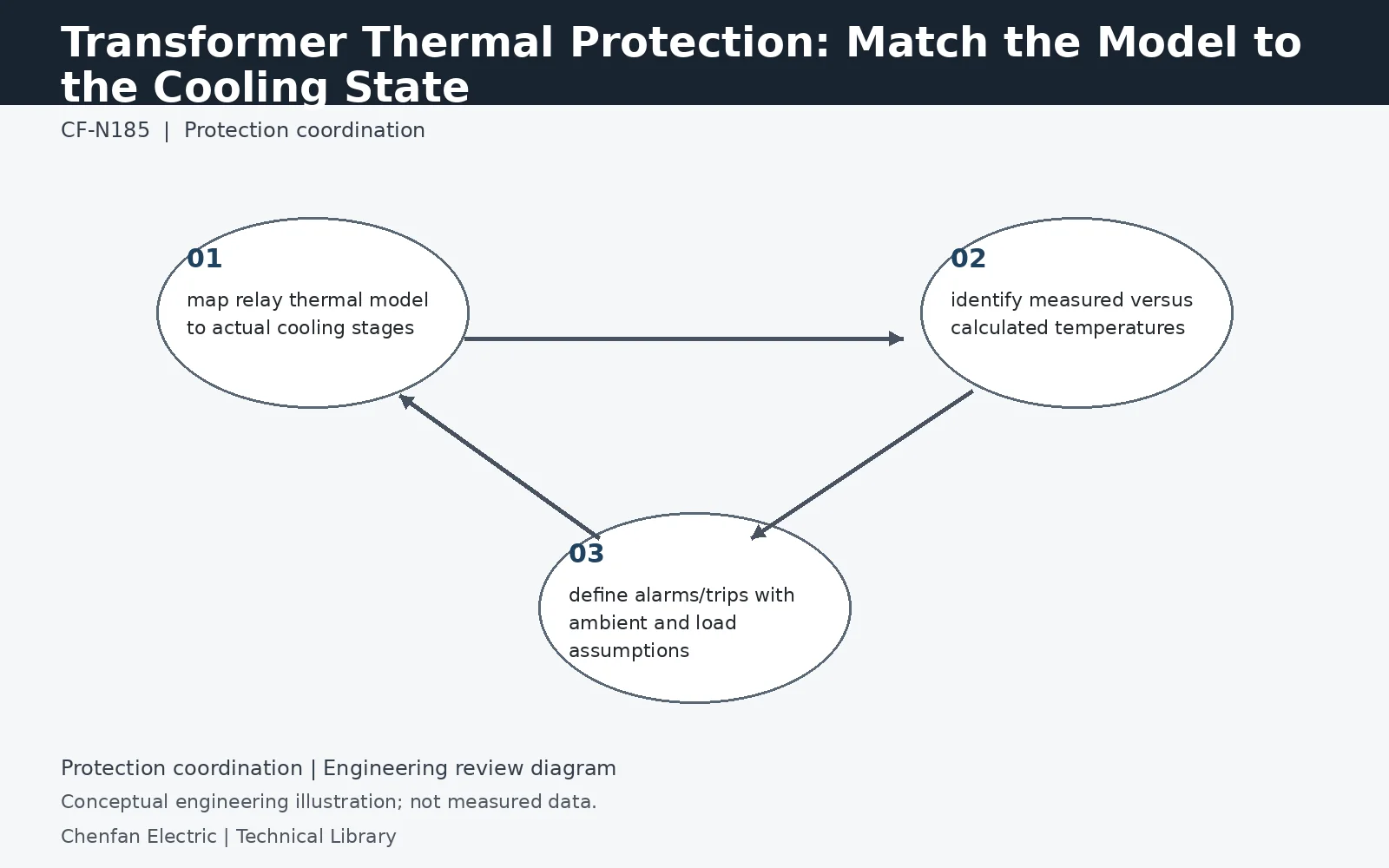
A thermal protection model must follow the transformer cooling state. Top-oil and winding hot-spot response differ when pumps or fans are off, staged or failed, and a fixed current threshold cannot represent the same thermal condition. The protection file should map each cooling stage, temperature sensor/model input, alarm/trip criterion and assumed ambient/loading history.
Cooling commanded on is not cooling proven available
A fan or pump command indicates control intent, not necessarily delivered cooling. Depending on the installation, auxiliary supply, motor status, flow or other feedback may be needed to establish the available stage. The protection model should use the verified state defined by the design. If a forced-cooling stage is unavailable, the permitted load and thermal response can change even though transformer current has not increased. Specify how loss or ambiguity of cooling feedback is handled.
Temperature depends on the preceding load
The same present current can produce different thermal margins after a cool start and after several hours of heavy loading. For liquid-immersed units, top-liquid temperature and winding hotspot also respond on different timescales. Use the appropriate thermal model with the required history, ambient and cooling inputs. A fixed current alarm can provide useful supervision but does not fully represent insulation thermal exposure or justify an emergency loading duration by itself.
Distinguish measured temperature from an estimated hotspot
Identify each sensor's physical location and whether the reported hotspot is measured directly or calculated from other inputs. Sensor failure, calibration drift and model mismatch need defined responses. Dry-type winding sensors and liquid-immersed thermal models are not interchangeable. The final protection schedule should tie alarms, load restrictions and trips to the manufacturer-supported limits and the approved operating philosophy, without treating one generic temperature threshold as valid for every insulation and cooling system.
Technical reference framework
[1] IEEE C37.91-2021 — Protecting power transformers.
[2] IEC 60076-1:2011 — Power transformers, General.
[3] IEC 60076-7:2018 — Loading guide for mineral-oil-immersed power transformers.