

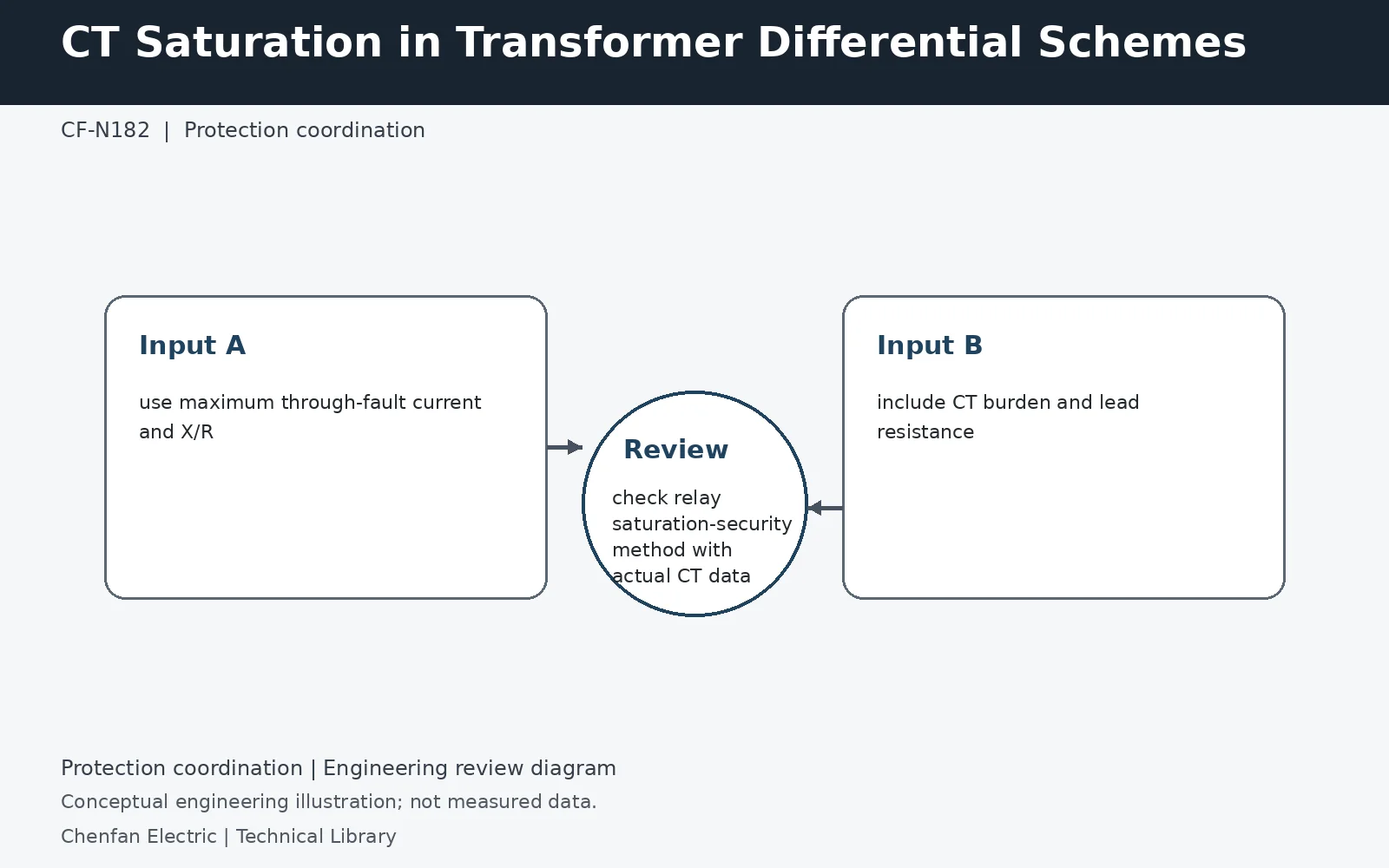
CT saturation can create false differential current during heavy external faults. Risk depends on fault magnitude and X/R, CT ratio/core performance, secondary burden, lead resistance and the relay algorithm. A stable differential scheme therefore needs a through-fault/CT study based on the actual maximum fault current, not only a nominal CT accuracy class printed on a drawing.
Unequal CT distortion can create apparent differential current
During an external fault, the primary currents should balance after the appropriate ratio and phase compensation. If one CT saturates more severely or earlier than another, their reproduced secondary currents no longer balance perfectly. The relay can then see a false operating quantity. This is not an internal transformer fault, but the protection must remain secure for the credible external-fault condition while retaining sensitivity to genuine faults.
Calculate the burden at the relevant secondary current
As an elementary illustration, 50 A through 1.0 ohm of total resistive secondary circuit requires 50 V before considering the CT's internal excitation behavior; 0.5 ohm requires 25 V. The full burden includes leads, relay inputs and other connected devices, with the appropriate return path. These values do not prove saturation or its absence. They show why lead length and circuit resistance must accompany the CT excitation and transient-performance data rather than being omitted from the selection.
Include DC offset and remanence in the transient assessment
Fault inception angle, network X/R and CT remanence can affect the flux excursion and time to saturation. A symmetrical RMS current alone omits these influences. Use the relay supplier's approved CT-assessment method with the actual maximum fault duty and relevant burdens, then check the algorithm's behavior with suitable test waveforms. A printed CT accuracy class is necessary information, but it is not a complete stability demonstration for every external fault.
Technical reference framework
[1] IEEE C37.91-2021 — Protecting power transformers.
[2] IEC 60076-1:2011 — Power transformers, General.