

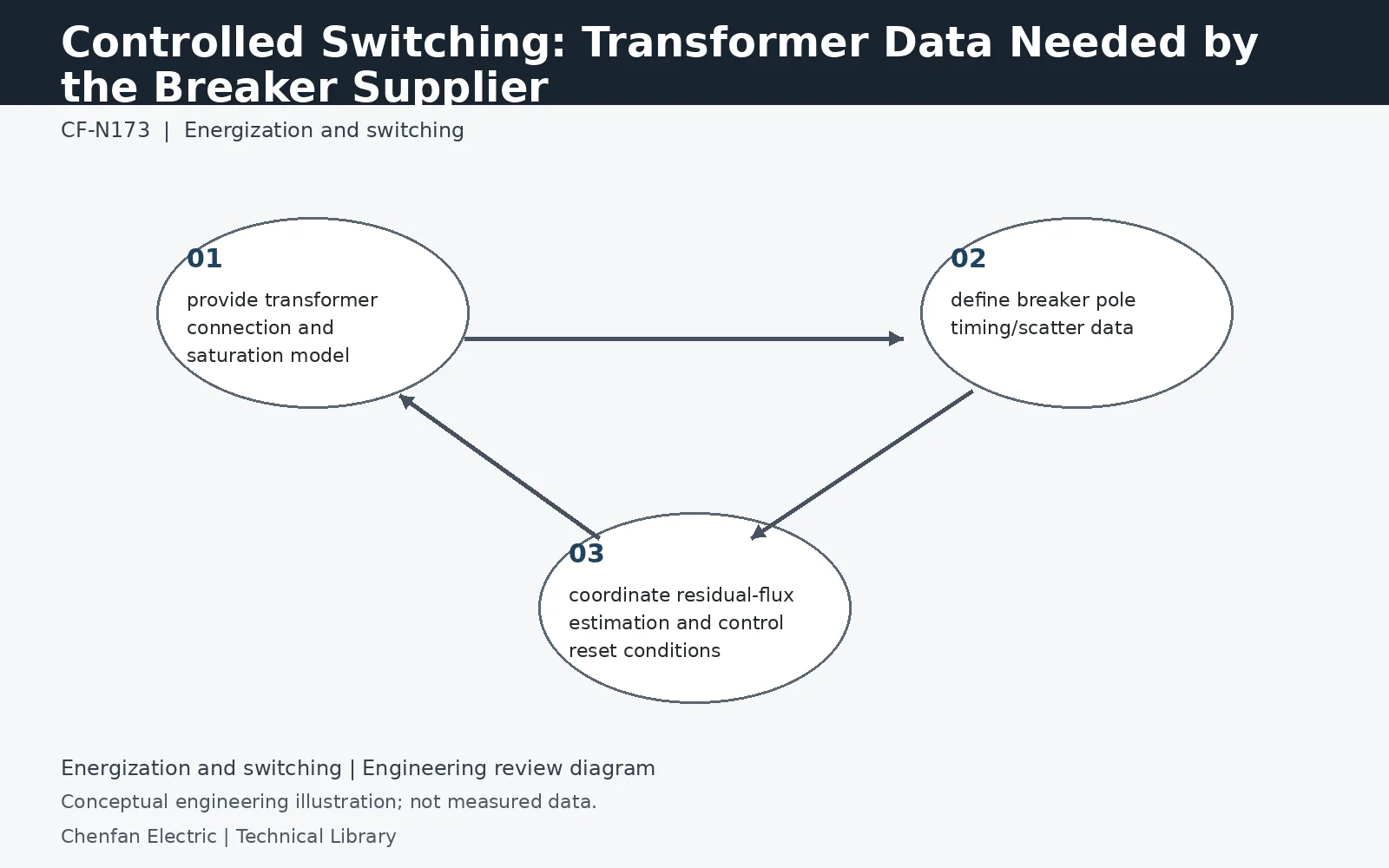
Controlled switching aims to choose breaker closing instants that reduce inrush or switching stress, but the breaker supplier needs transformer-specific data. Typical inputs include winding connection, residual-flux behavior or estimation method, saturation characteristics, system voltage/frequency, breaker pole scatter and the network seen from each terminal. The controller settings are therefore project-specific, not a generic transformer accessory.
The target closing instant depends on the magnetic state
Controlled closing seeks to align the prospective flux with the flux already present in the core so the subsequent trajectory avoids excessive saturation. The suitable instant depends on residual flux, winding connection and interactions among phases. A universal instruction such as “always close at voltage peak” does not cover every three-phase transformer or residual-flux state. The controller supplier needs a documented method for estimating or bounding the initial flux, including what happens when that information is unavailable.
Electrical contact timing matters more than the command timestamp
The interval between a command and current initiation includes mechanism travel, pole scatter and dielectric prestrike behavior. It can change with operating conditions and breaker wear. Use breaker data relevant to the proposed application, including the uncertainty that the controller can compensate and the uncertainty that remains. An ideal simulation with simultaneous, perfectly timed poles is useful as a reference but cannot establish the performance of the installed breaker-controller combination.
Specify measurable outcomes and fallback operation
The acceptance objective may concern peak inrush, voltage disturbance, nuisance-trip avoidance or a combination of these. Define the source conditions, transformer states and timing tolerances over which the supplier demonstrates the result. Also identify the permitted behavior after loss of voltage reference, failed flux estimation or controller unavailability. Controlled switching should be evaluated as a coordinated system with declared limitations, not as an accessory that guarantees negligible inrush in every condition.
Technical reference framework
[1] CIGRE Technical Brochure 568 — Transformer energization in power systems: A study guide.
[2] IEC 60076-8:1997 — Application guide.