

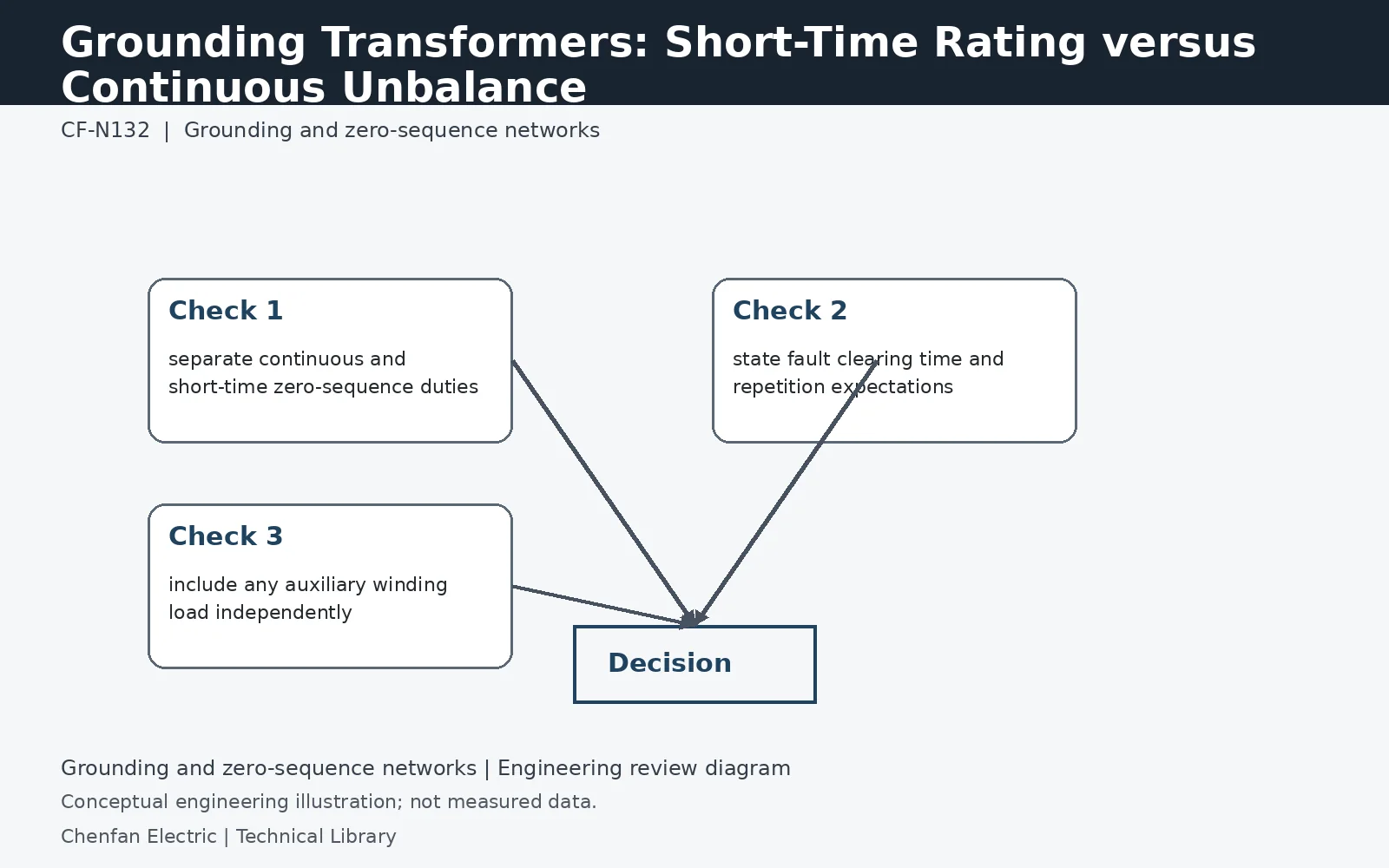
Grounding-transformer short-time rating is driven by zero-sequence fault duty and clearing time; continuous rating is driven by persistent neutral current, unbalance or auxiliary loading. Mixing those duties can oversize or undersize the unit. The design input should therefore separate continuous neutral current, fault current, duration, duty cycle, ambient/cooling conditions and any auxiliary winding load.
A ten-second duty is not a continuous rating
A requirement such as 400 A neutral current for 10 seconds describes a short-time event, not permission to carry 400 A indefinitely. For a simple constant-current comparison, the thermal exposure is proportional to I²t: doubling the duration doubles that exposure. Actual temperature rise also depends on starting temperature, construction and cooling. Do not derive a continuous neutral-current rating by dividing the short-time current by an arbitrary factor or by the duration; ask the manufacturer to declare both capabilities explicitly.
Translate neutral current into the winding duty
Under a symmetrical zero-sequence condition, neutral current is three times the zero-sequence component in each external phase conductor. Thus 300 A at the neutral corresponds to 100 A of zero-sequence current per external phase. This identity does not by itself give the current in every zigzag winding section or a usable auxiliary kVA rating. Those depend on the connection and turns arrangement. Give the supplier neutral current and connection requirements without disguising them as an ordinary three-phase load rating.
Define the condition before a repeat fault
A second fault after a short interval may begin with a warmer winding than the first. Include the anticipated sequence of events, minimum recovery interval and any standing unbalance or auxiliary load. Continuous harmonic neutral current also needs its own spectrum; the same RMS current at different frequencies need not produce the same additional losses. The acceptance schedule should distinguish continuous temperature-rise evidence from short-time withstand evidence, with the operating assumptions recorded beside each rating.
Technical reference framework
[1] IEC 60076-8:1997 — Application guide.
[2] IEC 60076-1:2011 — Power transformers, General.
[3] Post Glover GT110-08 — Zig-zag grounding transformers.