

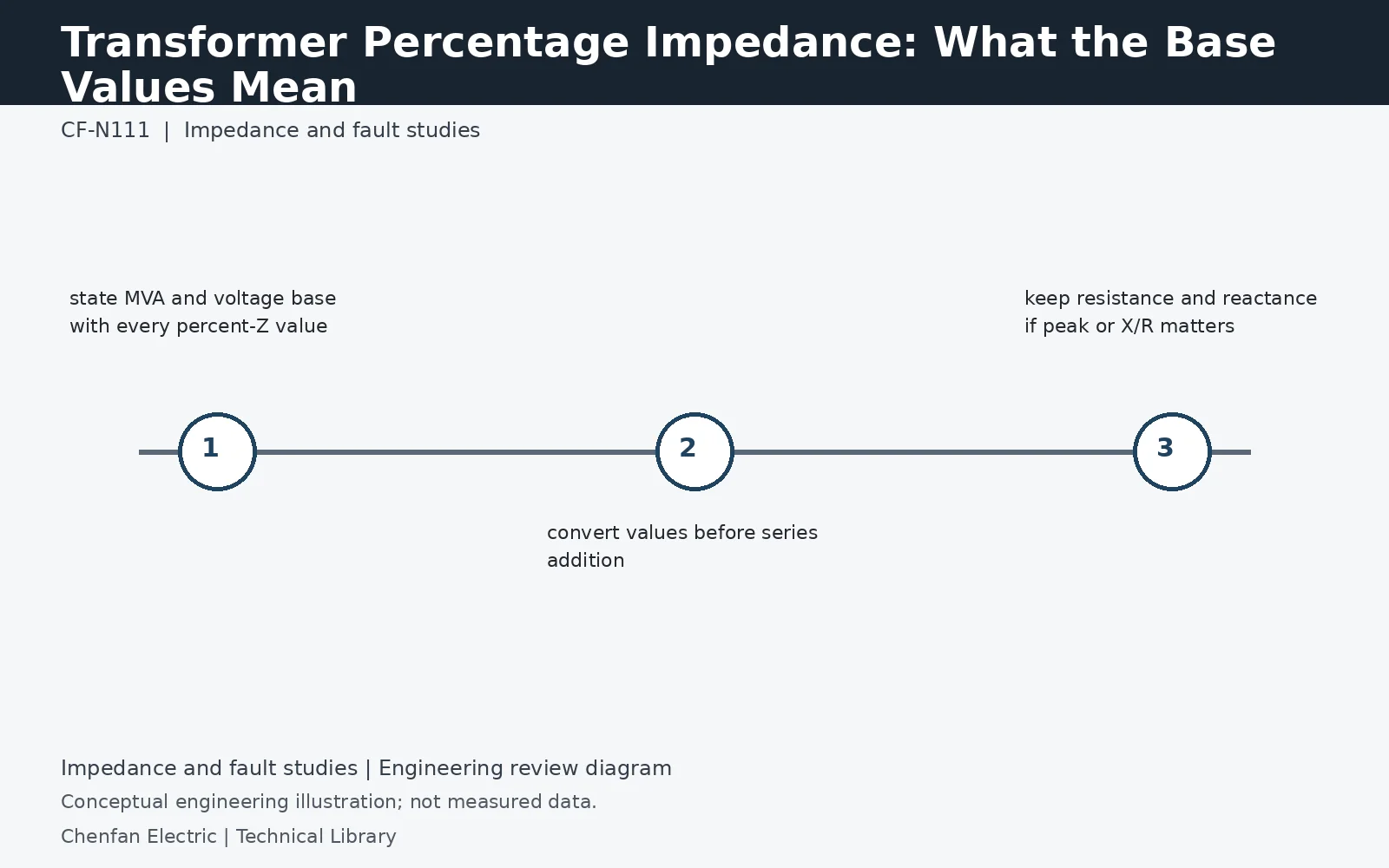
Percentage impedance is a per-unit quantity on stated voltage and power bases. It is not an ohmic value and cannot be compared or added across different bases without conversion. For a two-winding transformer the familiar short-circuit impedance is usually referred to the rated power and a selected winding voltage; for system studies, convert every source and transformer impedance to one common MVA and voltage base before combining them.
Recover the physical impedance from the percentage
For a three-phase base using line-to-line kV and total three-phase MVA, Zbase in ohms equals kV²/MVA. Multiply this by percent impedance divided by 100 to obtain the equivalent impedance magnitude referred to that side. For illustration, 8% on a 10 MVA, 33 kV base corresponds to 0.08 × 33²/10 = 8.712 ohms. The equivalent impedance referred to the other winding is different in ohms because the voltage reference changes. Keep the reference side visible in every exported study table.
Change the base without changing the transformer
The conversion is znew = zold × (Snew/Sold) × (Vold/Vnew)², with all quantities referred consistently. At unchanged voltage, the preceding 8% becomes 16% on a 20 MVA base. The transformer still has the same impedance and the same nameplate capacity. This distinction matters when combining utility source data, several transformer ratings and cable values. Convert resistance and reactance consistently rather than adding percentage magnitudes from different bases or discarding their impedance angles.
Keep the test basis beside the converted value
The original factory value should remain traceable after conversion. Retain the winding pair, tap, frequency, temperature reference, guaranteed value and measured result separately. A study-base conversion cannot correct an input taken from the wrong winding pair or tap. For fault calculations, state whether source impedance and other infeed are included. For parallel sharing, include connection impedances. Percent Z is a useful normalized input, but its number alone neither predicts every fault duty nor certifies that two units will share load satisfactorily.
Technical reference framework
[1] IEC 60076-1:2011 — Power transformers, General.
[2] IEC 60076-5:2006 — Ability to withstand short circuit.
[3] IEC 60076-8:1997 — Application guide.