

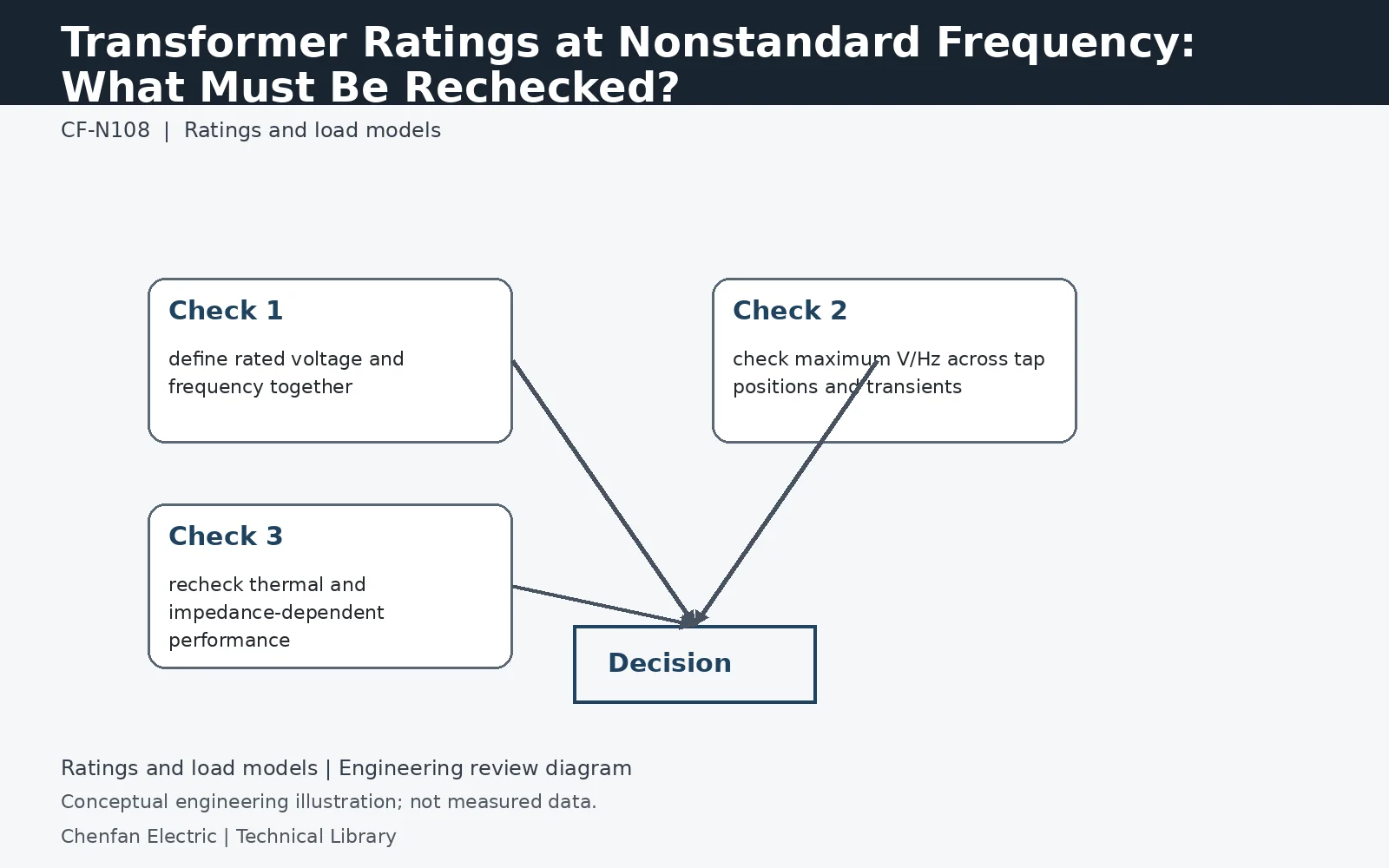
Changing frequency changes volts-per-hertz and therefore core flux, while also changing reactance, losses, cooling and the behavior of connected equipment. A transformer designed for one rated frequency cannot be re-rated by editing the nameplate alone. The allowable voltage at a different frequency must respect the magnetic flux limit, and the thermal consequences of changed losses and load spectrum must be rechecked.
Use volts per turn per hertz as the magnetic check
For approximately sinusoidal excitation, induced winding voltage follows E ≈ 4.44 f N Φmax. With turns unchanged, preserving E/f preserves the corresponding peak flux approximately. A 60 Hz winding subjected to its original voltage at 50 Hz sees a 20% increase in the voltage-to-frequency ratio. Reducing voltage to 50/60 of its original value is a first magnetic screening step, not a complete rerating. Supply waveform, tap position and the manufacturer's excitation limits still determine whether the proposed condition is acceptable.
A flux-safe voltage does not preserve full kVA
For a balanced three-phase winding, S = sqrt(3) V I. If voltage is reduced to 83.3% while allowable current remains unchanged, its apparent-power capability on that basis is also 83.3%. Restoring the original kVA would require 20% more current, which cannot be assumed permissible. At a higher frequency, keeping the original voltage reduces flux but does not automatically permit a voltage increase: insulation, terminals, taps and connected equipment retain their own limits. Recalculate current duty rather than treating V/Hz as the only constraint.
Request a frequency-specific loss and accessory review
Leakage reactance varies with frequency, while conductor and structural losses have frequency-dependent components. The old percentage impedance and load-loss figures therefore need an explicit conversion or replacement basis. Check cooling fan and pump supplies, instruments, tap-changer auxiliaries and the intended load spectrum. For procurement, obtain a manufacturer-issued voltage, current, frequency and cooling schedule, together with the applicable test evidence. Neither a changed label nor a material-loss table for the core alone proves the whole transformer's revised thermal performance.
Technical reference framework
[1] IEC 60076-1:2011 — Power transformers, General.
[2] IEC 60076-8:1997 — Application guide.
[3] IEC 60076-7:2018 — Loading guide for mineral-oil-immersed power transformers.