

Bidirectional power flow does not, by itself, require a special core material. Main magnetic excitation is governed by induced voltage, turns, frequency, waveform and magnetic state—not by the sign of active power alone. Reverse-power operation still needs review because control, tap position, loading and waveforms may change with operating direction.
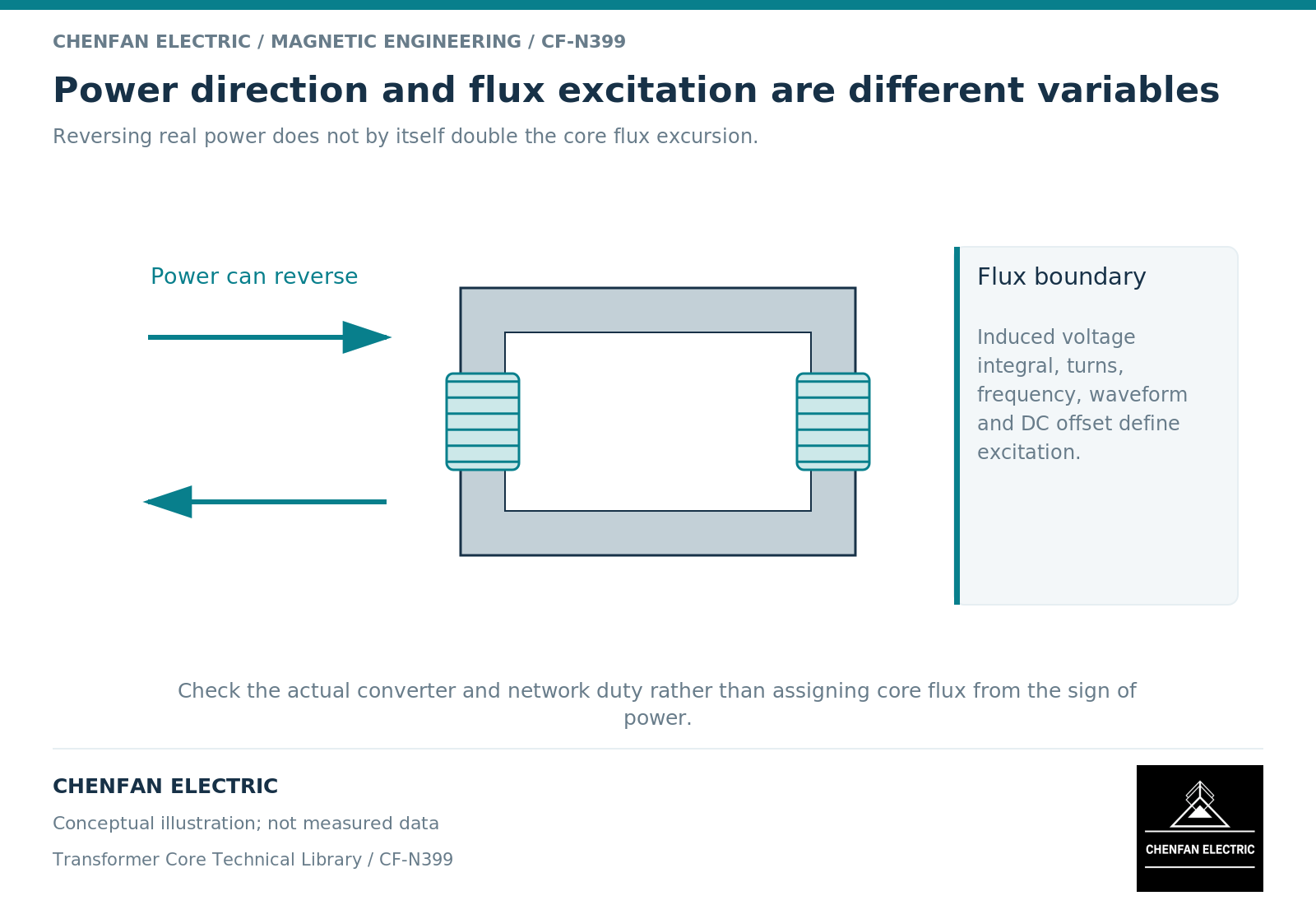
Separate the power reference from the flux equation
With a chosen voltage and current reference, active power changes sign when the phase relationship produces energy flow in the opposite direction. Faraday’s law remains e(t) = N dΦ/dt for the same winding reference. [1]
For an ideal transformer with unchanged induced voltage waveform and turns, reversing power transfer does not require reversing or increasing the main flux excursion. The load-related current changes to support the new energy flow.
This is a statement about an idealized comparison. Real winding drops, source conditions and regulation can change the induced voltage. Those effects must be evaluated rather than assumed absent.
Review what the operating direction actually changes
A grid-connected converter may use different voltage or reactive-power control in charging and discharging states. Tap selection, energized winding, current spectrum and exceptional operating cases may also differ.
Transformer design guidance distinguishes main excitation, winding losses and leakage behavior. [2] A bidirectional duty should preserve those distinctions instead of reducing the requirement to a “reverse power” label.
| Operating input | Required comparison between directions |
|---|---|
| Induced voltage per turn | Same or different excitation envelope |
| Frequency and voltage waveform | Flux excursion and harmonic content |
| Tap and energized winding | Active turns and internal voltage basis |
| Current magnitude and spectrum | Winding and structural losses |
| Reactive-power requirement | Current duty beyond active-power transfer |
| Start, stop and abnormal states | Relevant transient and control conditions |
A current or voltage offset is a separate magnetic issue. It should be specified and analyzed directly, not assumed to be an inherent consequence of power reversal.
Compare paired operating cases
Use one reference convention throughout the review. Record both active and reactive power, voltage, current, tap and waveform for each direction. Then determine which quantities are actually unchanged.
A pair of equal active-power magnitudes can have different current magnitudes if voltage or power factor differs. Consequently, equal power in both directions does not automatically mean equal winding heating.
Similarly, a main-core loss comparison should use the actual induced-voltage waveform and temperature basis. It should not be inferred from the power-flow arrow or the converter’s nameplate rating.
Release an envelope, not a material slogan
The core specification should contain the magnetic operating cases required across both directions, including any relevant voltage or frequency extremes. The complete-transformer design should address winding, insulation, cooling, leakage and protection requirements.
A material substitution must still be supported by its own magnetic and manufacturing evidence. Calling a steel grade “bidirectional” does not establish a technical property unless a specific, relevant requirement is defined and verified.
For Chenfan Electric core projects, the useful input is therefore a clear excitation envelope and controlled core geometry. The system designer retains responsibility for the converter and transformer operating states that generate that envelope.
The practical conclusion is straightforward: reverse power is not a new law of magnetization, but it can create different operating conditions. Separate the unchanged physics from the changed duty, and review the latter explicitly rather than marketing an unexplained special core.
References
[1] Lloyd Dixon / Texas Instruments. Magnetics Design 1 – Introduction and Basic Magnetics.
[2] Lloyd Dixon / Texas Instruments. Magnetics Design 4 – Power Transformer Design.