

Magnetostriction is a strain associated with magnetization, not a scalar force that can be assigned unchanged to every direction in a core. A structural model must preserve the material axes, the strain definition and the operating conditions of the source data. Otherwise even a plausible strain magnitude can drive the assembly in the wrong direction.
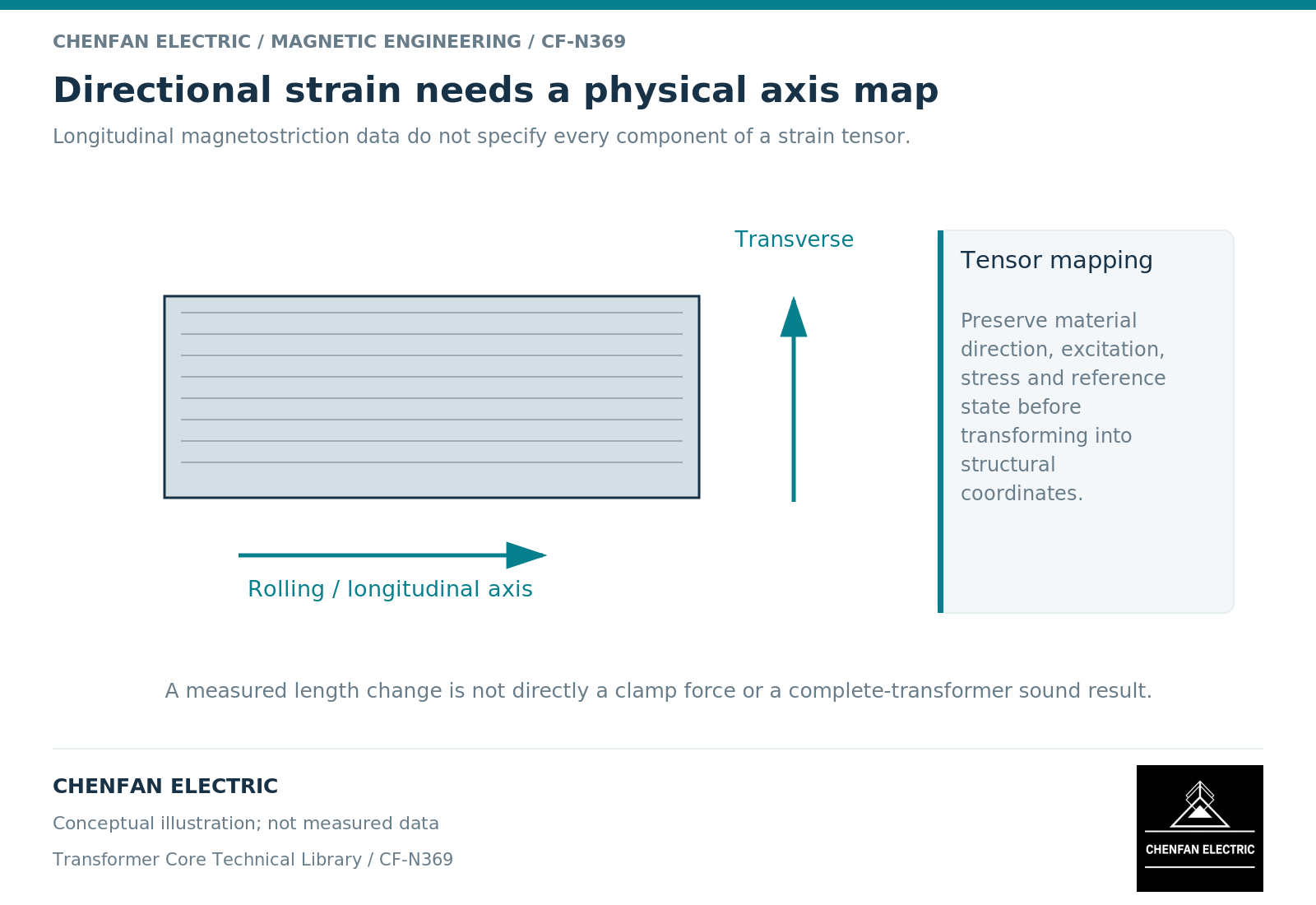
Distinguish a measured length change from a strain tensor
A longitudinal measurement describes fractional length change along a specified direction. It does not, by itself, define transverse strain, shear components or the response under a different magnetization direction. Research on anisotropic magnetoelastic modeling explicitly distinguishes directional coefficients and strain tensors. [1]
For a lamination, identify the rolling, transverse and thickness directions. A coordinate label such as “x” is meaningful only when its relationship to those physical directions is documented. The local material axes can rotate between limbs and yokes even within one global model.
This is a data-definition issue before it is a solver issue. Increasing mesh density cannot repair an incorrect assignment of material direction.
Preserve the measurement conditions
A magnetostriction dataset should identify the material state, specimen direction, magnetic excitation, stress condition, temperature and reference state. Single-sheet measurement descriptions also identify the measured longitudinal elongation and its synchronization with magnetic excitation. [3] A maximum length-change value without these conditions is inadequate for a time-dependent assembly model.
Magnetostrictive strain is not the same as the magnetic B–H relationship. A normal magnetization curve can support a magnetic-field model while leaving the mechanical source unspecified. Ferromagnetic modeling guidance distinguishes constitutive magnetic models and their directional or history dependence. [2] That guidance does not turn a magnetic permeability curve into strain data.
The assembly may also constrain a strain that was measured on a relatively free specimen. The resulting mechanical stress depends on the structural model and boundary conditions. Do not interpret free strain directly as an observed clamp force.
Transform the source into the structural coordinates
When a strain tensor is available in material coordinates, it must be transformed consistently into the structural coordinate system. Conceptually, this uses the same physical rotation for the axes and the tensor components; it is not achieved by changing only a text label.
For a deliberately simplified longitudinal-only model, state which components are retained and which are omitted. That simplification may support a limited comparative study, but it should not be presented as a full description of three-dimensional magnetostriction.
| Data item | Model consequence |
|---|---|
| Measurement direction | Which strain component is supported |
| Local material axes | How source directions map into the assembly |
| Excitation history | Which part of the strain cycle is represented |
| Mechanical preload | Whether source data match the stress state |
| Structural constraints | How imposed strain produces displacement and stress |
Validate the response at the same level
Material strain measurements, core vibration and complete-transformer sound are different observables. Agreement at one level does not prove agreement at the next, where interfaces, supports and acoustic radiation contribute.
A useful review first checks the local material assignment and source waveform. It then checks structural mode shapes, contact assumptions and the measurement direction used for comparison. This order prevents the model from being tuned mechanically to compensate for a misoriented magnetic strain source.
The handover should include an axis map and the provenance of the strain data, not an invented universal magnetostriction coefficient for all electrical steel. Without suitable directional data, retain an explicitly bounded sensitivity study instead of presenting a precise noise prediction as established performance.
References
[1] P. Nieves and coauthors. MAELAS 2.0: A new version of a computer program for the calculation of magneto-elastic properties (2021).
[2] Cesare Tozzo / COMSOL. Modeling Ferromagnetic Materials in COMSOL Multiphysics.
[3] BROCKHAUS. Magnetostriction Tester.