

Post-saturation inductance controls how a transient model behaves after the core enters a strongly nonlinear region. It should not be chosen as an unexplained multiple of leakage inductance. Identify the model’s definition, reference winding and evidence before using the value to predict inrush or other high-excitation currents.
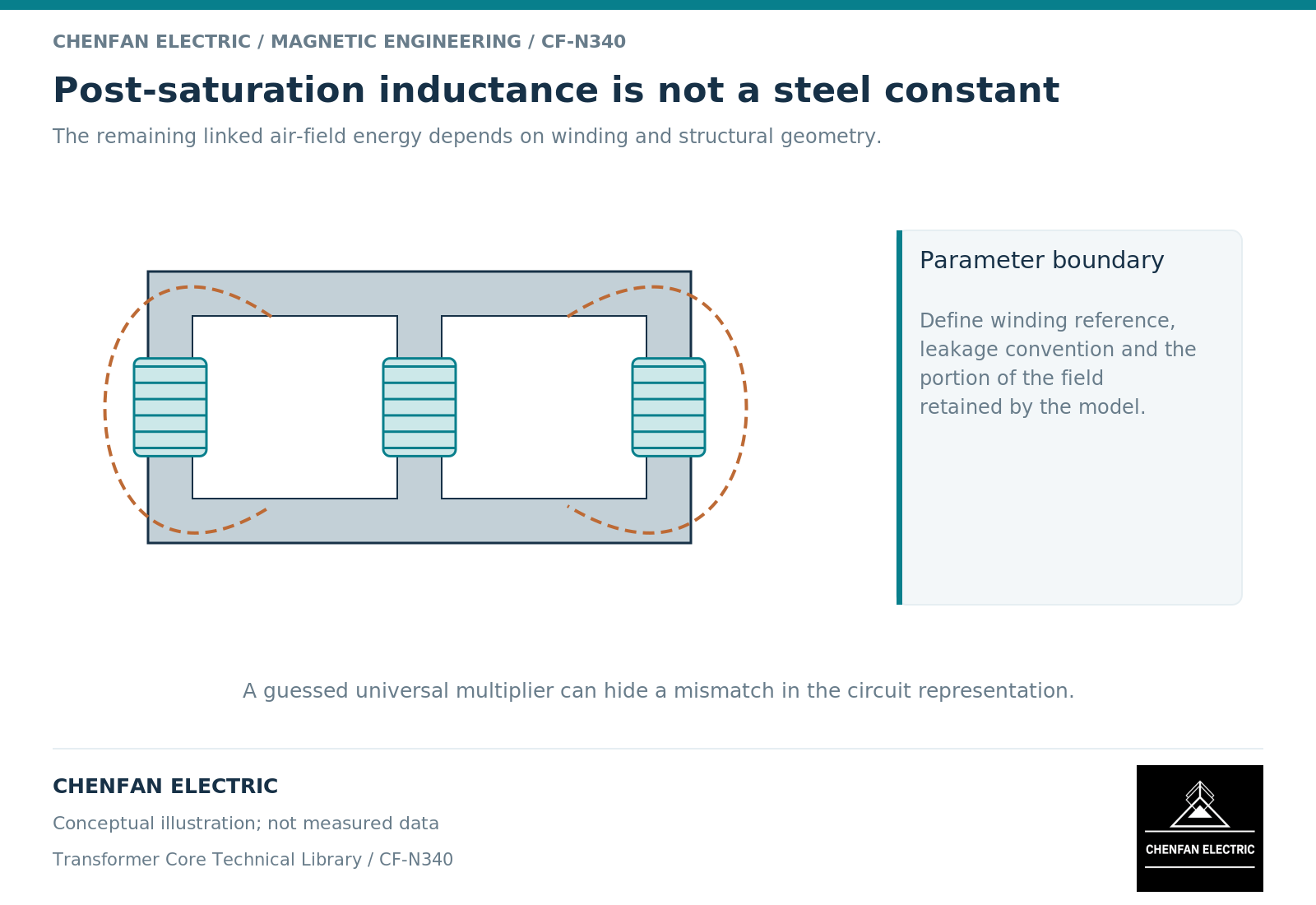
Distinguish three quantities that are often conflated
Leakage inductance represents flux that does not link all windings in the same way as the main mutual flux. Magnetizing inductance represents the excitation branch under a defined state. A post-saturation or air-core-related slope describes the high-field behavior of a particular model.
These quantities are related through the model formulation, but they are not interchangeable labels. Classical transformer documentation discusses an air-core parameter and also shows why moving a saturation branch across leakage elements can alter the result. [1]
The first task is therefore to inspect the equivalent circuit. A parameter with the same name in two software packages may be placed differently or use a different reference side.
Preserve the high-field slope and its basis
For a nonlinear flux-linkage curve, the local slope d(lambda)/di changes with operating point. A model may approach a chosen asymptotic slope at high excitation. The available laboratory data often constrain the normal operating range better than the deep nonlinear region.
State whether the post-saturation value comes from geometry, a dedicated measurement, fitting or an engineering assumption. A convenient default is acceptable only as a disclosed assumption for a study whose sensitivity has been checked; it is not a measured transformer property.
Reference-side conversion also matters. An inductance referred through an ideal turns ratio scales with the square of that ratio. Mixing per-unit bases or winding sides can create a large numerical error while leaving the curve visually plausible.
Avoid double-counting the same field contribution
A detailed winding model may already represent part of the field that a simpler model absorbs into an air-core-related parameter. Adding both without examining their definitions can overstate the limiting inductance.
A field calculation can help establish the relevant inductive behavior, but its source arrangement, material assumptions and dimensionality must match the intended parameter. [2] A magnetostatic coil inductance with the steel removed is not automatically the correct drop-in value for every nonlinear transformer circuit.
Check the model against a known limiting case. The current response should remain consistent with the represented source and winding impedances, and the transition into the high-field region should not introduce an artificial discontinuity.
Report sensitivity with the transient result
| Review item | Required record |
|---|---|
| Parameter meaning | Branch location and mathematical definition |
| Reference basis | Winding, turns ratio, units and per-unit bases |
| Evidence origin | Measurement, field calculation, fit or assumption |
| Supported range | Excitation levels covered by evidence |
| Sensitivity | Change in the decision-driving transient output |
Vary the uncertain high-field parameter over a defensible interval and report its effect on peak current, waveform duration or the study’s other target. Do not hide a large sensitivity behind a single nominal trace.
The handover should make clear which conclusion is robust and which depends on uncertain deep-saturation behavior. That is more valuable than presenting a precise inrush peak generated from an undocumented default, and it prevents a leakage-test result from being used as proof of a different magnetic parameter.
References
[1] Manitoba Hydro International / PSCAD. The Classical Approach.
[2] David Meeker. Finite Element Method Magnetics User Manual.