

Half-cycle saturation under direct-current bias means that the alternating magnetic trajectory enters a strongly nonlinear region more severely in one polarity than in the other. It does not mean the voltage has become a half-wave supply, nor does it imply that one half of the physical core stops working.
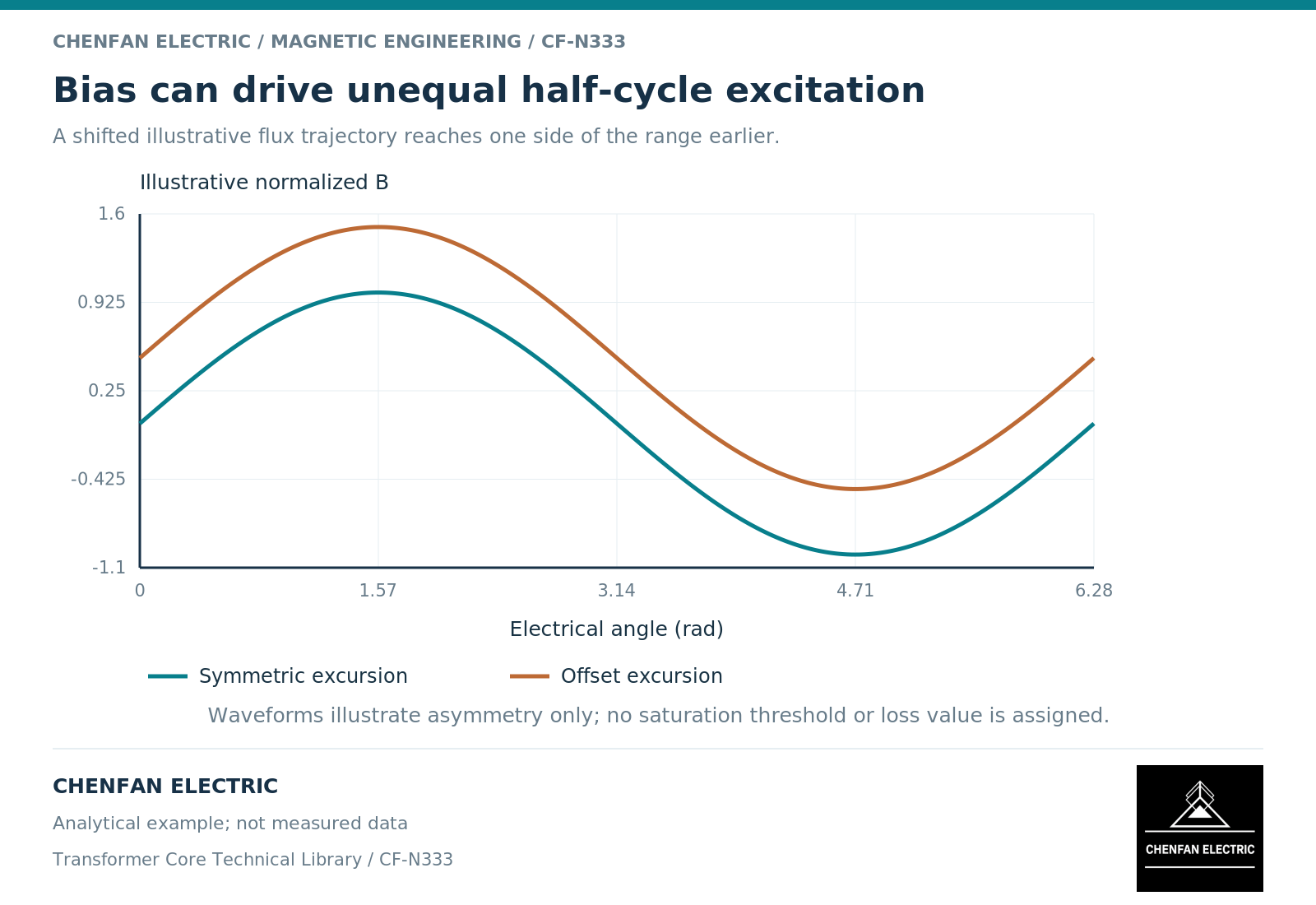
The operating region is displaced
An alternating excitation normally drives the material through positive and negative portions of its characteristic. A biasing magnetomotive force shifts the operating region. One excursion can then approach the high-field region sooner, while the opposite excursion remains farther from it.
History-dependent magnetic behavior and nonlinear constitutive choices determine how that trajectory is represented. [1] A centered sinusoidal flux-density sketch with a vertical offset is useful conceptually, but is not a complete solution of a current-biased transformer circuit.
The actual flux waveform and magnetizing current must satisfy both the winding circuit and the magnetic response. Treating the offset as an arbitrary addition without checking that coupled solution can produce an attractive but inconsistent picture.
Current asymmetry can be much stronger than flux asymmetry
Near a nonlinear knee, the incremental magnetizing response changes sharply. A relatively small additional flux excursion may require a much larger increase in current. Therefore the ratio of positive to negative current peaks cannot be read directly as the ratio of the corresponding flux peaks.
This is one reason to retain full waveforms rather than relying only on root-mean-square current. A single scalar can conceal which polarity is affected, the duration of the current pulses and the harmonic content relevant to the system.
Studies of geomagnetically induced currents identify half-cycle saturation as a mechanism associated with reactive demand, harmonics and heating. [2] Those general mechanisms do not establish the magnitude of any effect in an unevaluated transformer.
Interpret the time scale correctly
A sustained bias can maintain asymmetric cycles, while a switching transient may create an offset that evolves as the circuit settles. Similar-looking first-cycle waveforms can therefore belong to different duties.
The thermal consequence depends on the loss distribution and time history. A brief peak and a repeated pulse train should not be treated as equivalent merely because their maxima match. The relevant assessment may need both local electromagnetic losses and a transient thermal model.
A conceptual illustration should label the centered and biased trajectories as schematic. It should not include invented measured-current amplitudes or imply a universal saturation threshold for all steels.
Use a polarity-resolved evidence checklist
| Evidence item | Interpretation supported |
|---|---|
| Bias current definition | Source and magnitude of the displaced excitation |
| Alternating winding voltage | Flux-change boundary |
| Positive and negative waveforms | Which excursion is more nonlinear |
| Core topology | Available branch and return paths |
| Loss and temperature history | Consequence of the specified duration |
Also retain the initial state and the period used for any harmonic analysis. A spectrum taken during a changing transient has a different interpretation from a spectrum of a settled periodic response.
The correct conclusion is conditional: the evaluated bias and alternating duty produce a specified asymmetric response in a specified design. It is not enough to label a waveform “half-cycle saturation” and then infer a damage level, safe current or required redesign without the remaining electrical and thermal evidence.
References
[1] Cesare Tozzo / COMSOL. Modeling Ferromagnetic Materials in COMSOL Multiphysics.
[2] Jessica Wert and coauthors. The Effects of Correctly Modeling Generator Step-Up Transformer Status in Geomagnetic Disturbance Studies (2022).